How to Order Custom Struts Properly

How to Order Custom Struts Properly

A custom strut order usually goes wrong in one of three places – the measurements are off, the force is guessed, or the end fittings are assumed. If you are working out how to order custom struts for a canopy, toolbox, hatch, machine guard or marine locker, getting those basics right saves rework, delays and unsafe operation.

Custom struts are not complicated, but they are specific. A strut that is close enough on paper can still overextend, underperform or put too much load into hinges and mounts. That matters whether you are replacing a failed pair on a caravan door or specifying a new setup for industrial equipment.

How to order custom struts without guesswork

The fastest way to get the right result is to treat the order like a fitment job, not a generic parts purchase. The more accurate the application details, the easier it is to match length, force, stroke and hardware.

Start with the application itself. What is the strut lifting, supporting or controlling? A bonnet, side-opening toolbox lid, heavy machinery cover and cabin seat base may all use petrol struts, but they do not behave the same way. Mounting angle, lid weight, hinge position, opening travel and environmental conditions all affect the final specification.

If you are replacing an existing strut, record everything printed on the old unit if it is still legible. Part numbers, force in Newtons, extended length and brand markings can all help. Even then, do not rely on the label alone. Previous struts are sometimes incorrect, substituted or fitted to compensate for another issue.

If it is a new application, measurements and operating details become even more important. In most cases, a specialist can work from clear dimensions and photos, but those inputs need to be consistent.

The measurements you need before ordering

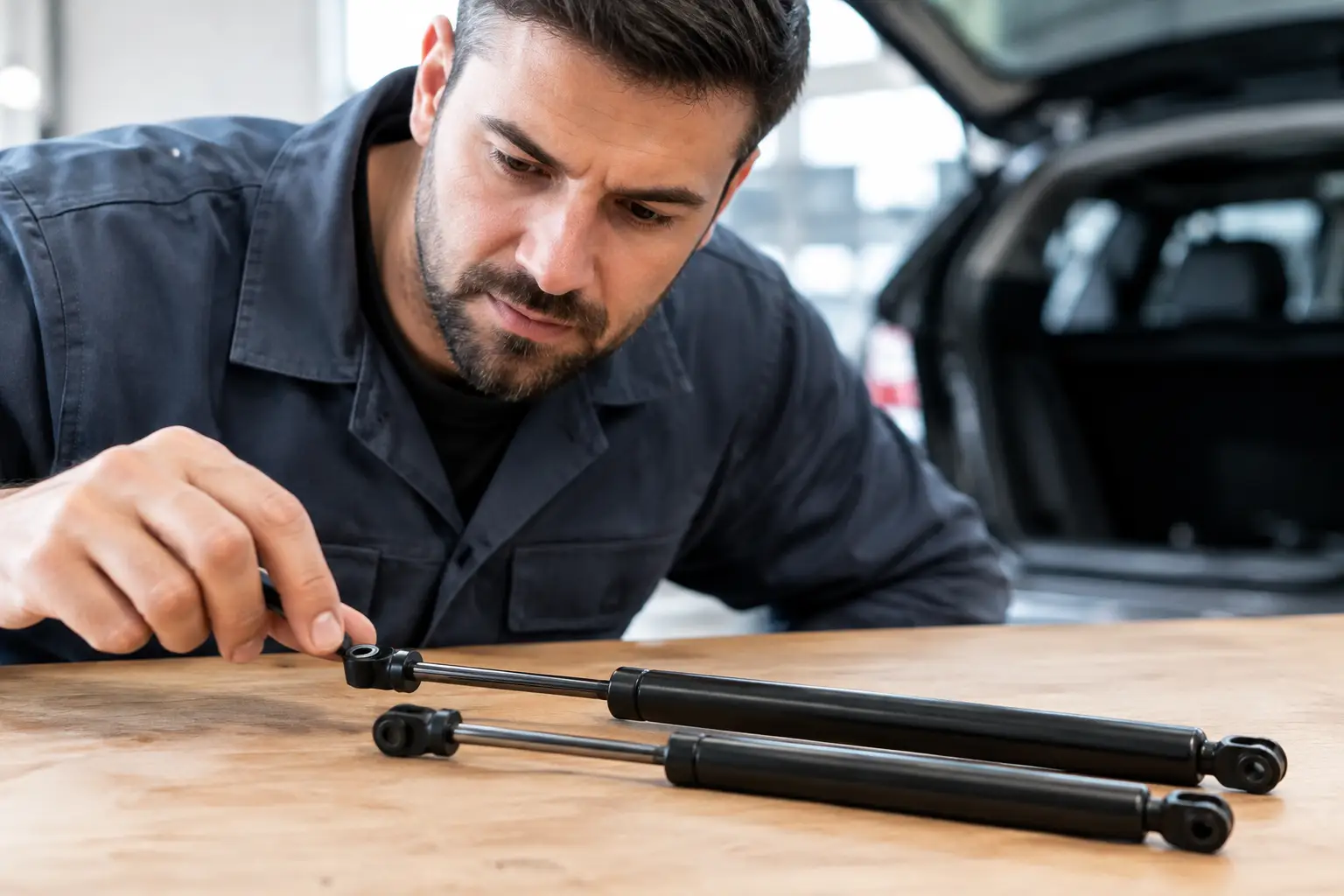
The key dimensions are usually extended length, compressed length and stroke. Extended length is measured centre-to-centre between the mounting points when the strut is fully open. Compressed length is measured the same way when closed. Stroke is the difference between the two.

That sounds simple, but measuring the body of the strut instead of the full centre-to-centre mounting length is a common mistake. Another is measuring the strut while it is still installed under load and not fully opened or closed. For a proper custom order, you want the real geometry of the application, not an estimate.

You also need to identify the end fittings. Ball sockets, eyelets, forks and clevis ends are not interchangeable unless the mounts are changed as well. Thread size matters too. A strut with the correct force and length can still be unusable if the fittings do not suit the brackets.

Photos help here, especially if they show both mounting ends, the full open position and the full closed position. For trade and industrial buyers, a quick site photo often clears up more than a written description.

Measure from centre to centre

This is worth repeating because it causes a lot of ordering errors. On most petrol struts, the working length is taken from the centre of one mounting point to the centre of the other. Not body length. Not rod length. Not overall metal length without fittings.

If one fitting is changed, the effective length may change too. That is why the full fitting type should always be confirmed as part of the order.

Check closed clearance

A strut may fit perfectly when open and still bottom out when the panel closes. Closed clearance is especially important on low-profile lids, compact cabinets and machinery guards where space is limited. If the compressed length is too long, something has to give, and it is usually the mounting points or the panel itself.

Force rating is where many orders fail

The correct force is not just about how heavy the lid or panel is. It also depends on where the hinges sit, where the struts mount, how many struts are used, and the angle they work through.

This is why copying the weight of the panel into an enquiry is helpful but not enough on its own. A 20 kg lid mounted close to the hinge behaves differently from the same lid with the strut mounted further out. The opening angle changes the effective force requirement as well.

If you are replacing a strut and the old one worked properly before it wore out, the printed Newton rating is a good starting point. If the old strut never held correctly, forced the lid up too aggressively, or required too much effort to close, that rating may need to change.

For new applications, it is usually best to provide dimensions, mounting points and lid weight so the force can be specified properly. Guessing high is not safer. An overpowered strut can twist hinges, crack fibreglass, distort aluminium lids or make closing unsafe. Too little force is obviously a problem too, especially on heavy hatches and access covers.

Tell the supplier how the strut will be used

A petrol strut for a weekend camper trailer and one for a mining or marine application may look similar, but service conditions can be very different. Heat, dust, salt exposure, washdown requirements and cycle frequency all matter.

If the strut is fitted near the coast, on a boat, or in a corrosive environment, materials and finish should be considered early. If it is on plant or industrial equipment that opens and closes constantly, duty cycle matters. If it supports a safety-critical access panel, controlled movement and reliable holding force matter more than simply matching dimensions.

This is where a proper custom enquiry saves time. You are not just ordering a size. You are specifying how the part needs to perform in service.

What to include in a custom strut enquiry

If you want a quote turned around quickly, provide the basic technical details up front. The best enquiries usually include the application, whether it is a replacement or a new setup, the extended and compressed lengths, the end fitting types, the force if known, and clear photos.

It also helps to note whether you need one strut or a pair, whether left and right units differ, and whether brackets are required. On vehicle, caravan and toolbox jobs, mention if the mounting points are original or modified. On industrial jobs, note the panel weight, opening angle and any site constraints.

If you do not know the exact force, say so. That is better than entering a guessed number that sends the quote down the wrong path.

Replacement job or new design – the process differs

When ordering a replacement, the goal is usually to match an existing working specification or improve on one that failed prematurely. In that case, the old strut gives you a reference point, but the application should still be checked. If brackets have shifted, hinges have worn, or a lid has been modified, a straight copy may not be right.

For a new design, there is more calculation involved. The supplier may need mounting geometry, panel dimensions and weight distribution to recommend the correct force and placement. This is common on custom canopies, plant guards, cabinets, access doors and marine compartments.

Neither approach is better. They just require different information.

Common mistakes when ordering custom struts

Most problems are avoidable. People often measure the wrong points, assume the force from a similar-looking strut, or forget to mention that the application uses two struts sharing the load. Another common issue is not accounting for the rod orientation or the actual opening angle needed.

There is also the temptation to over-spec the force because the old struts feel weak. Worn struts do lose pressure over time, but that does not mean the original force was wrong. It may simply mean they have reached the end of service life.

On custom lids and hatches, bracket position is another variable. Moving a mount by even a small amount can change how the strut behaves through the arc. If the order is based on planned mount locations rather than installed ones, make that clear.

Getting the best result the first time

If you want to know how to order custom struts efficiently, the short answer is this: give exact measurements, avoid guessing the force, and describe the job clearly. A specialist supplier can usually work through the rest much faster when the enquiry includes the real application details.

That matters when equipment is down, a vehicle hatch is unsafe, or a production job is waiting on the right hardware. For Australian buyers, fast turnaround is useful, but accuracy matters more because the wrong strut still costs time.

Petrol Struts supports both straightforward replacements and custom applications across vehicles, machinery, marine, agricultural and industrial use. Whether you are ordering one pair for a toolbox or specifying multiple units for equipment fitout, the best starting point is the same – clear dimensions, clear photos and a clear description of what the strut needs to do.

If you are unsure about one part of the spec, do not fill the gap with a guess. Send what you can measure properly, explain how the panel operates, and let the fitment be worked out from there.

How to Replace Hatch Struts Properly

How to Replace Hatch Struts Properly

A hatch that drops without warning is more than annoying. On a vehicle, canopy, toolbox or cabinet, failed struts turn a simple lift-up panel into a safety issue. If you need to know how to replace hatch struts, the job is usually straightforward, but only if you match the right strut and fit it the right way.

The mistake most people make is treating all petrol struts as interchangeable. They are not. Two struts can look almost identical and still differ in force, extended length, compressed length, end fittings or mounting geometry. Get one of those wrong and the hatch may not open fully, may be hard to close, or may overload the mounts and fail early.

How to Replace Hatch Struts Without Guesswork

Start by checking whether the existing struts are actually the problem. If the hatch slowly sags, will not stay open, or needs extra effort to lift, the struts are likely worn out. If the hatch is twisted, binds on one side, or the brackets are bent, replacing the struts alone may not fix it. A new strut cannot compensate for poor alignment or damaged hardware.

Before removal, support the hatch securely. Use a prop, have a second person hold it, or secure it with suitable bracing. Never rely on one weak strut while removing the other. On larger hatches, lids and access doors, the load can shift quickly once one side is disconnected.

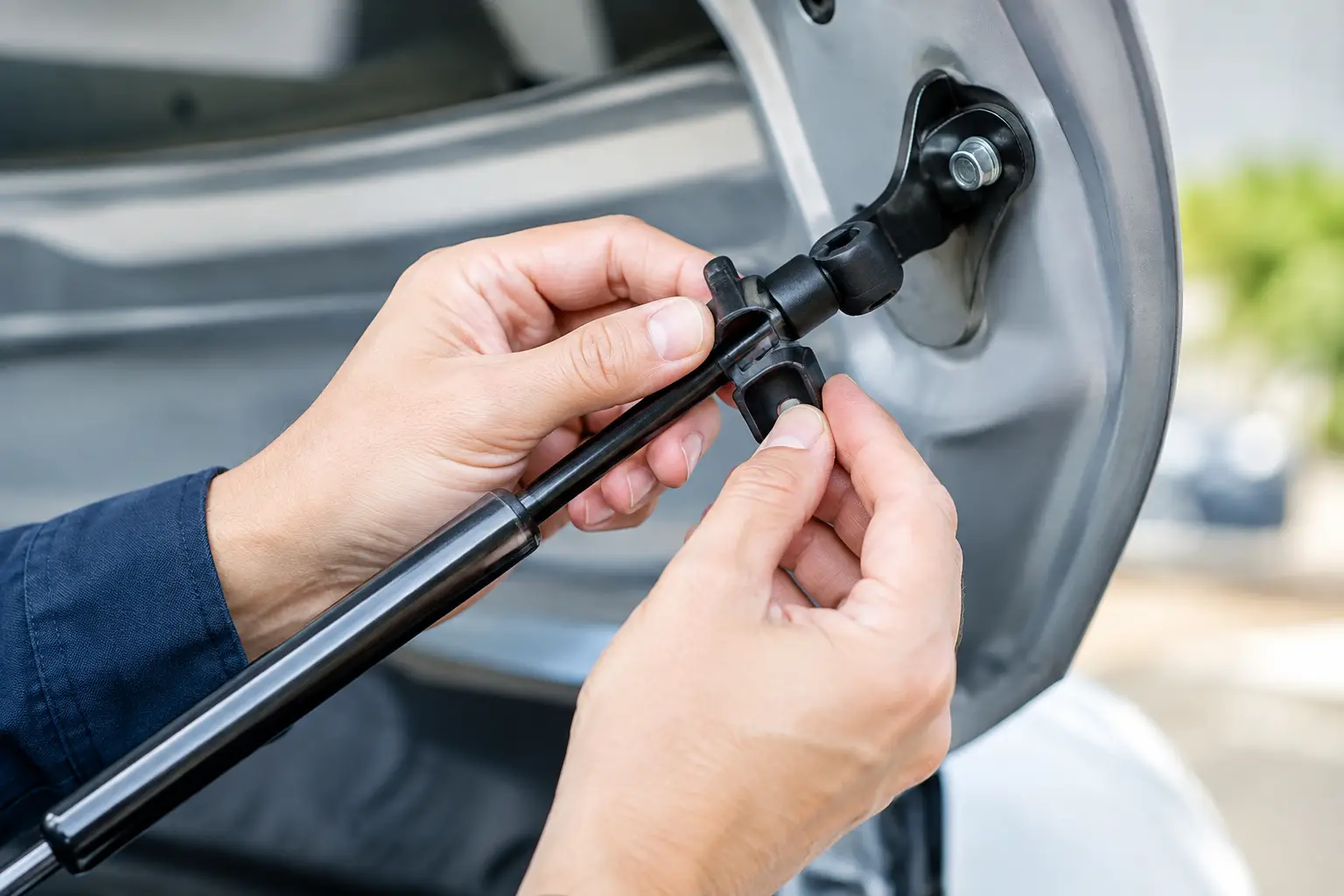
Most hatch struts are fitted with either ball socket ends, eyelets or specialised brackets. In many automotive and light industrial applications, ball sockets are retained by a small metal clip. You do not usually need to remove the clip completely. A small flat screwdriver can be used to lift it slightly, just enough to release the socket from the ball stud. Once the clip is eased back, pull the strut off the fitting.

Remove one strut at a time if possible. That helps keep the hatch aligned and reduces the chance of mixing up orientation or hardware. If both struts need to come off together, take a few photos first and note which end faces up and which fitting goes where.

Measure Before You Order

If there is a part number on the old strut, that is the best place to start. It can speed up identification and may confirm force rating and dimensions. If the label is missing or unreadable, measure the strut manually.

The key measurements are extended length, compressed length and stroke. Extended length is measured centre-to-centre between the mounting points when the strut is fully open. Compressed length is the same measurement when fully closed. Stroke is the difference between those two figures. You also need to identify the end fittings and bracket types.

Force matters just as much as size. Petrol strut force is usually marked in Newtons, often shown as N on the body. If the old strut says 250N, 400N or 800N, that number is critical. Fitting a stronger strut is not automatically better. Too much force can make the hatch difficult to shut, place stress on hinges and brackets, or cause the panel to spring open too aggressively. Too little force and it simply will not hold safely.

There are cases where matching the old force exactly is not ideal. If the hatch has been modified with added weight, such as internal lining, racks or accessories, the original rating may no longer be correct. Likewise, if a canopy door or toolbox lid has always felt marginal, it may need a revised specification rather than a like-for-like swap. That is where application details matter.

Choosing the Correct Replacement Strut

When working out how to replace hatch struts properly, the replacement process starts well before installation. You need the right combination of dimensions, force and end fittings for the application.

For a rear hatch on a wagon or SUV, the safest option is usually a direct replacement based on original specification. Vehicle hatches are designed around a set opening angle, hinge position and closing effort. Changing those values too far can affect operation.

For canopies, camper trailers, toolboxes, cabinets and industrial access panels, there is often more variation. In these applications, the strut may have been selected by size and force rather than a vehicle-specific part number. If that is the case, details such as lid weight, hinge location, opening angle and mounting point position become important. A strut specialist can use those details to confirm whether you need a stocked replacement or a custom setup.

Material and finish also matter in harsh conditions. Marine use, washdown environments and exposed outdoor applications may require corrosion-resistant components rather than a basic painted steel unit. In trade and industrial settings, durability is not just about the tube and rod. End fittings, brackets and seal quality all affect service life.

Fitting the New Struts

Once you have the correct replacement, compare it side by side with the old unit before fitting. Check the length, fitting style and orientation. In most cases, the rod should be mounted facing down when the hatch is closed. That helps keep the internal seal lubricated and can extend service life. There are exceptions depending on the application, but rod-down is a common rule for standard fitments.

Snap or press the new strut onto the ball studs or attach it to the existing hardware as required. If the socket feels too tight, check the retaining clip position rather than forcing it. If the replacement is slightly too long or too short to fit easily, stop there. Do not lever the hatch into place or force the strut onto misaligned mounts. That usually means the dimensions or fittings are wrong.

After fitting one side, move to the other. Once both struts are installed, cycle the hatch carefully through its full range. It should open smoothly, hold reliably, and close without excessive resistance. Watch for twisting, uneven travel or contact with surrounding panels.

If the hatch now opens too quickly or feels difficult to pull down, the struts may be overpowered. If it still drops or struggles near full extension, they may be underpowered or incorrectly positioned. In either case, the issue is usually specification, not installation technique.

Common Problems After Replacement

A hatch that still does not work properly after new struts are fitted usually points to one of a few common issues. The wrong Newton rating is one. Incorrect length is another. Worn hinges, loose brackets and cracked mounting points are also common, especially on older vehicles, canopies and heavily used equipment.

Temperature can affect performance as well. Petrol struts generally feel firmer in warmer conditions and softer in colder weather. A small change is normal. A major change usually means the strut was already marginal for the application.

Another issue is replacing only one strut when the hatch uses a pair. That can leave uneven force across the panel and create twisting loads. In most cases, paired struts should be replaced together, especially when one has already failed.

When DIY Is Fine and When to Ask for Help

For a standard rear hatch, toolbox lid or access panel with clearly matched replacement struts, DIY replacement is usually well within reach. Basic hand tools, careful measurement and safe support of the hatch are often all that is needed.

Where it gets more technical is on custom applications. If the hatch is oversized, unusually heavy, fitted with non-standard brackets, or part of machinery or industrial equipment, correct strut selection becomes more than a simple parts swap. The mounting geometry determines how the strut behaves through the full opening arc. A strut that looks right on paper can still perform poorly if the mounting points are wrong.

That is also why measurements alone do not always tell the full story. If you are replacing struts on a caravan bed, plant enclosure, marine hatch or fabricated toolbox, it helps to provide photos, dimensions, fitting type and any markings from the old strut. The more complete the information, the better the chance of getting a replacement that works first time.

A specialist supplier such as Petrol Struts can usually help identify whether you need a direct replacement, different end fittings, or a custom-rated option for the way the hatch is actually used.

Replacing hatch struts is not a complicated job, but it is a precise one. Support the hatch properly, match the dimensions and force accurately, and do not ignore worn brackets or alignment issues. Get those basics right and the result is simple – a hatch that lifts smoothly, stays where it should, and gets back to doing its job safely.

Gas Struts vs Spring Hinges: Which Fits?

Gas Struts vs Spring Hinges: Which Fits?

A toolbox lid that slams shut or a hatch that will not stay open is not just annoying – it is a safety and usability problem. When people compare petrol struts vs spring hinges, they are usually trying to solve one of two issues: they either need controlled lift and hold-open support, or they need a simple hinge mechanism that helps a panel return to position. The right choice depends less on price alone and more on load, movement, access, and how the part will be used in the real world.

Petrol struts vs spring hinges: the basic difference

Petrol struts are motion-control components. They use compressed petrol to assist lifting, slow movement, and hold a lid, hatch or panel in an open position. In practical terms, they do more than connect two surfaces – they help manage weight and movement.

Spring hinges are different. They are still hinges first, with a spring built in to provide return force or resistance through the arc of movement. They are commonly used where a door, flap or panel needs to self-close or maintain tension, but they do not usually provide the same controlled lift support or open-position holding that a petrol strut does.

That distinction matters. If the application involves a heavy canopy window, caravan bed base, machinery cover or marine hatch, a spring hinge on its own is often not enough. If the application is a lighter door or access flap that simply needs closing tension, a petrol strut may be unnecessary.

Where petrol struts make more sense

Petrol struts are generally the better option when the panel has noticeable weight, the opening arc needs control, or the user needs both hands free once the panel is open. That is why they are widely used on ute canopies, trailers, engine covers, storage compartments, seating bases and industrial enclosures.

The main advantage is controlled motion. A properly specified petrol strut helps lift the load, resists sudden dropping and supports the panel at the top of travel. That improves safety, especially on heavier lids or in commercial settings where the same compartment is opened repeatedly throughout the day.

They also allow more precise tuning. Force rating, extended length, compressed length, stroke, end fittings and mounting position all affect how the panel behaves. This is useful when the load is awkward, the opening angle is limited, or the available mounting space is tight.

In harsh environments, that control becomes even more valuable. On work vehicles, agricultural equipment, marine fit-outs and mining applications, vibration and frequent use can expose the limits of basic hinge hardware fairly quickly.

Where spring hinges are the better fit

Spring hinges suit simpler jobs. If you need a panel or door to return toward closed without relying on manual effort every time, they can be an effective and compact solution. They are often used on lighter cabinetry, small access doors, gates, and utility compartments where a closing action matters more than assisted opening.

They also have fewer variables than petrol struts. In the right application, that can mean easier selection and less concern about force matching. You are not trying to calculate lift assistance against panel weight in the same way.

That said, simplicity can be a limitation. A spring hinge does not usually slow a heavy lid through its travel, and it will not hold a hatch open the way a petrol strut can. If the goal is safe access to a storage area, service bay or overhead opening, spring tension alone may leave the user still supporting the load by hand.

Load, control and safety

This is where the petrol struts vs spring hinges comparison becomes practical rather than theoretical. Think about what happens during opening and closing, not just at rest.

A spring hinge applies tension through rotation, but it does not necessarily counterbalance a heavy panel well across the full range of motion. Depending on geometry, the force may feel different at different points of travel, and on heavier lids it can still allow quick or uneven closing.

A petrol strut, when correctly sized and mounted, is designed to work with that geometry. It can provide a more useful force curve through the lift cycle and reduce the effort needed to open the panel. More importantly, it can stop the panel from dropping sharply.

For workshops, service vehicles and industrial equipment, that safety factor should not be treated as an extra. If a lid opens above head height or covers tools, batteries, pumps or service points, controlled support is usually the safer option.

Installation and space considerations

Spring hinges can be attractive because they are compact and mechanically straightforward. If the panel already needs a hinge and there is limited room for extra hardware, they may fit the layout more easily.

Petrol struts need space to operate. You have to account for extended length, compressed length, stroke and bracket positions. Mounting geometry is critical. A strut with the right force but the wrong mounting points can perform poorly, over-centre, or fail to hold the load open at the required angle.

This is one reason strut selection should be based on measurements, not guesswork. Panel weight, hinge position, centre of gravity, required opening angle and available fixing points all matter. On custom builds and replacements where the original part is missing, technical advice saves time and avoids ordering a unit that is close, but not correct.

Maintenance, durability and replacement cycles

Neither option is immune to wear. Spring hinges can lose tension over time, especially in high-cycle or corrosive environments. Hinges also carry rotational load directly, so if alignment shifts or mounting points wear, performance drops.

Petrol struts are wear items too. Seals age, pressure declines and lift assistance reduces over time. The difference is that failure is often easier to identify in use. If a hatch no longer stays up or the opening effort has clearly increased, the strut is usually the part to replace.

For demanding applications, build quality matters. Cheap hardware may fit initially but perform poorly under repeated use, vibration, dust or moisture. In trade and fleet settings, downtime and call-backs cost more than the part itself, so it makes sense to choose components built for regular service rather than occasional domestic use.

Cost: cheaper upfront is not always cheaper overall

Spring hinges are often less expensive to buy, and for light-duty jobs that may be the correct decision. If the panel is small, the movement is simple and open-position support is not required, there is no point overcomplicating the setup.

But on heavier lids, replacing proper lift support with a cheaper hinge solution can create other costs. You may end up with difficult access, user fatigue, damaged lids, bent mounting points or avoidable safety risks. In some cases, people fit stronger spring hinges to compensate, only to find the panel still behaves poorly because the mechanism is not designed for controlled support.

A petrol strut system usually costs more than a basic hinge, but it can deliver better function, safer operation and less stress on the rest of the assembly. That is particularly relevant for commercial vehicles, caravans, trailers and industrial equipment where the hardware gets used often and failure is more than a minor inconvenience.

How to choose between petrol struts and spring hinges

Start with the application, not the part name. Ask what the panel needs to do. If it must lift smoothly, stay open reliably and close under control, petrol struts are generally the right direction. If it simply needs a return action on a lighter door or flap, spring hinges may be enough.

Then look at the load and layout. Heavy horizontal lids, overhead hatches and access covers usually benefit from petrol struts. Light vertical doors and simple closures often suit spring hinges better. There are also jobs where both are used together – a hinge for pivot and a strut for assistance and hold-open control.

Finally, think about who is using it and how often. A once-a-month cabinet access panel has different demands from a toolbox on a service ute or a machinery cover opened several times a shift. Frequency of use, environment and risk level should influence the choice.

If you are replacing an existing part, match the original function before you match the hardware style. If the old setup used petrol struts, there was usually a reason. If you are designing from scratch, accurate measurements and application details will point you to the safer and more reliable option.

Good hardware should make the job easier, not create a workaround. When the panel is heavy, awkward or used every day, getting the support system right pays off every time it opens.

How to Fit Toolbox Struts Properly

How to Fit Toolbox Struts Properly

A toolbox lid that drops without warning is more than annoying – it is a hand injury waiting to happen. If you are working out how to fit toolbox struts, the job is not just about bolting on a pair of petrol struts and hoping for the best. Fitment, force, mounting position and lid weight all have to work together, otherwise the lid can bind, sit too high, refuse to stay shut or fly open too hard.

For ute toolboxes, trailer boxes, canopy compartments and workshop storage, the right strut setup makes access safer and faster. The wrong setup usually shows up straight away. You will feel it in the first few opens and closes.

What toolbox struts actually do

Toolbox struts support the lid through its opening arc and control how the weight behaves as it lifts and closes. A correctly fitted petrol strut reduces the effort needed to open the lid, helps hold it open at the right angle and limits sudden drop on the way down.

That sounds simple, but every toolbox is a bit different. A checker plate lid with no lining behaves differently from a heavy steel lid with seals, internal trays or added racks. Hinge position matters too. Even two boxes of similar size can need different strut lengths and force ratings.

Before you fit toolbox struts, check these basics

The first step in how to fit toolbox struts properly is confirming whether you are replacing an existing pair or setting up a new installation.

If you are replacing old struts, inspect the current setup before removing anything. Measure the extended length from centre to centre of the mounting points, check the end fitting style and note how the body and rod are oriented. If the old setup worked well, matching those dimensions will usually keep the geometry correct. If the old struts failed because the lid was too heavy or the opening angle was poor, it is worth reassessing the force and bracket positions rather than copying a bad setup.

For a fresh fit-out, you need four practical details: lid weight, lid dimensions, hinge position and the opening angle you want. These figures determine strut force and where the brackets should sit on the lid and the box body.

Measuring up for the correct strut

Good measurements save time. Poor measurements usually lead to lids that do not open fully or put too much load into the hinges.

Start by measuring the lid itself. Record the width, depth and approximate weight. If you cannot weigh the lid directly, estimate it as accurately as possible based on material and construction. A lightweight aluminium lid is one thing. A reinforced steel lid with carpet lining and hardware is another.

Next, measure from the hinge line to the point where you expect the strut to attach on the lid. Then measure the available space inside the toolbox when the lid is closed. This matters because the compressed strut must fit without bottoming out or fouling on internal trays, seals or stored gear.

You also need the open position. Most toolbox lids work well somewhere around 80 to 100 degrees, but there is no universal number. A shallower opening may suit a low-clearance installation under a canopy. A wider opening can make sense on a deep toolbox where access is the priority.

How to fit toolbox struts in the right position

Bracket location is what makes or breaks the job. The strut needs enough leverage to help lift the lid, but not so much that it overpowers the closing action.

In most toolbox applications, one bracket mounts to the fixed box body and the other to the underside of the lid. When closed, the strut should sit in a controlled, slightly compressed position. When open, it should be close to full extension without hitting its hard limit.

As a general rule, the body of the strut is usually mounted at the upper end and the rod at the lower end when the lid is closed. That orientation helps keep the internal seal lubricated and can improve service life. There are exceptions depending on space and bracket arrangement, but if you reverse the unit without a good reason, do not expect the best long-term result.

The mounting points must also allow the strut to move through the full arc without twisting. If the brackets are misaligned, the ball joints or eyelets can bind and wear prematurely. That side load is one of the more common causes of early failure.

Choosing the correct force

This is where many toolbox installs go wrong. People often assume stronger is better. It is not.

If the struts are overpowered, the lid may spring open aggressively, sit proud when shut or place unnecessary stress on the hinge and mounting points. If they are underpowered, the lid will still feel heavy and may not stay open safely. On a worksite or around a trailer, that is not a small issue.

Force is measured in Newtons. The right rating depends on lid weight, lid size, hinge geometry and where the strut brackets are mounted. Two 250N struts do not automatically suit every mid-sized toolbox. In some cases one strut is enough. In others, a pair is the only stable option, especially on wider lids where you want even support across the span.

If the box is used constantly, it is worth allowing for real-world use rather than just theoretical weight. Dust seals, added accessories and heavy daily cycles all affect how the lid behaves over time.

Fitting the struts step by step

Once you have the correct struts and brackets, support the lid securely before starting. Do not rely on one old strut, a loose prop or your shoulder while trying to line up fittings.

Fit the brackets first. Make sure the mounting surface is solid enough for the load. Thin sheet can need reinforcement, especially on larger lids. Fasteners should suit the material and application. Rivets may be fine in some lighter setups, but bolts with washers or backing plates are often the better option where repeated load is involved.

With the lid in the closed or near-closed position, clip or fasten the strut onto the brackets. Do not force it into place at an angle. If the strut is too short or too long to line up cleanly, stop and recheck the geometry. Forcing it will only mask a fitment issue.

Open the lid slowly and watch the strut travel. It should move freely through the arc, with no contact against toolbox walls, seals, drawer systems or stored equipment. Then close it again and confirm the lid seats properly without needing excessive pressure.

If you are fitting a pair, install both sides symmetrically. Uneven bracket placement can rack the lid, create hinge stress and make the opening feel rough.

Common fitment problems and what causes them

A lid that will not stay shut usually points to too much force, poor bracket position or a strut that is too long in the closed position. A lid that opens only part way can mean the extended length is too short or the lid-side bracket is mounted too close to the hinge.

If the lid feels heavy at the start of the lift but easier near the top, the geometry may be giving you poor initial leverage. Moving the mounting point can change that. If the lid twists during opening, one side may be mounted out of line or the lid itself may need two struts instead of one.

Noise, binding or jerky movement usually means misalignment, worn brackets or interference somewhere in the opening path. Petrol struts should operate smoothly. If they do not, something is off in the setup.

Replacement jobs versus new installations

Replacement is normally simpler if the original system was correct. Match the extended length, compressed length, end fittings and force rating as closely as possible. Check bracket wear while you are there. There is no point fitting new struts onto loose or cracked mounts.

New installations take more planning because there is no proven geometry to copy. This is where technical advice matters. A toolbox with unusual dimensions, a thick lid or limited internal clearance may need a custom approach rather than an off-the-shelf guess.

That is especially true for tradespeople who rely on the box every day. A cheap mismatch can cost more in downtime and frustration than getting the correct strut from the start.

When to ask for help

If you know the lid weight, dimensions, hinge type and the opening angle you want, a strut specialist can usually narrow the options quickly. If you do not know the weight, photos and measurements of the toolbox and current bracket positions can still help.

For unusual setups, including side-opening boxes, oversized lids or custom canopies, it is often better to get fitment guidance before drilling anything. Suppliers such as Petrol Struts deal with these applications every day, and that can save a lot of trial and error.

A toolbox lid should open cleanly, stay where it is meant to stay and close without a fight. If it does not, the answer is usually not a stronger strut – it is a better fit.

Choosing Gas Struts for Ute Canopies

Choosing Gas Struts for Ute Canopies

A canopy door that drops without warning is more than an annoyance. On a work ute, it slows access, risks damage to tools and can turn a simple grab-and-go job into a safety issue. That is why choosing the right petrol struts for ute canopies matters – not just for lift assistance, but for reliable daily use in dust, heat, corrugations and constant opening cycles.

Not all canopy struts fail for the same reason, and not all replacements should match what came off the vehicle without question. In plenty of cases, the original strut was under-specced, the canopy weight changed after fit-out, or the mounting geometry was never quite right. If you want the lid or side door to open cleanly, stay up properly and close without a fight, the details matter.

What petrol struts do on a ute canopy

Petrol struts support the weight of a canopy door, hatch or window through its opening and closing movement. They reduce the effort needed to lift the panel, control the motion and hold it in the open position. On side-opening doors and rear hatches, they also help prevent sudden drop-off once the panel passes its balance point.

On a ute canopy, the working environment is usually harder than on a passenger vehicle. There is vibration, dust ingress, weather exposure and frequent loading around the mounting area. Add ladder racks, roof loads, shelving or internal fit-outs, and the way a door opens can change significantly. That is why canopy applications often need closer attention to strut force, stroke and end fittings than people expect.

How to choose petrol struts for ute canopies

The first thing to check is whether you are replacing like-for-like or correcting a problem. If the existing struts worked well for years and the only issue is loss of pressure, matching the original specifications is often the right move. But if the canopy door never stayed up in wind, needed two hands to close, or twisted under load, copying the old strut may just repeat the same fault.

Start with the key measurements. Extended length is the distance from centre of one mounting point to the centre of the other when the strut is fully open. Compressed length is the same measurement when closed. Stroke is the difference between those two. These figures affect both opening angle and whether the strut will fit without bottoming out or overextending.

Force is the next major factor, usually measured in Newtons. Too little force and the canopy door will sag, especially when loaded with central locking hardware, internal trim or a heavier glass panel. Too much force and the door may spring open too aggressively, place unnecessary load on hinges, or become difficult to shut. On dual-strut canopy doors, the total support comes from both struts together, so each unit must be selected with the pair in mind.

Mounting position also changes performance. A strut fitted a few millimetres differently can alter leverage enough to affect opening effort and holding force. That is one reason a strut with the same length and force as another application is not always a true match.

Common signs your canopy struts are wrong or worn

When petrol struts are at the end of service life, the symptoms are usually obvious. The hatch drops in cool weather, the side door no longer reaches full height, or the panel slowly creeps down while you are working out of the canopy. Oil mist around the rod seal, visible corrosion, bent rods and damaged end fittings are all signs replacement is overdue.

There are also signs the strut specification is wrong rather than simply worn out. If a new set makes the panel hard to latch, pushes the door out of alignment, or opens with excessive force, the Newton rating or geometry is likely off. The same applies when one side carries more load than the other and the door twists during movement.

In trade and fleet use, these issues are not minor. Repeated shock loading can damage brackets, crack fibreglass mounting areas and shorten hinge life. Replacing failed struts without checking the surrounding hardware can leave the same problem waiting to happen again.

Measuring petrol struts for ute canopies properly

If there is a part number on the old strut, that is the easiest starting point. Even then, it is worth confirming the measurements and end fittings before ordering. Labels fade, previous replacements may have been incorrect, and some imported canopies use non-standard fittings.

Measure the strut centre-to-centre in both open and closed positions if possible. Check the diameter of the rod and tube, note the style of end fitting, and look at how the brackets are mounted. Ball sockets, eyelets, forks and angled ends are not interchangeable in every setup. You should also check whether the strut is fitted rod-down in the closed position, which is generally preferred for seal lubrication and service life.

If the old strut is missing or the canopy has been modified, the best approach is to measure the door size, estimate or weigh the panel, and record the bracket positions. Photos of the open and closed arrangement help identify geometry issues quickly. For custom applications, that information makes the difference between a close guess and a strut that actually works.

Standard replacement or custom struts?

A standard replacement suits many ute canopies, especially where the canopy brand and door layout are common and unchanged. If the original setup was sound, a quality direct replacement is usually the fastest fix. This is often the case for rear lift-up glass, side access doors and service body compartments.

Custom struts are the better option when the canopy has been altered, the door material is heavier than standard, or the application has a known weakness. Aluminium canopies with added racks, toolboards or dual-skin doors can end up outside the range of an off-the-shelf match. The same goes for older canopies where brackets have shifted or replacement hardware is no longer available.

This is where specialist support matters. A supplier that deals with automotive and industrial applications every day can assess whether you need a simple replacement, a revised force rating or a full custom setup. That saves time, avoids trial-and-error ordering and reduces the risk of damaging the canopy through poor fitment.

Why quality matters on working vehicles

Ute canopies live a harder life than many strut applications. Heat cycling, coastal air, red dust, washdowns and rough roads all work against seals and moving parts. Cheap struts can look the same on the shelf, but poor seal quality, inconsistent force and weaker finish tend to show up quickly in service.

For workshop operators, tradies and fleet managers, the cost of a failed canopy strut is rarely just the part itself. It is downtime, call-backs, damaged hinges, interrupted jobs and avoidable safety risk. Better struts last longer, operate more consistently and are less likely to lose pressure early.

It is also worth checking the broader quality picture – manufacturing standards, warranty backing and whether the supplier can support both standard and custom requirements. A dependable supplier should be able to help with technical selection, not just dispatch a box.

When installation details make the difference

Even the correct strut can perform badly if installed poorly. Worn ball studs, loose brackets and misaligned mounts can create side load on the rod, which shortens seal life. Over-tightened hardware or a bracket mounted on thin unsupported panel material can also lead to failure under repeated use.

If you are replacing both struts on a canopy door, replace them as a pair. Mixing an old weak unit with a new one often causes uneven lift and panel twist. Check hinge condition while you are there, because a stiff or sagging hinge changes the load on the strut and can make a good part look faulty.

Where fitment is uncertain, getting advice before ordering is the better move. Petrol Struts supports both replacement and custom enquiries, which is useful when the canopy setup is non-standard or the original markings are gone.

What to have ready before you order

The fastest way to get the right result is to supply clear details from the start. A part number is ideal, but measurements, photos, end fitting type and canopy make are often enough to identify a match. If the door has been modified, mention any added weight such as internal lining, shelving, glass, central locking or external racks.

If you are dealing with a fleet or multiple canopies, it helps to confirm whether all vehicles use the same strut and bracket arrangement. Small production changes between model years can matter. Taking the time to verify one unit properly usually saves rework across the rest.

A good canopy strut should do its job quietly and consistently. You should not have to prop the door with your shoulder, wrestle it shut, or wonder whether it will stay up over your head. Get the measurements right, be honest about the load, and choose quality over guesswork. That is usually the difference between another short-term fix and a canopy that works properly every day.

Gas Strut Buying Guide for the Right Fit

Gas Strut Buying Guide for the Right Fit

A gas strut that is 10 mm out in length or 50 N off in force can turn a simple replacement into a lid that will not stay open, a canopy that slams shut, or a hatch that is unsafe to use. This gas strut buying guide is built for people who need the right part the first time, whether that is for a ute canopy, toolbox, caravan bed, machinery guard or marine hatch.

What this gas strut buying guide should help you avoid

Most buying mistakes come down to one of three issues: the wrong dimensions, the wrong force, or the wrong end fittings. Sometimes the old strut has no readable part number, and sometimes the strut that was originally fitted was never right for the job in the first place. Either way, matching by appearance alone is risky.

A proper replacement starts with the application details and the strut specifications working together. If one of those is missing, you can often still identify the correct strut, but you need accurate measurements and a clear picture of how the strut is mounted and used.

Start with the application, not just the old part

If you are replacing a failed strut, the old unit is useful, but it should not be your only reference. Equipment changes over time. Hinges wear. Added accessories increase weight. A canopy door with new shelving or a toolbox lid with extra lining may need a different force from the original fitment.

That is why the first question is simple: what is the strut doing? Holding open a bonnet is different from controlling a heavy horizontal lid. A seat base, access hatch, cabinet flap and engine cover all move differently and load the strut in different ways. Mounting angles, travel, and weight distribution all affect what will work.

For trade and industrial buyers, this matters even more. A strut on a machine guard or service panel is part of safe operation, not just convenience. If the panel lifts too fast, does not open fully, or drops unexpectedly, it becomes a maintenance issue very quickly.

The key measurements that matter

When ordering a gas strut, there are a few measurements that carry most of the weight.

Extended length

This is the centre-to-centre measurement when the strut is fully open, taken from the middle of one end fitting to the middle of the other. It determines how far the lid, hatch or panel can open. If the replacement is too long, it may overextend the mounting points or stop the panel from closing properly. If it is too short, you may lose opening angle.

Compressed length

This is the centre-to-centre measurement when the strut is fully closed. It matters because the strut must fit into the available space without bottoming out before the panel shuts. A compressed length mismatch is one of the most common causes of poor fitment.

Stroke

Stroke is the difference between compressed and extended length. It tells you how far the rod travels. In most cases, if your compressed and extended lengths are correct, the stroke will also be correct, but it is still worth checking.

Shaft and tube diameter

These dimensions help identify the strut series and load range. They are not usually the first measurements a buyer looks at, but they are useful when matching a replacement or confirming compatibility with brackets and fittings.

End fittings

Ball sockets, eyelets, forks and clevis fittings are common, but sizes vary. Even if the strut body dimensions are correct, the wrong fitting can make installation impossible or create misalignment under load.

Understanding force in a gas strut buying guide

Force is usually measured in Newtons, shown as N on the strut body. This number tells you how strongly the strut pushes out. If the old strut still has a printed force rating, that is a good starting point. If it does not, or if the previous setup was not performing well, you need to work from the application.

Too little force and the panel will feel heavy, may not stay open, or may need manual lifting the whole way. Too much force and it can be difficult to close, place stress on hinges and mounts, or kick open too aggressively.

There is no single force that suits a given lid size because the result depends on weight, hinge position, mounting geometry and how many struts are being used. A long lightweight hatch can need less force than a shorter but heavily built lid. Two struts also do not always mean simply splitting the load in half without checking the mounting positions.

This is where buyers often benefit from specialist advice. If you can supply lid weight, overall dimensions, hinge location, and bracket positions, a supplier can usually narrow the correct force much more accurately than guessing from the old strut alone.

Matching by part number versus matching by specification

If the original part number is legible and the application is unchanged, matching by part number is often the fastest path. It reduces guesswork and is ideal for vehicle and machinery replacements where the original fitment is known.

But many struts arrive with faded markings, aftermarket substitutions, or no useful identification at all. In those cases, matching by specification is more reliable. That means measuring the strut, identifying the end fittings, and confirming the force if possible.

For custom applications, there may be no part number to match at all. Caravan conversions, custom toolboxes, fabricated storage systems and industrial builds are specification jobs from the start.

New installation or replacement – the buying approach changes

A replacement job is mainly about identifying what was fitted and whether it performed correctly. A new installation is about design.

For new installs, think beyond the strut itself. You need to consider bracket placement, opening angle, lid weight, centre of gravity and whether the strut is meant to lift, support, dampen, or all three. A badly positioned bracket can make a correctly rated strut feel wrong. The strut may be technically strong enough, but mounted in a way that gives poor leverage.

This is common on canopies, cabinets and service boxes. People often focus on force rating first, when geometry is the bigger issue.

Material and environment matter more than many buyers expect

Not every gas strut is going into a clean, dry workshop environment. Marine applications, agricultural equipment, mining gear and exposed trailers deal with moisture, dust, vibration and corrosion. In those conditions, material quality and sealing matter.

If the strut is working near salt spray, washdown areas or corrosive environments, standard hardware may not last as well as a more suitable option. The same applies to frequent-cycle industrial use where durability is not just about holding force but about long-term consistency.

Quality standards and construction details are worth paying attention to here. Buyers comparing on price alone often end up replacing budget struts sooner, especially where loads are high or the environment is harsh.

Common applications and where buyers get caught out

Automotive buyers often assume bonnet and boot struts are straightforward, but model variations and aftermarket accessories can change what is needed. A canopy window with added racks or a rear hatch with modified hardware may need something different from standard.

In caravans and campers, bed lifts, storage lids and external doors often fail because the strut has been overworked or underspecified from the start. Toolboxes are similar. A steel lid with rubber lining and internal trays is heavier than it looks.

For industrial and machinery use, speed of replacement matters, but so does safety. If a guard or access panel is part of servicing procedures, you need a dependable match, not a close-enough option. The same goes for marine hatches and agricultural equipment where a failed strut quickly becomes a usability problem.

What details to have ready before you order

The fastest way to get the right recommendation is to have the practical details sorted before making an enquiry. That usually means the extended and compressed length, end fitting type, force rating if visible, and clear photos of the existing strut and mounts. For a new application, include lid or panel weight, dimensions, hinge position, and where you intend to mount the strut.

Good photos help more than many buyers realise. A side view of the installation, a close shot of each end fitting, and a readable image of any markings can save a lot of back-and-forth.

If the job is urgent, accuracy still matters. Quick supply only helps if the part you receive actually fits and performs properly.

When custom gas struts make more sense

Sometimes there is no off-the-shelf answer, and forcing a standard part into a non-standard application creates more trouble than it solves. Custom gas struts are often the better option for modified vehicles, specialised machinery, fabricated enclosures and applications with unusual opening geometry or force requirements.

The advantage is not just fit. It is having the strut built around the job instead of compromising on length, force or fittings. For buyers managing fleets, workshops or repeated equipment builds, that can also make future replacements much easier.

One of the strengths of a specialist supplier such as Gas Struts is being able to handle both standard replacements and custom specification work without treating them as separate worlds. That matters when the application is specific and downtime is expensive.

A good gas strut purchase is rarely about finding something that looks close. It is about getting the length, force, fittings and application details working together so the result is safe, reliable and built for real use. If you are unsure, measure carefully, take clear photos, and ask the question before you order. It is the simplest way to avoid fitting the same problem twice.

Heavy Duty Gas Strut Review: What Matters

Heavy Duty Gas Strut Review: What Matters

A failed strut usually gets attention when a canopy lid drops, a toolbox refuses to stay open, or a machine guard becomes a safety risk. That is where a proper heavy duty petrol strut review matters. For trade vehicles, industrial equipment, trailers, marine hatches and agricultural gear, the difference between a strut that merely fits and one that performs properly shows up fast in daily use.

This is not a product category where the cheapest option wins for long. Heavy duty petrol struts are load-bearing components, and once forces increase, small mistakes in sizing, end fittings, mounting geometry or seal quality become expensive. If you are replacing a failed strut or specifying one for a new build, the review criteria need to go beyond simple length and pressure.

Heavy duty petrol strut review – the real buying criteria

A good heavy duty petrol strut should do three things consistently. It should lift or support the load safely, operate smoothly through the full stroke, and maintain force over time in the environment it is actually used in. If one of those drops out, the strut is not doing the job, even if the catalogue dimensions look right.

Force rating is usually the first number buyers look at, but it should not be the only one. A strut with the wrong force can be just as problematic as a worn-out unit. Too little force and the hatch or lid falls away. Too much and the panel becomes difficult to close, hinges take extra stress, and mounting points can distort or fail.

Extended length, compressed length and stroke also matter, but they only tell part of the story. Mounting position changes leverage, and leverage changes effective force. That is why two struts with the same nominal force can behave very differently on different applications. A ute canopy side window, a caravan front boot, and a heavy machinery access panel all ask for different geometry.

Build quality is the next separator. On heavy-use applications, the rod finish, sealing system, cylinder strength and end fitting quality all affect service life. In cleaner, lower-cycle environments, lower-grade struts can sometimes hold up for a while. In mining, marine, agriculture or road-exposed vehicle use, they tend to show their limits quickly.

Where heavy duty struts perform well – and where they don’t

Heavy duty petrol struts are well suited to repetitive lifting tasks where controlled assistance is needed. They are commonly used on toolboxes, service bodies, trailers, canopies, machinery covers, marine lockers, cabinetry, seating assemblies and industrial access doors. In these cases, a correctly specified strut reduces strain on the user and supports safer opening and closing.

They are less forgiving when buyers treat them as universal parts. A strut chosen only by eye, or matched by approximate length without checking force and end fitting detail, often creates more problems than it solves. The panel may open too aggressively, stop short, twist during movement, or place uneven load on hinges. On heavier lids, this is not just inconvenient – it can become a maintenance and safety issue.

Temperature is another factor that gets missed. Petrol strut force varies with temperature, so a unit that behaves acceptably in a mild workshop may feel different on a hot day in the Pilbara or a cold early start in the southern states. For demanding applications, that variation should be considered before finalising force selection.

What separates a quality heavy duty strut from a cheap one

The biggest difference is usually not visible in a photo. It is in consistency. Better-quality struts deliver more reliable force, smoother operation and slower degradation over time. That matters when the application cycles frequently or carries real weight.

A quality strut will usually have better corrosion resistance, stronger end attachments and better sealing. That becomes especially important on marine gear, trailers, farm equipment and trade vehicles that live outdoors. Surface rust on the rod, contamination around seals, or play in the ball joints are early warning signs that service life may be short.

Certification and manufacturing standards also matter more than many buyers realise. If a supplier can back its product quality with recognised production standards and application support, that is usually worth more than a low upfront price. For buyers managing fleets, workshops or industrial assets, fewer failures and fewer incorrect replacements generally save more than bargain purchasing ever does.

Fitment is where most problems start

A large share of petrol strut failures are not really product failures. They are fitment errors. The old strut may have been wrong from the beginning, and replacing it with the same part only repeats the issue.

The key checks are straightforward. Confirm the extended length from centre to centre, the compressed length, the stroke, the end fitting type and thread size, and the force in Newtons if it is marked. Then check how the strut is mounted. Orientation, bracket position and open angle all affect performance.

If the original markings are worn off, measuring the part is only half the job. You also need to know what the strut is supporting, where the hinge point sits, and whether one or two struts are used. Lid weight, weight distribution and available mounting space all influence the correct specification.

For custom or modified setups, relying on a direct measurement alone can lead to poor results. This is where technical advice matters. A specialist supplier can work from dimensions, load details and photos to narrow down the right force and mounting arrangement, which is often faster than trial and error.

Heavy duty petrol strut review for common applications

On vehicles, the priority is usually dependable support with compact fitment. Bonnets, canopies, service bodies and toolboxes need struts that open cleanly and cope with vibration, dust and weather exposure. Here, durability and bracket strength are just as important as lift force.

On caravans and trailers, smooth movement matters because many access doors are relatively light but awkwardly hinged. Overpowered struts can twist frames or make closures difficult. Underpowered ones leave doors unsafe in windy conditions. Balance is more important than headline force.

In industrial and machinery use, the stakes are higher. Guards, covers and inspection panels are often heavier, used more frequently and expected to stay secure during maintenance. This is where heavy duty really has to mean something. Material quality, repeatability and proper specification are not optional.

Marine and agricultural applications place extra pressure on corrosion resistance and sealing. Salt, moisture, mud and fertiliser exposure can shorten the life of poor-quality struts quickly. Buyers in these sectors should be cautious about generic replacements that do not match the operating environment.

Is custom sizing worth it?

Sometimes yes, and sometimes it is unnecessary. If you have a straightforward replacement and the original unit performed correctly, a matching stocked strut is usually the practical choice. It is faster, simpler and often the most economical path.

If the old strut failed repeatedly, the lid has been modified, the brackets are not standard, or the application has unusual weight or travel, custom supply often makes more sense. The same applies when the load has to open to a precise angle or clear surrounding hardware. In those cases, a custom-spec unit can prevent ongoing issues with fitment and premature failure.

For trade and industrial buyers, custom is often less about special treatment and more about reducing downtime. Getting the correct strut the first time matters when equipment availability is tied to labour, site access or vehicle use.

What a buyer should ask before ordering

The useful questions are practical. What is the exact application? What length and stroke are required? What force is needed? What end fittings are used? Is the environment dusty, wet, corrosive or high-cycle? Is the current strut lifting correctly, or has it always been marginal?

If a supplier can answer those questions clearly and help work through missing details, that is a good sign. A broad range also helps, because it increases the chance of finding the correct specification rather than forcing a near match. For buyers who need support across different vehicles, trailers, cabinets or industrial assets, dealing with a specialist supplier such as Petrol Struts can shorten the process significantly.

Final verdict

A proper heavy duty petrol strut review comes down to one principle – the right strut is the one that matches the real load, the real geometry and the real operating conditions. Price matters, but not more than safe support, service life and fitment accuracy. If you are replacing a failed unit, take the extra few minutes to check dimensions, force and mounting detail properly. That is usually the difference between a quick fix and a part that keeps doing its job long after the first install.

Camper Roof Gas Struts: What to Check

Camper Roof Gas Struts: What to Check

A camper roof that will not stay up is more than an annoyance. It slows setup, puts extra strain on hinges and lift points, and can become a safety issue fast. When camper roof petrol struts start losing force, leaking oil or no longer matching the roof weight, the fix is not just buying a pair that looks similar. The right strut needs to match the roof geometry, mounting positions and lifting load, or the roof will still be hard to raise, unstable, or over-assisted.

Why camper roof petrol struts fail

Most failed struts are not mystery faults. They usually come down to seal wear, gas pressure loss, corrosion, rod damage or a strut that was never correctly specified for the job. In camper applications, all of those problems are made worse by vibration, road dust, water exposure and long periods parked up between trips.

Heat also plays a part. Petrol struts naturally feel firmer in hot weather and softer in cold weather, so a marginal setup can seem acceptable in summer and underpowered in winter. If the roof has had accessories added over time, such as solar panels, racks, awnings or storage, the original struts may simply no longer have enough force to handle the extra weight.

There is also the opposite problem. Struts that are too strong can put unnecessary load into hinges, fibreglass sections and mounting brackets. They can make the roof difficult to pull down and may cause uneven lifting if the installation geometry is not right. More force is not always better.

What matters when replacing camper roof petrol struts

The starting point is always the existing strut and the roof setup itself. If the current struts worked properly when new, their specifications are usually the best guide. That means checking the extended length, compressed length, end fitting type and Newton rating marked on the body.

If the markings are worn off or the struts were wrong from the start, measurements become critical. Extended length is measured centre-to-centre from one mounting point to the other when the strut is fully open. Compressed length is measured the same way when closed. Both matter because a strut that is too long may stop the roof closing properly, while one that is too short may reduce opening height or change the lift angle.

Force rating is where many buyers come unstuck. The required Newton force depends on roof weight, the number of struts used, where they mount, and how far they sit from the hinge line. A heavier roof does not automatically mean a huge jump in force, because mounting geometry changes the effective leverage. Two roofs with similar weights can need very different struts.

End fittings also need to match. Ball sockets, eyelets, forks and brackets are not interchangeable unless the rest of the hardware suits them. Even a small mismatch can create binding, side load or accelerated wear.

When standard struts are enough and when they are not

For many camper trailers and pop-top setups, a direct replacement is straightforward if the original strut size and force are known. In that case, the main priority is getting the same dimensions, the same end fittings and a quality replacement built for repeated outdoor use.

Custom applications are different. If the roof has been modified, the original hardware is missing, or the lifting action has never been right, a standard shelf item may only solve part of the problem. A custom-specified strut can account for roof weight changes, bracket repositioning and the actual opening arc of the lid or roof section.

That is especially relevant on older campers where repairs have been made over time. New hinges, altered brackets or replaced roof panels can shift the load path enough to make the old specification unreliable. In those cases, measuring the application properly saves time and avoids buying twice.

The signs you need more than a like-for-like replacement

If the roof drops suddenly near the top of travel, if one side lifts faster than the other, or if the roof requires excessive effort to close, the issue may not be only strut wear. Bent brackets, worn pivots, hinge resistance and body distortion can all affect strut performance.

A strut that repeatedly fails early can point to side loading or poor alignment. Petrol struts are designed to work in line with their intended movement. If they are forced to twist or carry lateral load, seals and rods wear faster. That is common in camper setups where brackets have shifted slightly or aftermarket parts have changed the mounting angle.

It is also worth checking whether both struts are failing together. If one has clearly weakened before the other, the stronger unit may be carrying uneven load. Replacing struts as a matched pair is generally the safer option on camper roofs.

How to measure a camper roof strut properly

Good measurements make ordering easier and reduce the risk of getting the wrong part. The most useful details are the full extended length, full compressed length, end fitting type, rod diameter, tube diameter, and any part number still visible on the old strut.

Photos help too, especially if they show the strut fitted in both open and closed positions. On camper roof jobs, bracket orientation matters. A strut may physically fit the mounts but still foul on surrounding hardware if the fitting angle is wrong.

If no markings are visible, do not guess the force from size alone. Similar-looking struts can have very different Newton ratings. A specialist supplier can usually narrow it down faster if you provide measurements, photos, details of the camper model, and whether any accessories have been added to the roof.

Material quality matters in outdoor use

Camper roof hardware lives a harder life than many indoor or automotive applications. Dust, washdowns, salt air near the coast and long storage periods all work against seal life and surface finish. That is why build quality matters more than it might on a lightly used cabinet or internal hatch.

A decent strut should deliver consistent force, corrosion resistance and long-term sealing under repeated cycling. Lower-grade units often lose pressure early or develop rough rod movement that damages seals. That usually shows up first as inconsistent lift assist, then as visible oiling or complete failure.

For trade users, repairers and owners who want fewer callbacks or repeat replacements, certified quality and proven manufacturing standards are not just sales language. They are part of reducing downtime and avoiding avoidable rework.

Installation points that affect performance

Even the correct strut can underperform if installed badly. Mounting points need to be secure, aligned and strong enough to handle the load through the full opening and closing movement. Loose brackets and cracked mount areas are common on older campers and should be repaired before new struts go on.

Orientation also matters. In many applications, fitting the strut with the rod facing down when closed helps lubrication at the main seal and can improve service life. That depends on the specific installation, so the actual movement path should always be checked.

After fitting, test the roof slowly through the full range. Look for binding, twisting, bracket flex and uneven lift. If the roof flies up too aggressively or needs excessive force to latch down, the specification may need adjustment.

Getting the right result the first time

For a simple replacement, the fastest path is to supply the existing part number and measurements. For anything less clear, the best approach is to treat it as a specification job rather than a generic spare part order. That means giving the supplier enough information to assess size, force and fitment properly.

A specialist in petrol struts can usually help with both standard replacements and custom setups, which is useful when the camper is older, modified or missing original documentation. In Australia, where campers see everything from coastal corrosion to inland dust and rough corrugated roads, getting the strut right is not just about convenience. It is about safe operation and hardware that lasts.

If your camper roof has become harder to lift, will not stay open, or no longer closes cleanly, take the time to check the struts before the problem spreads to hinges and mounts. A correct set of camper roof petrol struts makes setup easier, protects the structure and saves a lot of frustration on the next trip.

How to Select Gas Strut Brackets

How to Select Gas Strut Brackets

A petrol strut can be perfectly matched for force and length, then still perform poorly because the brackets are wrong. That usually shows up as binding at full stroke, uneven lid movement, twisted mounts, or brackets tearing out of thin material. If you need to select petrol strut brackets properly, the job is not just finding something that bolts on. It is about matching the bracket style, mounting geometry and fixing method to the way the panel or lid actually moves.

Why bracket selection matters

The bracket is the load transfer point between the strut and the structure. If that point is weak, poorly aligned or in the wrong position, the strut cannot do its job properly. In heavy-use applications such as canopies, toolboxes, engine covers, machinery guards and marine lockers, the bracket is often what determines whether the setup lasts or starts loosening after a short period.

A lot of fitment issues are blamed on the strut when the real problem is bracket choice. A strut needs to pivot cleanly through its arc. The bracket needs enough clearance for the end fitting, enough strength for repeated opening cycles, and a mounting face that will not distort under load. That is why selecting brackets should be done at the same time as selecting the strut, not after.

How to select petrol strut brackets for the application

Start with the application, not the bracket catalogue. A toolbox lid, a caravan hatch and an industrial access panel may all use similar petrol struts, but the bracket requirements can be very different. The first thing to check is how the panel opens and what space is available around the mounting points.

If the strut end needs to sit close to a wall, frame or recessed edge, a compact bracket may be required to avoid fouling. If the mounting face is offset, you may need a raised or angled bracket to keep the strut running in line. If the lid or door is heavy and opens frequently, the bracket must cope with higher cyclic loads and should be fixed into material that can carry that load without cracking or pulling through.

The end fitting also matters. Ball studs, eyelets, forks and clevis fittings do not all mount the same way, and they do not all offer the same range of movement. The bracket has to suit the strut end fitting exactly. Trying to adapt mismatched hardware usually creates side load, and side load is one of the quickest ways to shorten strut life.

Match the bracket to the end fitting

This sounds basic, but it is where many replacement jobs go off track. A ball stud bracket is designed for socket-style strut ends and gives smooth articulation during opening and closing. Eyelet and fork arrangements can work well in specific applications, especially where pin fixing is preferred, but they need proper alignment and enough space for rotation.

If you are replacing an existing unit, use the original bracket style as a starting point, but do not assume it was right. If the old setup showed signs of wear, bent brackets or uneven movement, it is worth reviewing the geometry rather than copying it exactly.

Check the mounting geometry, not just the fixing holes

The bracket position controls leverage, opening angle and how the strut behaves through the stroke. Small changes in position can make a large difference. Move a bracket too far from the hinge and you may reduce the effective lifting support. Move it too close and the lid may become hard to close or place too much force into the mount at the start of travel.

You also need to look at open and closed positions. In the closed position, the strut must not bottom out before the lid is fully shut. In the open position, it must not overextend the panel or force the hinge past its intended range. Good bracket selection supports the motion at both ends, not just at mid-stroke.

Material strength and mounting surface

A strong bracket fixed to a weak panel is still a weak installation. Thin aluminium, sheet metal, fibreglass and composite panels often need reinforcement plates or backing washers so the load is spread properly. This is especially important on caravan doors, boat hatches, canopy lids and fabricated boxes where repeated opening can fatigue the mounting area.

Bracket material should suit the environment as well as the load. Zinc-plated steel may be suitable for many enclosed or general-use applications. Stainless steel can be the better choice in marine, washdown or corrosive environments. In agricultural, mining and off-road settings, dust, vibration and moisture all add stress to hardware, so bracket durability matters as much as strut quality.

There is always a trade-off. Heavier-duty brackets can improve durability, but they may take up more room or require different fixing points. Compact brackets save space, but only if they still provide enough clearance and strength for the load path.

Common bracket types and where they fit best

Most applications fall into a few practical bracket styles. Flat surface brackets work well where there is a straightforward mounting face and enough room for the strut to articulate. Angle brackets help when the mounting point needs to stand off from a frame or align with an offset lid structure. Side-mount and offset brackets are useful in confined installations, particularly in cabinets, compartments and machinery covers.

Ball stud brackets are widely used because they allow easy clip-on installation and a useful range of angular movement. Pin-based brackets can be more suitable in some industrial or fabricated setups where a more fixed mechanical connection is preferred. Neither is better in every case. It depends on access, movement arc, service conditions and how often the unit may need to be removed.

When custom bracket solutions make sense

Not every job suits an off-the-shelf bracket. Custom can be the better option when the available mounting surface is awkward, the lid is oversized, or there are clearance issues with frames, seals or adjacent components. This is common in modified vehicles, specialist trailers, machinery guarding and retrofit access systems.

A custom bracket can solve multiple problems at once by correcting offset, spreading load and positioning the strut for the right opening characteristics. That often produces a cleaner and more durable result than trying to shim or adapt a standard part.

Mistakes people make when they select petrol strut brackets

The most common mistake is choosing brackets by appearance alone. If it looks close, it can still be wrong in pivot angle, stand-off height or load direction. The second mistake is focusing only on whether the bracket physically fits the panel, without checking whether the strut end can rotate freely throughout the full opening cycle.

Another issue is underestimating fixing strength. Self-drilling screws into thin sheet may hold for a while on a light lid, but they can loosen quickly on a heavy hatch or on equipment exposed to vibration. Bolting through with proper reinforcement is often the better long-term option.

There is also the problem of uneven installations. If paired struts are used, both brackets need to be positioned accurately. Minor variation from side to side can twist the lid, overload one strut and wear hinges prematurely.

What information you should have before ordering

If you want the right bracket first time, measurements and application details matter. The useful information includes the strut type, end fitting type, extended and compressed lengths, and the intended open angle. It also helps to know the panel weight, hinge position, mounting material and any clearance restrictions around the closed and open positions.

Photos are often valuable because they show details that dimensions alone can miss, such as recessed lips, frame members, nearby latches or the way a lid overlaps the body. For replacement work, a photo of the existing bracket and its mounting area can save a lot of guesswork.

For new installations, even a rough sketch with hinge line, proposed mounting points and lid dimensions can help determine whether a standard bracket will work or whether a different configuration is needed. That is where specialist advice can make the process faster, especially for trade and maintenance teams trying to avoid repeat fitting work.

Bracket selection is part of system design

Petrol struts, end fittings and brackets should be treated as one working system. A good strut on a poor bracket setup will still create poor movement, excess wear and unreliable support. The right bracket gives the strut the alignment and support it needs to work properly over time.

For practical applications, that means looking beyond the hole pattern and asking a few basic questions. Will it articulate cleanly? Will the mounting face carry the load? Will it survive the environment? Will it hold position without distorting the panel or fighting the hinge geometry?

If the answer to any of those is unclear, it is worth checking before you order. A bracket is a small component, but it has a direct effect on safety, service life and how well the whole setup performs. Get that part right, and the rest of the installation usually follows.

Why Gas Struts Fail and What Causes It

Why Gas Struts Fail and What Causes It

A hatch that drops without warning usually does not fail all at once. It starts by lifting a bit slower, holding a little lower, or needing a hand where it never used to. That is usually the first real sign of why petrol struts fail – pressure loss, wear, incorrect specification, or operating conditions the strut was never sized for.

Petrol struts are simple in principle, but they work under load, in changing temperatures, and often in dirty or corrosive environments. On a toolbox, canopy, caravan bed, engine cover, cabinet or machine guard, they are expected to lift smoothly and hold consistently for years. When they stop doing that, the cause is often straightforward, but not always obvious.

Why petrol struts fail in real working conditions

Most failed struts come down to one of four issues: loss of petrol pressure, seal degradation, rod damage, or incorrect selection for the job. Sometimes it is only one of these. In many cases, it is a combination.

The petrol inside the strut provides the extension force. If pressure drops over time, the unit loses lift. That drop can happen slowly through normal ageing, or faster if seals are damaged or the strut has been exposed to contamination, side loading or excessive heat. A strut that still looks fine on the outside can already be well past its useful working force.

Seal wear is another common cause. The piston rod moves through the seal every cycle, and that seal has to retain pressure while keeping out dust, moisture and grime. In clean indoor applications, service life is usually longer. In agricultural, marine, mining and transport settings, the seal has a harder life. Dirt, salt, vibration and frequent cycling all speed up wear.

Then there is fitment. A good quality strut will still fail early if it is too weak, too strong, mounted on the wrong angle, or forced to work with poor bracket geometry. This is one reason replacement by appearance alone often goes wrong. Two struts can have the same length and end fittings but completely different force ratings and internal damping.

Pressure loss is the most common reason

When people ask why petrol struts fail, the first answer is usually pressure loss. Petrol struts are charged units. If the internal petrol pressure drops enough, the strut can no longer support the intended load.

That pressure loss is not always dramatic. Many struts lose performance gradually over years of use. A bonnet or lid may still open, but it will not stay fully raised. A heavy hatch may hold in mild weather but sag in the cold. A bed base may feel fine unloaded, then drop once weight shifts onto it. These are all practical signs that the force is no longer where it needs to be.

Temperature plays a part here. Petrol pressure changes with ambient conditions, so struts often feel stronger in hotter weather and weaker in colder weather. That does not mean the strut is defective. It does mean that a marginal strut, or one already losing pressure, tends to show its weakness first on a cold morning or in a shaded workshop.

Not every weak strut is worn out

Sometimes a strut seems to have failed when the application has changed. Added accessories, a heavier lid lining, extra storage on a hatch, or modified hinges can all shift the load beyond what the original strut was designed to handle. In that case, the strut is under-specced rather than simply worn out.

This matters because replacing like-for-like is not always the right fix. If the lid weight, centre of gravity or mounting points have changed, the correct replacement may need a different force rating or different dimensions.

Seal wear and contamination shorten service life

The seal is doing more work than most people realise. It holds pressure in and keeps contamination out, while the rod cycles under load. Once that sealing surface starts to wear, performance drops.

A scratched, nicked or corroded rod is especially hard on seals. Even minor surface damage can compromise sealing over time. That is why painted-over rods, tool marks, grit build-up and chemical exposure are all worth paying attention to. The rod needs to stay clean and smooth. If it does not, the seal tends to wear faster and pressure loss follows.

In marine and coastal applications, salt accelerates this problem. In farm and earthmoving environments, dust and grit do the same. On trailers, utes and service bodies, vibration adds another layer of stress. None of these conditions automatically ruin a strut, but they do narrow the margin for poor-quality units and poor maintenance.

Incorrect mounting causes premature failure

Petrol struts are designed to work in a specific orientation and through a specific arc. If that geometry is off, loads are transferred in ways the strut was not meant to handle.

Side loading is a common example. Petrol struts are intended to take force along their axis. If the brackets are misaligned, bent, or mounted so the strut twists during travel, extra stress goes into the rod, seal and end fittings. The strut may still operate for a while, but wear increases and failure comes earlier.

Mounting position also affects lubrication and damping. Many petrol struts are designed to be installed rod-down in the closed position so the internal oil helps lubricate the seal and support end-of-stroke damping. Mounting them the wrong way can reduce service life and change how the strut feels in operation.

End fittings and brackets matter too

A failed strut is not always a failed cylinder. Worn ball studs, loose brackets, cracked mounts or elongated fixing holes can make the whole assembly feel unreliable. In some cases the strut itself is still serviceable, but the hardware around it is not.

That is worth checking before ordering replacements, particularly on older caravans, trailers, toolboxes and machine covers where repeated movement can fatigue the mounting points.

Overextension, overcompression and misuse

Petrol struts are not designed to act as hard stops unless the system has been engineered that way. If a lid is regularly forced beyond its intended open angle, or slammed closed against the strut, internal damage can build up. The same applies when someone uses the strut body as a handle, lever point or tie-down point.

Misuse is not always obvious. A common example is fitting a stronger strut to make a heavy lid feel easier to open, without checking hinge strength or closing effort. The lid may open better, but the higher force can overload brackets, distort panels, or make closing unsafe. Stronger is not automatically better.

Corrosion and environment are major factors

Outdoor and heavy-use applications are harder on petrol struts than indoor cabinetry or light-duty access panels. Rain, washdown, fertiliser, salt spray, mud and chemical residue all affect lifespan. Even where the tube looks acceptable, corrosion on the rod or fittings can lead to rough movement, seal damage and eventual pressure loss.

For that reason, material grade and surface finish matter. So does choosing a strut built for the environment rather than just matching length and force. In harsh conditions, a cheaper unit can become a false economy very quickly.

How to tell when a petrol strut has actually failed

A failed petrol strut does not always mean total collapse. More often, it means the unit no longer performs its intended job safely or consistently.

Typical signs include slow extension, inability to hold the load at full height, oil residue around the rod seal, visible rod damage, uneven lifting between paired struts, or a hatch that drops partway through travel. Noise, looseness at the ends, or jerky movement can also point to mounting or hardware issues rather than internal failure alone.

If a paired setup has one weak strut and one stronger strut, the stronger one often masks the problem for a while. That is why struts are generally best replaced as a pair on dual-strut applications.

Preventing repeat failures

The best way to avoid repeat issues is to match the replacement to the real application, not just the old part number if the setup has changed. Closed length, extended length, stroke, end fittings, mounting centres, force rating and intended orientation all matter. So does the weight of the panel and where that weight sits relative to the hinge.

Regular cleaning of the rod with a soft cloth helps in dirty environments, but avoid greases and heavy sprays on the rod unless the manufacturer specifically recommends them. They can attract grit or interfere with the seal. It also pays to inspect brackets and hinges at the same time. A new strut fitted to worn hardware can still give poor results.

Where the application is unusual, heavily loaded or exposed to hard conditions, getting the strut specified properly upfront usually saves time and rework. That is especially true for custom canopies, machinery guards, marine hatches, service bodies and modified caravan fit-outs where standard assumptions do not always apply.

A petrol strut usually fails for a practical reason, not a mysterious one. If you look at the load, the mounting geometry, the environment and the condition of the rod and hardware, the cause is usually there in plain sight. Get those details right, and the replacement is far more likely to do the job properly and keep doing it.