A petrol strut that is only slightly out in length, force or mounting position can turn a simple lid or hatch into a daily nuisance. Worse, it can create a safety problem when a toolbox lid drops, a canopy won’t stay up, or a machinery cover opens too aggressively. Installing petrol struts correctly is not just about clipping on a replacement. It starts with checking that the strut, brackets and geometry all suit the job.
Why installing petrol struts correctly matters
Petrol struts are doing more than holding weight. They control motion, support loads through an opening arc, and affect how a panel feels at the start and end of travel. If the installation is wrong, even a quality strut can perform poorly.
The most common issues are easy to recognise. A lid may be hard to close because the strut force is too high or the mounting point is too far from the hinge. It may lift only halfway because the stroke is too short. In some cases, the panel twists because the pair is not mounted evenly. On vehicles, caravans, trailers and industrial equipment, these problems usually show up under load and in real use, not while the unit is sitting empty in the workshop.
Correct fitment protects the hinges, brackets and the panel itself. It also helps the seals and internal lubrication in the strut work as intended, which has a direct effect on service life.
Start with the right strut, not just the old one
When replacing an existing unit, many people measure only the overall length. That is part of the picture, but not enough on its own. You need the extended length, compressed length, stroke, end fitting type and force rating. If the old strut has failed completely, read any markings still visible, but don’t assume the original setup was correct just because it was fitted that way.
For new applications, the process is more detailed. You need to know the panel weight, hinge position, opening angle, available mounting space and whether the strut is intended to lift, counterbalance or damp movement. A canopy side window, a boat hatch and a heavy machinery cover may all use petrol struts, but they do not use the same geometry.
This is where trade-offs matter. A stronger strut may feel better when lifting a loaded lid, but it can also put more stress on mounts and make closing difficult. A longer stroke may allow a wider opening angle, but only if there is room for the body and rod through the full arc.
Mounting orientation is not a minor detail
One of the most overlooked points when installing petrol struts correctly is orientation. In most standard applications, the strut should be mounted with the rod facing downward when the panel is closed. That position helps keep the internal seal lubricated and supports smoother operation over time.
If the strut is installed rod-up in a standard setup, it may still work at first, but the internal seal can dry out faster. That usually means shorter service life and less consistent damping. There are exceptions in tight spaces or specialised designs, but they need to be considered case by case rather than treated as interchangeable.
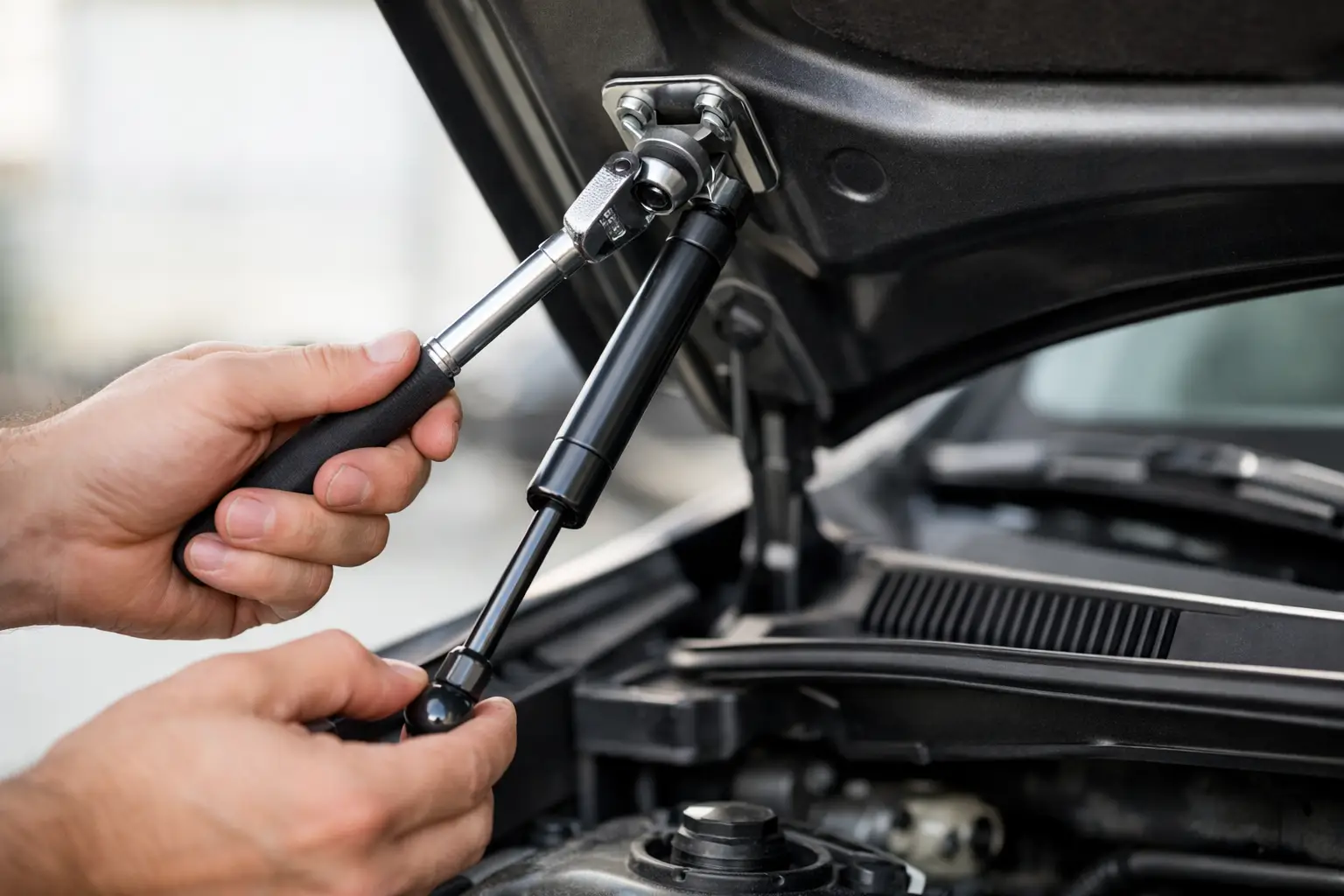
Bracket alignment matters just as much. The ball studs or pivots need to sit in line with the movement of the strut. If the strut is forced to work on an angle it was not designed for, side loading increases. That can wear the end fittings, damage the rod surface or cause early failure.
Installing petrol struts correctly on lids, hatches and doors
Most practical applications follow the same principle. One bracket mounts to the fixed frame and the other to the moving panel. The exact location of those brackets determines leverage, opening angle and closing effort.
Mounting closer to the hinge generally reduces leverage and may require more force from the strut. Mounting further away increases leverage, but only if the geometry still allows the strut to compress and extend properly through the full movement. Small changes in bracket position can make a big difference, especially on short lids or deep toolboxes.
Before drilling anything, test the motion. Measure the closed and open positions carefully and check that the strut will not bottom out before the panel shuts. If a petrol strut reaches full compression before the lid is fully closed, something will eventually bend or crack. If it reaches full extension too early, the lid may stop short of the intended opening angle.
For paired struts, both sides must be mounted symmetrically. If one side sits even slightly out, the panel can rack during opening. That puts uneven stress on hinges and brackets, and the problem gets worse over time.
Check the hardware as well as the strut
A replacement strut can only perform as well as the hardware holding it. Worn ball studs, cracked brackets and thin mounting surfaces are common reasons for repeat failures. If the old strut popped off, bent or tore out of the panel, inspect the mounting point properly before fitting the new unit.
On metal lids and frames, make sure the material thickness is enough for the load. On aluminium canopies, caravan furniture and lightweight access panels, backing plates or reinforced mounting points are often the better option. Timber cabinet applications also need care because screws can loosen over time if the substrate is too soft or the load is concentrated in one area.
Corrosion is another factor, particularly in marine and coastal use. If the environment is harsh, the strut grade and mounting hardware need to suit it. A good installation in the wrong material will still fail early.
Common mistakes that cause poor performance
Most petrol strut fitment problems come back to a short list of errors. The wrong force rating is common, especially when a heavier replacement is used to compensate for bad geometry. Incorrect bracket placement is another. So is assuming that if the end fittings clip on, the unit must be suitable.
Another frequent issue is replacing only one strut in a pair. If one has failed due to age and fatigue, the other is usually not far behind. Mixing an old weak strut with a new stronger one often creates uneven lift and twisting loads.
Temperature can also affect performance. Petrol struts generally feel firmer in hotter conditions and softer in colder ones. In Australia, that matters on exposed canopies, agricultural equipment and site boxes that sit in direct sun. If an application is right on the margin, seasonal temperature swings can expose the weakness.
A practical fitment check before final tightening
Once the strut is mounted, run through the full opening and closing cycle by hand and watch for any sign of binding, misalignment or over-travel. The panel should move smoothly without sudden kicks, hard stops or twisting. The strut body and rod should stay clear of surrounding surfaces through the full range.
Check whether the panel stays open at the intended angle and whether closing effort is reasonable. A heavy industrial hatch may need firm control, while a caravan compartment door should feel manageable and predictable. The right result depends on the application, not on a single universal feel.
If you are fitting a new design rather than a direct replacement, allow room for adjustment. Temporary mounting, test cycles and small bracket changes can save a lot of rework later.
When expert advice saves time
There is a point where trial and error becomes expensive. If the application is unusual, heavily loaded or safety-critical, getting the specification right early is the better option. That applies to machinery guards, custom storage systems, marine hatches, seating assemblies and any panel where failure could injure someone or damage equipment.
A specialist supplier can work from measurements, photos, force markings and application details to narrow down the correct strut and hardware. For custom jobs, the important details are usually straightforward: what the panel weighs, how far it opens, where the hinge sits, and what space is available when closed and open. Petrol Struts supports this kind of fitment guidance across standard and custom applications, which is often the quickest path when a generic replacement does not quite match.
Installing petrol struts correctly comes down to getting the basics right before the clips go on: proper measurements, suitable force, sound mounting points and geometry that works through the full motion. If the setup feels wrong in testing, it usually is – and fixing it early is far easier than replacing bent brackets, cracked lids or another failed strut a few weeks later.