
Why force guesses cause expensive problems
A petrol strut that is only slightly wrong can turn a simple lid, hatch or canopy into a daily nuisance. Too little force and the panel drops, sags or needs two hands to hold open. Too much force and it can kick up hard, twist hinges, stress mounts or refuse to close properly. In workshop, vehicle and industrial applications, that is not a small issue. It affects safety, fitment and service life.
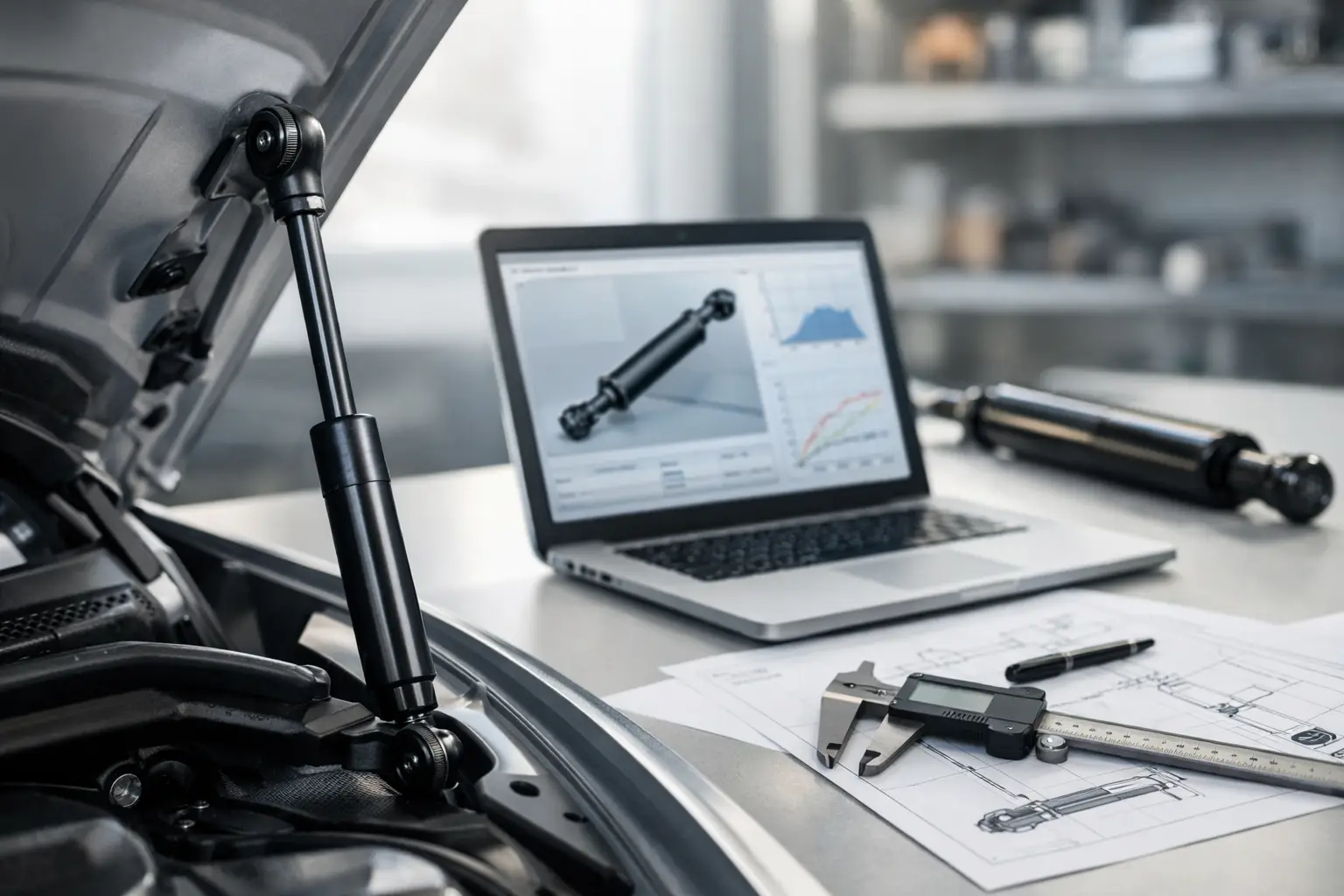
That is where a petrol strut force calculator becomes useful. It gives you a starting point for the force required to support or lift a panel based on weight, dimensions and mounting position. It does not replace proper measurement or application advice, but it helps narrow the numbers before you buy.
For anyone replacing failed struts on a toolbox, canopy window, caravan bed base, engine cover, access hatch or machinery guard, getting the force close matters just as much as getting the length and end fittings right.
What a petrol strut force calculator is actually doing
At a basic level, a petrol strut force calculator works out leverage. The panel weight is not acting directly on the strut. It acts through the hinge, and the strut pushes at a point along the panel through a particular mounting angle. That geometry changes everything.
A small, heavy hatch with the strut mounted far from the hinge may need less force than a lighter panel with poor mounting geometry. Likewise, two struts sharing the load will need a different force each than a single-centre-mounted unit. This is why matching a strut by eye, or by what “looks about right”, often ends badly.
Most force calculations are based on a few core inputs. The panel weight is one. The distance from hinge to the panel’s centre of gravity is another. Then there is the mounting point of the strut on the lid and on the fixed frame, plus the open and closed angles. From there, the calculation estimates the force needed to hold or assist movement through the stroke.
The numbers you need before using a petrol strut force calculator
If you want a useful result, the input data has to be realistic. Approximate dimensions can be enough for a first pass, but guessing the weight usually creates trouble.
Start with the panel or lid mass. If possible, weigh it. If that is not practical, calculate it from the material and dimensions, but allow for glass, seals, framing, lining, locks and accessories. A canopy side window with glass and hardware will be heavier than many people expect. A checker plate toolbox lid may be lighter than it looks.
Next, find the centre of gravity. On a plain rectangular lid with even material thickness, that is often near the middle. On an irregular panel, or one with mounted components, it can shift noticeably. This matters because the centre of gravity changes the turning force around the hinge.
Then measure the intended mounting positions. You need the hinge line, the strut bracket position on the moving panel, and the bracket position on the fixed structure. Small changes here can significantly alter the force required and the way the strut behaves near fully open or fully closed.
Finally, think about how the panel is meant to behave. Should it lift by itself once cracked open? Should it stay neutral and only hold at the top? Should it be easy to pull down from full extension? Those are different outcomes, and the target force may change depending on the job.
Why calculator results are a guide, not the final answer
A petrol strut force calculator is only as good as the assumptions behind it. Real-world installations involve friction in hinges, seal drag, body flex, wind load, uneven weight distribution and bracket limitations. On heavy-use equipment, vibration and repeated cycling also affect performance over time.
Temperature is another factor. Petrol struts generally feel firmer in higher temperatures and softer in lower ones. If a strut is fitted to a canopy, boat hatch or outdoor cabinet, seasonal conditions can change how it behaves. A setup that feels perfect in mild weather might be sluggish on a cold morning or over-energetic in summer heat.
Orientation matters as well. Most petrol struts are designed to be mounted rod-down where possible. That helps internal lubrication and can improve service life. If an application forces a different orientation, the strut may not perform exactly as expected from a simple calculator output.
That is why experienced suppliers treat the calculator result as a working number, then check it against known geometry, available lengths, stroke options, bracket travel and practical usage.
Common applications where force calculation matters
Some jobs are more forgiving than others. A lightweight cabinet flap may tolerate a bit of over-force without much trouble. A steel machinery cover or caravan storage hatch usually will not.
Automotive and 4WD applications often need careful force matching because the panels are used frequently and mounting space is tight. Canopy windows, ute toolboxes, rear glass sections and service bodies all rely on a strut that opens smoothly without overloading the frame.
In caravan, camper and trailer fit-outs, strut force affects day-to-day usability. Bed platforms, tunnel boots, external storage doors and kitchen lids need enough support to stay open, but not so much that they are difficult to close in confined spaces.
Industrial, agricultural and mining equipment tends to push harder on reliability. Access doors, guarding, inspection hatches and control box covers may be heavier, used in harsher conditions and expected to operate consistently despite dust, vibration and weather.
Marine installations add another layer. Corrosion resistance, changing temperatures and awkward opening angles make proper sizing more critical than many buyers expect.
One force figure is not enough on its own
A common mistake is to focus only on Newton force and ignore everything else. For a petrol strut to work properly, the extended length, compressed length, stroke and end fittings must all suit the application.
If the strut is the right force but the wrong length, the lid may not open far enough, may bottom out before full travel, or may place the brackets under unnecessary stress. If the fittings do not match the available space or articulation angle, the installation can bind or wear prematurely.
There is also the question of pair matching. If you are replacing two struts, replace them as a pair unless there is a very specific reason not to. An old weakened strut paired with a new unit often creates uneven lift and side loading.
For replacement work, the markings on the original strut can help if they are still legible. Force is often stamped in Newtons, and part numbers may identify the original specification. Even then, if the old setup never performed properly, copying it exactly may not be the best fix.
When to use the calculator and when to ask for help
A calculator is useful when you are planning a new setup, checking whether your current force makes sense, or narrowing options before ordering. It is particularly handy for straightforward lids and hatches with clear hinge geometry.
It becomes less reliable when the application is unusual – offset hinges, compound movement, very heavy panels, custom frames, multiple pivot points or non-standard opening arcs. In those cases, supplier input can save time and rework.
The practical approach is to gather the dimensions first, use the calculator to estimate force, then confirm the selection against the actual strut sizes and mounting geometry available. If you have photos, measurements, old part markings and the approximate panel weight, a specialist can usually identify whether the number is in the right range or needs adjustment.
That is also the point where custom force charging may come into play. Standard stocked forces suit many jobs, but not all. On specialised equipment, a custom-spec strut can be the better option if the geometry or load sits between standard ratings.
Getting a better result from your petrol strut force calculator
The best calculator results come from measured inputs, not estimates from memory. Measure from the hinge centreline, not the panel edge. Check dimensions in the closed and open positions. Confirm whether the load is shared across one strut or two. If there are added accessories such as racks, spare wheel mounts, insulation panels or tools fixed to the lid, include them.
It also helps to think about the user. A service hatch on a work vehicle might need more controlled movement than a storage lid opened once a month. A machine guard may need compliance-minded behaviour, where stable holding force matters more than light opening effort.
If you are replacing a failed unit and the old strut number is known, compare that information with the actual performance issue. If the lid used to fly open too aggressively, the answer may not be another strut with the same force. It may be a geometry correction, a different mounting point or a revised force rating.
For buyers who need a dependable starting point and direct technical guidance, Gas Struts can assist with sizing, replacement matching and custom applications through https://gasstruts.net.au/.
A calculator gets you closer to the right force. Good measurements, correct geometry and application advice are what turn that number into a strut that works properly every day.