A petrol strut can have the right force, the right length and the right stroke, then still fail the job because the end connection is wrong. That is why petrol strut end fittings matter. They control how the strut mounts, how it moves through its travel and how well it copes with vibration, misalignment and repeated use in real working conditions.
If you are replacing a failed strut on a toolbox, canopy, caravan hatch, engine cover or machinery guard, the fitting at each end is not a minor detail. It is part of the working geometry. Get it wrong and you can end up with binding, side load, poor opening angle or a strut that pulls off under load.
What petrol strut end fittings actually do
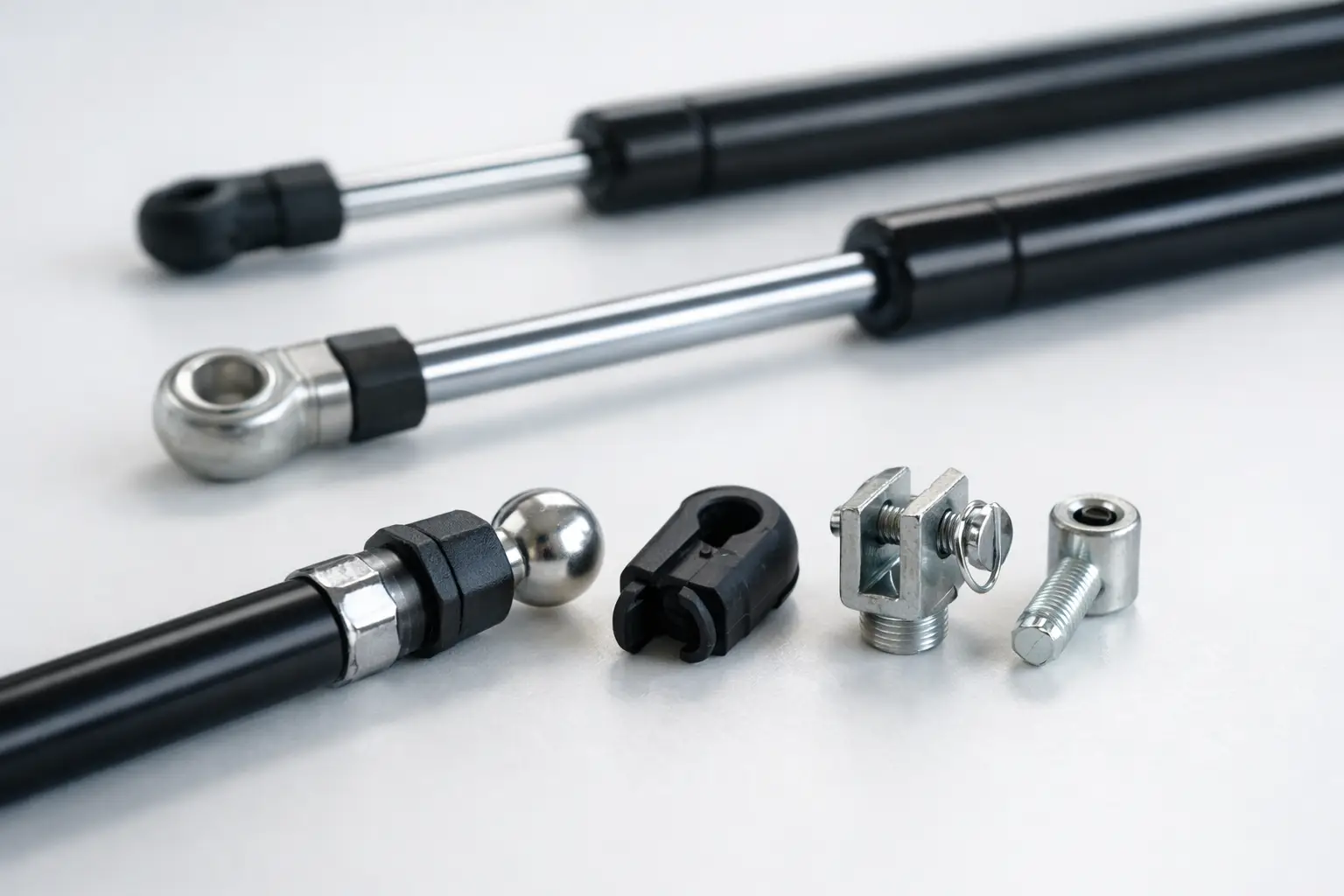
Petrol strut end fittings are the hardware pieces that connect the strut body and rod to your mounting points. Depending on the application, that might be a ball socket, eyelet, fork, clevis or blade-style fitting. Some allow angular movement more freely than others. Some are better suited to compact spaces. Some are designed for heavier-duty mounting where pin retention and bracket strength matter just as much as the strut itself.
The fitting choice affects three things straight away. First is fitment – whether the strut can physically connect to the existing brackets or studs. Second is articulation – whether the strut can move through the opening and closing arc without twisting or loading sideways. Third is service life – because the right fitting reduces wear on seals, brackets and the lid or panel being supported.
That is why matching only the extended length and force is not enough. End fitting style has to be treated as part of the specification, not an afterthought.
Common types of petrol strut end fittings
The most widely used fitting in general-purpose applications is the ball socket. This clips or snaps onto a ball stud and allows a practical amount of angular movement. You see it regularly on vehicle bonnets, boots, canopies, camper fit-outs and access doors because it is compact, quick to install and tolerant of normal alignment variation.
Eyelets are another common option. These use a through-hole connection with a bolt or pin. They can be a solid choice where the mounting arrangement is fixed and the hardware needs to be simple and secure. The trade-off is that they generally offer less freedom of movement than a ball joint setup, so alignment needs to be more controlled.
Fork or clevis fittings suit applications where a pin passes through a bracket between two prongs. They are often used where a more positive mechanical connection is needed, especially in industrial equipment, agricultural setups and machinery guarding. They can handle demanding use well, but they also need the bracket width, pin size and operating angle to be right.
Less common fittings include threaded adaptors, blade ends and specialist joints for custom installations. These are usually selected when standard hardware does not suit the available mounting space or the movement path of the panel.
Why fitting style changes performance
Two struts with identical force ratings can behave very differently if the end fittings are changed. A ball socket can cope with minor angular change during travel, while a rigid eyelet arrangement may transmit that same movement into side load. Side load is one of the quickest ways to shorten petrol strut life because these units are designed to work in line, not to absorb twisting or bending.
This matters on anything with flex, vibration or uneven mounting surfaces. Toolboxes on utes, marine hatches, trailers and off-road equipment all move more than they appear to when stationary. In those cases, a fitting that gives the strut some freedom to articulate can make the installation far more reliable.
There is also a space issue. A compact cabinet or battery box might not have room for a bulky fitting or large bracket swing. A heavier industrial lid may need a connection that can handle a larger pin and stronger bracket material. The right answer depends on the loads, the mounting layout and the way the panel opens.
How to identify the correct end fitting
The safest approach is to match the existing setup exactly unless there is a known problem with the original design. Start by checking the fitting type on both ends of the strut. It is not unusual for one end to differ from the other, particularly in custom or machinery applications.
Then measure the thread on the strut itself if the fitting is removable. Thread size is critical. Common thread sizes exist across many petrol strut ranges, but they are not universal. A fitting that looks close can still be wrong by pitch or diameter, and forcing it will damage the strut end.
You also need to measure the mating hardware. For ball sockets, that means ball size. For eyelets and forks, it means hole diameter, pin size and bracket width. If the existing brackets are worn, bent or ovalled out, that should be addressed as part of the replacement. A new strut on tired hardware often leads to the same failure repeating.
Photos help, but dimensions are better. When sourcing a replacement or custom setup, the useful details are the closed and extended lengths, stroke, force, end fitting type, thread size and bracket measurements. If the application is unusual, the opening angle and where the strut mounts relative to the hinge are also worth noting.
When you should change the fittings, not just the strut
Sometimes the old fitting style is the problem. If a lid has started binding near full extension, if brackets keep cracking, or if the rod end shows signs of side wear, the original end connection may not suit the movement path. In that case, replacing like-for-like is not always the best result.
A change from eyelets to ball sockets, for example, can improve articulation where the geometry is slightly off. Moving to a clevis arrangement can improve retention in rough-service equipment where shock load is high. On custom builds, changing the fitting can also help achieve the required installed length without changing the strut body itself.
That said, changing fittings usually means checking the bracket arrangement as well. A better end fitting on the wrong bracket is still the wrong setup. This is where application advice matters, especially for hatches, guards and lids that need consistent opening effort and safe holding force.
Material quality and application suitability
Not all end fittings are built to the same standard. In lighter domestic use, a basic fitting may do the job. In workshop, transport, agricultural or mining environments, the fitting needs to cope with vibration, dust, moisture and repeated load cycles. Corrosion resistance matters in marine and coastal conditions. Pin retention matters on moving equipment. Thread quality matters everywhere.
This is one reason trade and maintenance buyers tend to specify the full assembly rather than treating the fittings as generic accessories. The petrol strut, the fitting and the bracket form one operating system. Weakness in any part of that chain shows up quickly when the application is opened and closed all day.
For Australian conditions, that often means looking beyond simple compatibility. Heat, dust, washdown exposure and rough roads all place more demand on mounting hardware than a bench test ever will.
Ordering petrol strut end fittings without guesswork
If you are ordering replacements, the quickest way to avoid delays is to provide the actual details from the old unit and the mounting hardware. Part numbers are useful when they are still legible, but measurements are more reliable. If the application is custom, include what the strut supports, how heavy it is, how far it opens and whether the existing setup works properly.
At that point, a specialist supplier can usually tell whether the fittings should be matched, upgraded or changed to suit the job better. For unusual applications, that advice can save a lot of trial and error. Petrol Struts handles both standard replacements and custom requirements, which is useful when the part you need is not an off-the-shelf automotive match.
The main thing is not to reduce the decision to force and length alone. End fittings influence safety, movement and service life just as much as the cylinder specification does.
A strut only performs as well as the hardware holding it in place. If the fitting is right, the strut works smoothly and lasts. If it is wrong, the problems usually show up fast – and always at the worst time to deal with them.