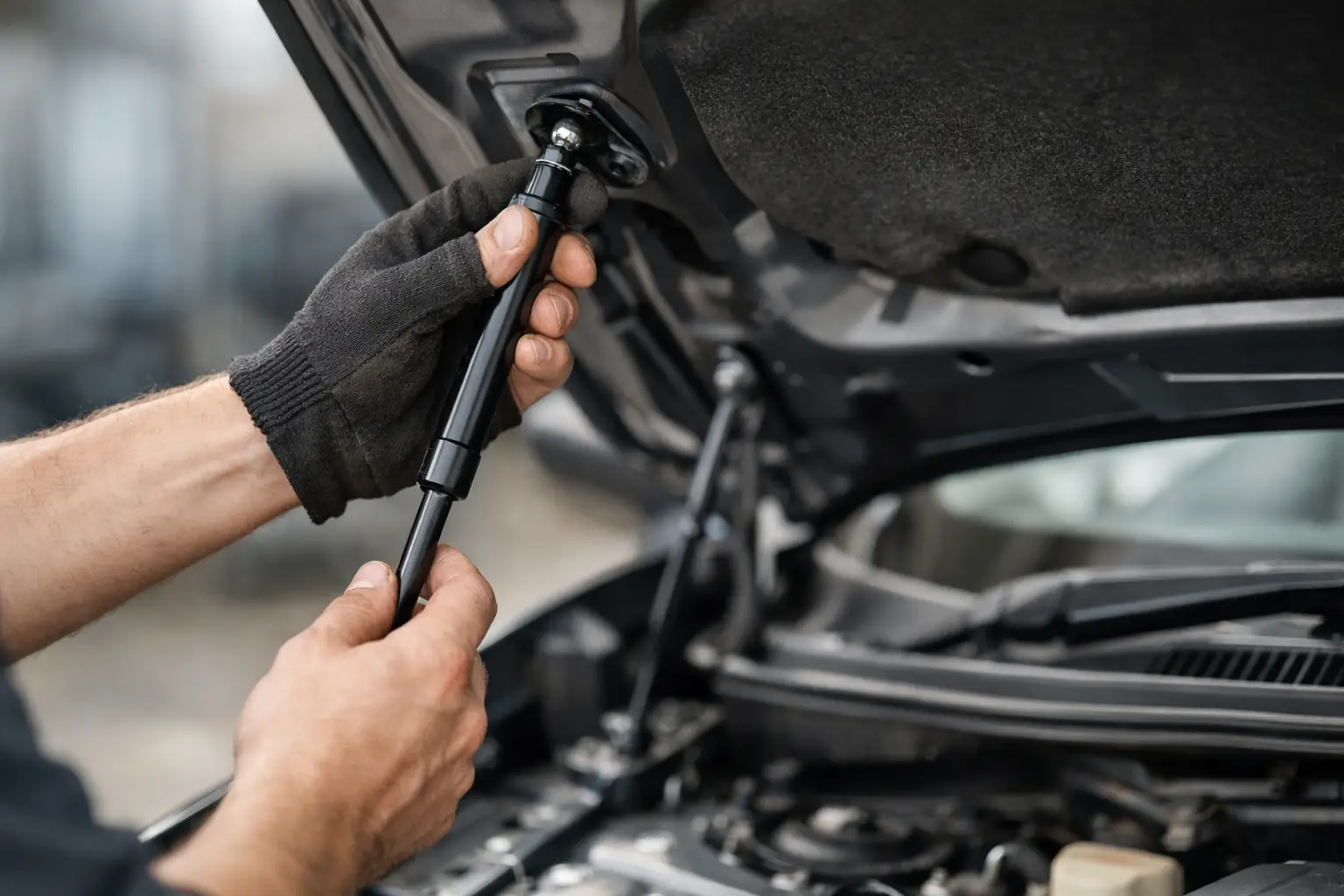
A bonnet that drops without warning is more than annoying – it is a safety problem. If you are replacing worn supports or fitting petrol struts to a bonnet that never had them, getting the setup right matters. When people ask how to fit bonnet supports, the real job is not just bolting on two struts. It is choosing the correct mounting position, stroke, length and force so the bonnet opens cleanly, stays up reliably and closes without damage.
What matters before you start
Bonnet supports work by balancing the weight of the bonnet through the arc of travel. That means fitment is not only about whether the ends physically attach. A strut can be the right length and still be wrong if the force is too high, the brackets are in the wrong position or the body of the strut is mounted the wrong way around.
On most vehicle applications, replacement is straightforward if the bonnet already uses petrol struts and you are matching the original specification. If you are converting from a prop rod to petrol struts, or dealing with a modified bonnet, you need to be more precise. Bonnet weight, hinge geometry and available clearance all affect the result.
Before you fit anything, check four basics: the extended length, compressed length, stroke, and force rating. Also inspect the mounting ends and bracket style. A support that is close enough on paper can still foul on surrounding panels, sit under constant side load or fail to hold the bonnet at full height.
How to fit bonnet supports with the correct setup
The cleanest installations start with measurement, not trial and error. Measure the existing strut if you are replacing one. Record the centre-to-centre length when fully extended and when compressed. Then confirm the stroke length, end fittings and mounting orientation.
If there is no existing strut, measure the bonnet in both the closed and open positions. You need to identify where brackets can be mounted so the strut sits within its working range across the full arc. At full open, the strut should be near extension but not hard against its mechanical stop. At closed, it should be near compression but still have a small margin. If you fit a strut that bottoms out before the bonnet fully closes, something will bend or crack.
Force selection is where many installations go wrong. Too little force and the bonnet will not stay up safely. Too much force and the bonnet may spring open aggressively, distort the panel around the brackets or be hard to close. Bonnet weight alone is not enough to calculate force because hinge position and mounting geometry change the leverage. A heavier bonnet mounted with favourable geometry may need less force than a lighter bonnet with poor leverage.
As a rule, matching the original force rating is the safest path on an existing petrol strut setup. For custom installs, it often pays to get technical advice before drilling anything.
Check the mounting orientation
In most applications, petrol struts should be fitted with the rod pointing downward when the bonnet is closed. That keeps the internal seal lubricated and helps extend service life. There are exceptions depending on bracket layout and clearance, but rod-down mounting is the standard starting point.
Also make sure the strut can move freely through the entire opening cycle. A slight misalignment at the bracket can create side loading. That may not show up immediately, but it shortens strut life and can cause premature seal wear.
Tools and preparation
You do not need a full workshop to fit bonnet supports, but you do need to work safely. Support the bonnet securely before removing any old struts or drilling new holes. Do not rely on one worn support to hold the bonnet while you remove the other. Use a suitable prop, and if the bonnet is heavy, get a second person to help.
Have your spanners or socket set ready, along with a drill and suitable bits if new brackets are going in. It is also worth checking the panel thickness and access behind the mounting point. Some installations need reinforcement plates or rivnuts rather than simple self-tappers. On a bonnet, thin sheet metal can fatigue if the load is concentrated into a weak area.
Replacing existing bonnet supports
If the bonnet already has petrol struts, replacement is usually a simple swap. Start by propping the bonnet open. Remove the old support one side at a time so the bonnet stays controlled. Many struts use spring clips on the socket ends. These usually do not need to be removed completely – just lifted slightly so the socket can pop off the ball stud.
Compare the old and new units before fitting. Check length, end type and force marking. If one side has failed, it is still best practice to replace the pair. A new support on one side and a tired one on the other can cause uneven loading and poor operation.
Fit the new strut in the same orientation as the original unless there is a clear reason not to. Once clipped or bolted in place, test the bonnet movement slowly. Look for smooth travel, full opening and positive support at the top. If the bonnet twists, binds or closes unevenly, stop and inspect the bracket alignment.
Fitting bonnet supports to a bonnet with no existing struts
This is the job that needs the most care. You are not just fitting hardware. You are creating the geometry that determines how the bonnet behaves.
Start with the bonnet fully open at the position you want it to hold. Choose a likely mounting point on the bonnet frame, not the outer skin, and a corresponding point on the engine bay structure that can take the load. Avoid thin unsupported sections. If the bonnet has internal bracing, use it. If the body-side mounting area is flimsy, reinforce it.
With the bonnet open, mock up the strut position and check the extended length. Then close the bonnet carefully through the arc and confirm the strut compresses without bottoming out and without fouling hinges, guards, wiring or engine components. This step often takes adjustment. A bracket moved 10 or 15 mm can change the opening behaviour significantly.
Bracket position changes the lift feel
Mounting the bonnet-side bracket closer to the hinge usually reduces the lifting effect but requires less stroke. Moving it further from the hinge increases leverage but also changes the force curve and can make the bonnet pop up harder near the end of travel. On the body side, small changes in bracket height and fore-aft position affect how soon the strut starts assisting and how well it holds at full open.
That is why custom bonnet support fitment is rarely a matter of copying a generic measurement from another vehicle. Similar bonnets can behave very differently.
Common mistakes that cause poor fitment
The most common mistake is choosing struts by eye. Close enough is not good enough with bonnet supports. Length and force both need to be right.
The second mistake is mounting to weak panels. A bonnet support may work for a few weeks, then the bracket starts tearing the panel because the load path was not considered. Reinforcement is cheap compared with repairing a bonnet frame.
Another issue is fitting supports with too much force. People often assume stronger is safer. In practice, over-force can stress hinges, crack mounting points and make the bonnet awkward to latch. The best setup feels controlled, not violent.
There is also the problem of replacing only one side. If one strut has failed, the other is usually not far behind. Replacing both keeps the bonnet balanced and avoids uneven wear.
When a custom solution makes more sense
Not every bonnet support job suits an off-the-shelf replacement. Modified 4WDs, utes with aftermarket panels, older vehicles, race cars and industrial engine covers often need a custom length or force. The same applies where added accessories have changed the panel weight.
In those cases, the useful information to have on hand is simple: the application, open and closed measurements, mounting type, approximate panel weight, and a few photos of the hinge and available mounting space. That gives a strut specialist enough detail to narrow down a workable solution without guessing.
For trade workshops and fleet maintenance, that saves time. For DIY vehicle owners, it reduces the chance of buying the wrong part twice.
Final checks after installation
Once fitted, cycle the bonnet several times. Open it fully and make sure it holds without drifting down. Close it and check that it latches without excessive force. Watch both sides for even movement. If one strut is taking more load, the bonnet may rack slightly as it opens.
Recheck all fasteners after a short period of use, especially on new bracket installs. Freshly fitted hardware can settle slightly under load. It is a small check, but it prevents bigger problems later.
If you are unsure on measurements, force rating or bracket position, stop before drilling and get the specification confirmed. A well-fitted bonnet support should feel almost invisible in use – open, hold, close, repeat. That is the standard worth aiming for.