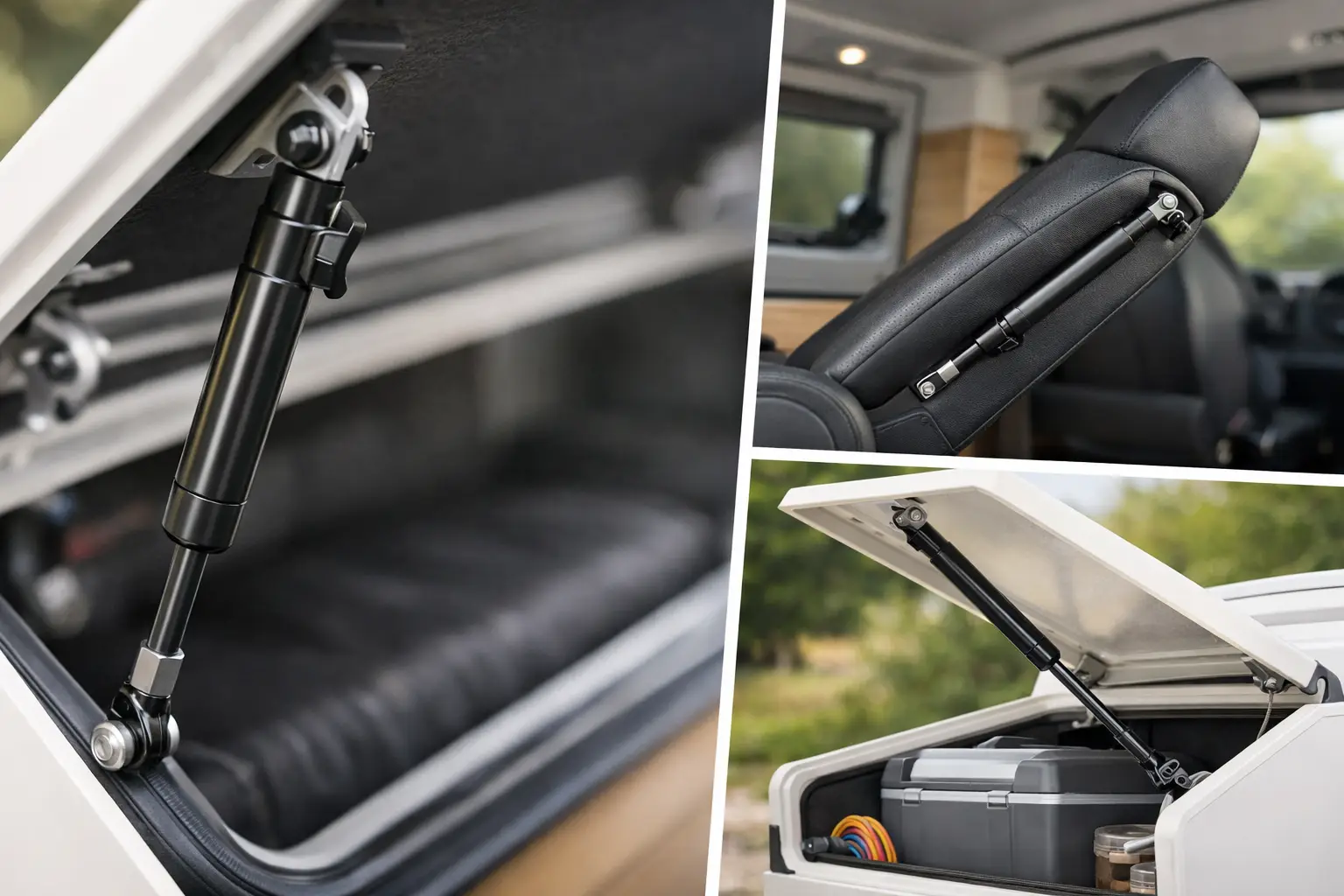
A hatch that will not stay put is more than an annoyance. On a service body, toolbox, plant guard or marine locker, it becomes a safety issue fast. That is where locking petrol struts earn their keep. They do more than assist lift and support weight – they let you hold a panel, lid or platform in position when the job calls for controlled movement, not just open-and-shut action.
What locking petrol struts actually do
A standard petrol strut provides lifting force and damped movement between two mounting points. A locking petrol strut adds a valve system that lets the rod lock at a set position, either across the stroke or at specific points depending on the design. That changes the job completely.
Instead of simply supporting a bonnet, canopy door or seat base, the strut can help keep it where the operator leaves it. In practical terms, that means safer access, easier adjustment and less reliance on props, latches or improvised supports.
Not all locking struts behave the same way. Some lock only when fully extended or compressed. Others allow variable positioning through the stroke and release by lever, cable or button. If you are replacing an existing unit, this difference matters more than many buyers expect. Two struts can look similar on paper and still perform very differently once fitted.
Where locking petrol struts make sense
The best applications are the ones where a moving part needs both assistance and stable positioning. Adjustable seating is a common example. The strut helps carry load, but the lock is what lets the user set height or angle without drift.
On industrial covers, access panels and machine guarding, the benefit is usually safety and workflow. A lid that opens smoothly and stays where it is placed is easier to work around than one that wants to rise, drop or slam shut. The same applies to marine compartments, caravan fit-outs and heavy storage lids where access can be awkward and both hands are needed once the hatch is open.
They are also useful on field equipment and vehicle-based setups where conditions are less predictable. Uneven ground, wind, vibration and regular stop-start use put more strain on both hardware and operators. A locking function can reduce movement that would otherwise make the setup frustrating or unsafe.
That said, locking petrol struts are not automatically the right upgrade for every lid or hatch. If the panel only needs to open to one fixed position and stay there, a standard petrol strut or fixed stay may be the better and more economical option. The locking feature is most valuable when adjustability or controlled hold is part of the actual use case.
How locking petrol struts work in real applications
The internal design varies by type, but the principle is straightforward. Petrol pressure provides the extension force, oil helps control movement, and the locking mechanism restricts rod travel when activated. Release is usually mechanical. In many setups, a lever or cable opens the valve so the rod can move again under load.
What matters in practice is how the strut behaves under the weight of the application. A lock does not compensate for incorrect force. If the strut is under-rated, the panel may still drop or feel unstable. If it is over-rated, operation becomes hard to control and mountings can be overstressed.
Orientation matters too. Some locking models are designed to run rod-down where possible for proper lubrication and seal life. Others are more forgiving, but mounting direction should never be assumed. In heavy-use settings such as mining, agriculture or mobile service equipment, fitting the right type the wrong way can shorten service life quickly.
Choosing the right locking petrol struts
The starting point is always the application, not the catalogue image. To match a locking petrol strut properly, you need the extended length, compressed length, stroke, end fitting type, mounting point centres and required force. If you are replacing an existing unit, part numbers help, but measurements are still worth checking because previous replacements are not always correct.
Force selection is where many jobs go off track. The actual load is only part of the equation. Mounting geometry, hinge position, opening angle and the centre of gravity all affect how much force is needed and when. A large hatch mounted close to the hinge behaves differently from a smaller lid with the strut mounted further out. Two applications with the same weight can need very different strut forces.
Then there is the locking function itself. Ask whether the strut needs to lock in extension, lock in compression, or lock in any position through the stroke. Also consider how it will be released. If the operator wears gloves, works in tight space or needs one-handed use, the release setup needs to suit that environment.
Material choice should also match the setting. Zinc-plated steel can be suitable in many vehicle and workshop applications, while stainless options are often preferred for marine use, washdown areas or environments where corrosion is a constant issue. There is no point specifying a precise force and stroke if the finish will not survive the conditions.
Common mistakes to avoid
One of the most common mistakes is treating locking petrol struts as a universal replacement for standard struts. They are more specialised, and the hardware around them often needs to match. Release mechanisms, brackets and travel clearances all need to be considered together.
Another issue is assuming a locked strut should carry shock loads. In reality, sudden impact, vibration or side loading can reduce performance and wear components faster. If the application sees rough handling, mobile plant movement or repeated heavy slam loads, the overall design may need extra support beyond the strut itself.
Side load is a frequent problem on lids and panels that twist during movement. Gas struts are designed to work in line. If the panel racks or the brackets are out of alignment, seals and rods wear prematurely. On locking types, that can also affect release and holding consistency.
There is also the question of user expectation. Some buyers expect the lock to feel completely rigid. In reality, a small amount of movement can be normal depending on the model and load. What matters is whether it holds position safely and consistently under normal operating conditions.
When custom specification is the better option
Off-the-shelf sizing works well for many common applications, but not for all of them. If the original setup was poorly designed, if the load has changed, or if the space available is tight, a custom solution is often the smarter path.
This is especially true on modified canopies, machinery covers, marine fit-outs, custom trailers and specialist seating systems. In these jobs, standard lengths or forces can force compromises in opening angle, access or safe operation. A properly specified strut can solve those issues before they become repeat failures.
For trade buyers and maintenance teams, that usually means supplying clear measurements, photos, mounting details and a description of how the panel should behave. If the current strut is failing, note whether the problem is lack of force, poor locking, awkward release, limited travel or corrosion. Those details save time and usually lead to a better result than simply ordering the closest visual match.
Installation and service life
Even a well-matched strut can underperform if installed badly. Mounts need to be secure, aligned and suitable for the load. Ball studs, brackets and fixings should not be treated as minor accessories. They are part of the working system.
During installation, avoid damaging the rod surface. Scratches, clamp marks and contamination shorten seal life. Do not lubricate the rod unless the manufacturer specifies it. Keep the movement clean and check that the release mechanism operates freely through the full range.
Service life depends on use frequency, environment and loading. A strut on a lightly used cabinet has a different duty cycle from one on a mine-site service hatch opened every day. Heat, dust, salt and vibration all count. If reliability matters, it is worth replacing tired struts before they fail outright, especially where operator safety is involved.
A good supplier should be able to help with more than just stock availability. Technical guidance on force, mounting geometry and replacement matching can prevent repeat issues, particularly when the application is unusual or heavily used.
Locking petrol struts are at their best when the job needs controlled movement, secure positioning and repeatable performance under load. Get the specification right, and the hardware stops being a work-around and starts doing the job properly.