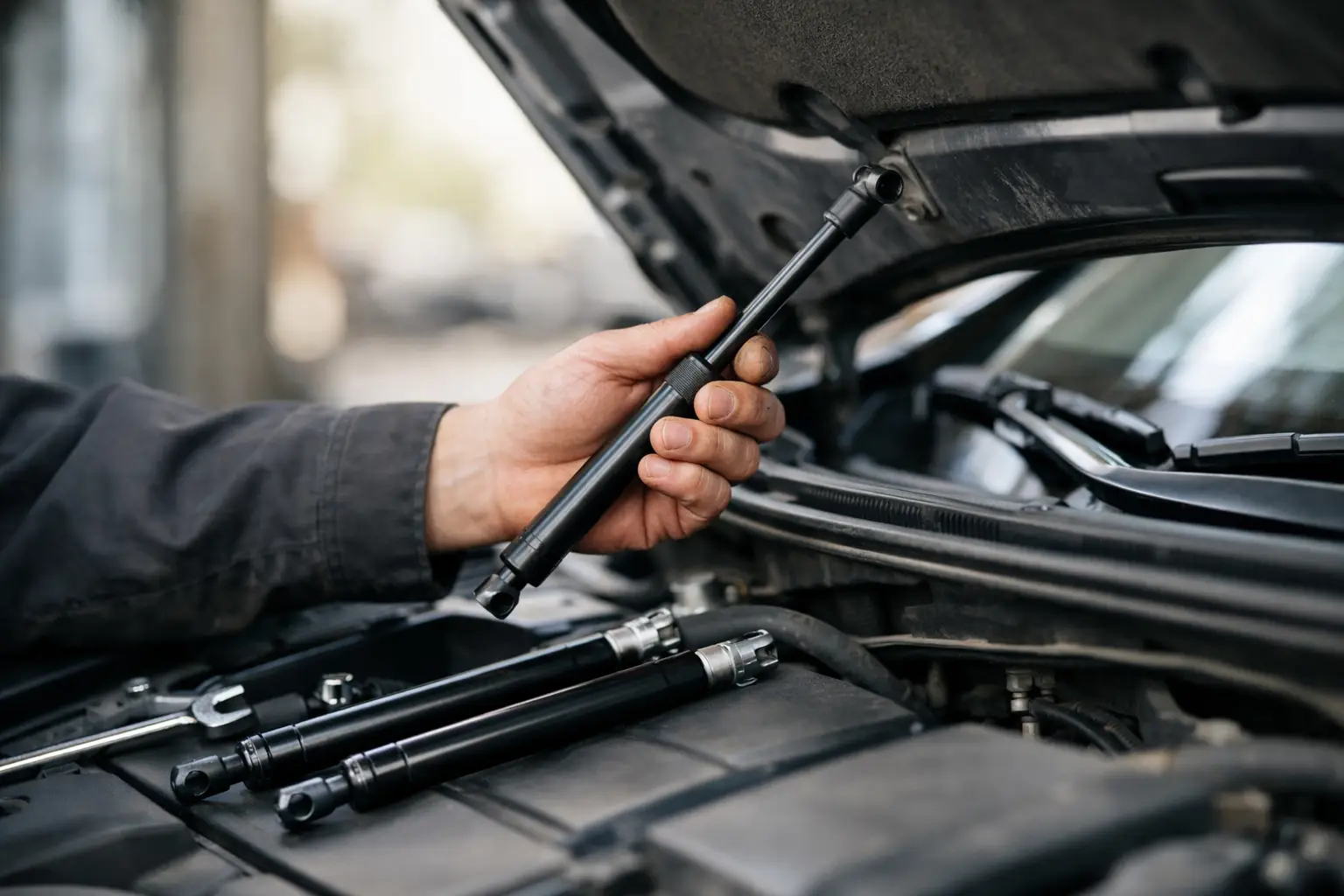
A canopy door that will not stay up, a toolbox lid that drops without warning, or a bonnet that suddenly feels heavier than it should – these are usually the first real signs that make people ask when should petrol struts be replaced. In most cases, the answer is not based on age alone. It comes down to how the strut is performing in its actual working conditions, how safely it supports the load, and whether the unit is showing signs of wear, leakage or force loss.
Petrol struts are designed to do one job consistently: control movement and support weight through a pressurised cylinder and rod assembly. When they are working properly, the movement feels steady, controlled and predictable. When they begin to fail, the change is often gradual at first. That is why many struts stay in service longer than they should, especially on equipment that gets used every day and only gets attention once something becomes unsafe or inconvenient.
When should petrol struts be replaced in practice?
The practical answer is simple: replace petrol struts when they no longer hold, lift, dampen or control the application as intended. If a hatch, lid, seat base, machine guard or access panel starts drifting down, needs extra force to open, slams shut, or feels uneven side to side, the struts are no longer doing the job properly.
That does not always mean the strut has completely failed. Partial force loss is common, and in many applications that is enough to create a safety issue. A caravan bed base that will not stay raised, a marine hatch that drops in windy conditions, or a service compartment door on plant equipment that no longer opens cleanly all point to replacement time. If safe operation depends on the strut, waiting for total failure is the wrong approach.
A second trigger is visible condition. If the rod is bent, pitted or scored, if oil is leaking from the seal area, or if the end fittings are worn or damaged, replacement is usually more sensible than trying to keep the unit in service. Petrol struts are sealed components. Once seals or internal pressure are compromised, performance does not recover.
Common signs a petrol strut needs replacing
Most failing petrol struts give some warning before they stop working altogether. The most obvious sign is reduced lifting force. You notice it when a lid that used to rise smoothly now stalls partway, or when you need to support the load by hand because the strut no longer has enough force.
Another common sign is inconsistent movement. A healthy strut should extend and compress in a controlled way. If movement is jerky, sticky or uneven, there may be internal wear, contamination on the rod, misalignment in the installation, or mounting points placing side load on the shaft. In some cases the strut itself is worn out. In others, the mounting geometry is also contributing to early failure.
Noise can also be a clue. Squeaking, knocking or clicking does not always come from the strut body, but worn ball joints, brackets or end fittings often show up at the same time. If the whole assembly has slack in it, replacing the strut alone may not solve the issue.
Then there is visible oil. A light film on the rod can be normal because the seal needs lubrication, but wet leakage, grime buildup around the seal, or oil tracking down the body is different. That usually points to seal deterioration and pressure loss.
Service life depends on the application
There is no single replacement interval that suits every petrol strut. A bonnet strut on a private vehicle used a few times a week lives a very different life from a toolbox lid on a service ute, or a machinery hatch in a dusty, high-vibration environment.
Cycle rate matters. The more often the strut opens and closes, the sooner wear will show up. Environment matters as well. Heat, salt, dust, mud, washdown exposure and chemical contact can all shorten service life. So can poor mounting geometry, overextension, bottoming out, or using a strut with the wrong force rating for the load.
Temperature is often overlooked. Petrol pressure changes with temperature, so a strut may feel weaker in cold conditions and firmer in hot conditions. That does not automatically mean it needs replacing. What matters is whether it still performs safely across the conditions the application actually sees.
For trade, industrial and agricultural use, replacement often becomes a maintenance decision rather than a wait-for-failure decision. If access doors, guards or covers are opened constantly and the struts are critical to safe handling, it makes sense to replace them once force loss becomes noticeable rather than stretching out their service life.
How to tell whether it is the strut or the setup
Not every lifting problem means the petrol strut is at fault. Hinges can bind, brackets can shift, lids can warp, and added accessories can change the load. A canopy door with extra racks or internal lining may now weigh more than the original struts were sized for. A toolbox lid that has been repaired may sit slightly out of alignment, putting side load on the struts and making them wear faster.
A basic check helps. Look at whether both struts extend evenly, whether the lid or panel sits square, and whether the brackets are secure. Inspect the rod surface for damage and the body for oil leakage. If the hardware is sound but the supported load still drops or feels heavy, replacement is usually the next step.
Where there has been a change to the application, a like-for-like replacement may not be enough. The force may need to be recalculated and the mounting position reviewed. That is especially relevant on custom canopies, machinery covers, marine hatches, caravan fit-outs and industrial access panels.
Why replacing both struts is usually the right move
If an application uses a pair of petrol struts, replacing both at the same time is usually the better option. When one has lost force, the other is often not far behind. Fitting one new strut next to one worn strut can lead to uneven lifting, twisting load, poor alignment and shorter life for the new unit.
This matters on wide lids, heavy hatches and any setup where balanced support is important. Uneven force is not just inconvenient. It can damage hinges, distort panels and create a pinch hazard during opening or closing.
Choosing the right replacement
Getting the replacement timing right only solves half the problem. The other half is matching the new strut correctly. The key details are extended length, compressed length, stroke, end fitting type and force rating in Newtons. Orientation and mounting position also matter.
If the original strut has a readable part number, that is the best starting point. If not, measure the strut eye-to-eye or centre-to-centre in both open and closed positions, note the fittings, and check any markings on the body. For applications where the original setup was marginal, or the load has changed, proper specification becomes more important than simply matching dimensions.
This is where specialist support saves time. A supplier that handles automotive, industrial, marine, agricultural and custom applications can usually identify whether you need a direct replacement or a revised specification. Petrol Struts, for example, supports both standard replacement and custom-fit solutions, which is useful when the original hardware was undersized, obsolete or part of a modified installation.
When immediate replacement is the safest option
Some failures can wait until the next planned service. Others should not. If a strut is supporting anything overhead, near operators, or over stored equipment, replacement should be treated as urgent once performance drops. The same applies where a failed strut could damage hinges, slam a panel shut, or make emergency or service access harder.
Machine guards, engine covers, service doors, marine lockers, caravan compartments and workshop storage lids all fall into this category. If the supported panel cannot be trusted to stay where it should, the strut is already past its useful life.
A sensible replacement mindset
The best time to replace a petrol strut is just before poor performance turns into a safety issue, not after. If the strut no longer supports the load properly, leaks, binds, or shows physical damage, it is time. If the application has changed and the old specification no longer suits, it is also time.
A petrol strut is a small component, but it affects how safely and efficiently the whole assembly works. If there is any doubt, measure the existing unit, note the application, and get the replacement matched properly. That gives you a cleaner fit, better service life and less chance of dealing with the same problem again in a few months.