A lid that flies open, drops shut, or sits half-way and refuses to behave is usually telling you the same thing – the strut force is wrong. If you’re asking what pressure petrol strut do I need, the answer is not just about buying a stronger unit. It comes down to force, mounting position, lid weight, geometry, and how you want the application to move in real use.
Getting that right matters whether you’re replacing a failed canopy strut, fitting out a toolbox, supporting a caravan bed base, or specifying struts for industrial machinery. Too little force and the panel will not stay up safely. Too much and you can damage hinges, brackets, or the panel itself, while making it hard to close.
What pressure petrol strut do I need for my application?
In most cases, “pressure” is used as shorthand for the strut’s force rating, usually shown in Newtons (N). That rating tells you how much pushing force the petrol strut provides when extended. So when customers ask what pressure petrol strut do I need, the practical question is usually: what Newton rating do I need?
Common forces can range from light cabinet and access hatch applications through to heavy canopies, engine covers, machinery guards, and marine compartments. The right rating depends on more than weight alone. A 20 kg lid mounted with poor geometry may need more force than a heavier lid with ideal mounting points.
That is why matching by appearance alone often leads to the wrong result. Two struts can have the same overall length and end fittings but completely different force ratings.
The main factors that determine gas strut force
The weight of the panel is the first part of the calculation, but it is not the only one. You also need to consider where the hinges sit, where the strut mounts, and how far the centre of gravity is from the hinge line.
A long, shallow lid can behave very differently from a shorter, deeper panel of the same weight. The further the weight acts away from the hinge, the more leverage it creates, and the more force the strut needs to control it.
Panel weight and load distribution
Start with the actual weight of the moving part, not a rough guess. If the lid, hatch, seat base, or cover has added accessories such as carpet lining, tools, spare wheel mounts, framing, or insulation, include those as well.
Load distribution matters too. If most of the mass is concentrated near the free end rather than near the hinges, the required force increases.
Mounting geometry
This is where many replacement jobs go off track. The distance between the hinge and the strut mounting points changes how efficiently the strut can support the load.
A strut mounted closer to the hinge has less mechanical advantage and usually needs higher force. Move the mounting point further out and the same lid may need less force. Small dimensional changes can make a noticeable difference.
Opening angle and intended movement
Think about how far the panel needs to open and what you want it to do. Do you want full lift assistance, soft support through the travel, or simply enough hold-open force at the top?
Some applications need strong initial lift. Others need controlled support without aggressive opening. A strut that is technically strong enough can still be wrong if it opens the panel too quickly or makes closing difficult.
One strut or two
If an application uses two struts, the required support is shared across both sides. That does not mean you can estimate roughly and divide by two. Uneven loads, off-centre mounting, and panel flex can all affect the final force selection.
On wide lids, dual struts often provide better stability. On narrower access panels, one correctly specified strut may be enough.
How to identify the right replacement strut
If you are replacing an existing petrol strut and the original setup worked properly before it failed, the fastest option is to match the existing unit’s specifications.
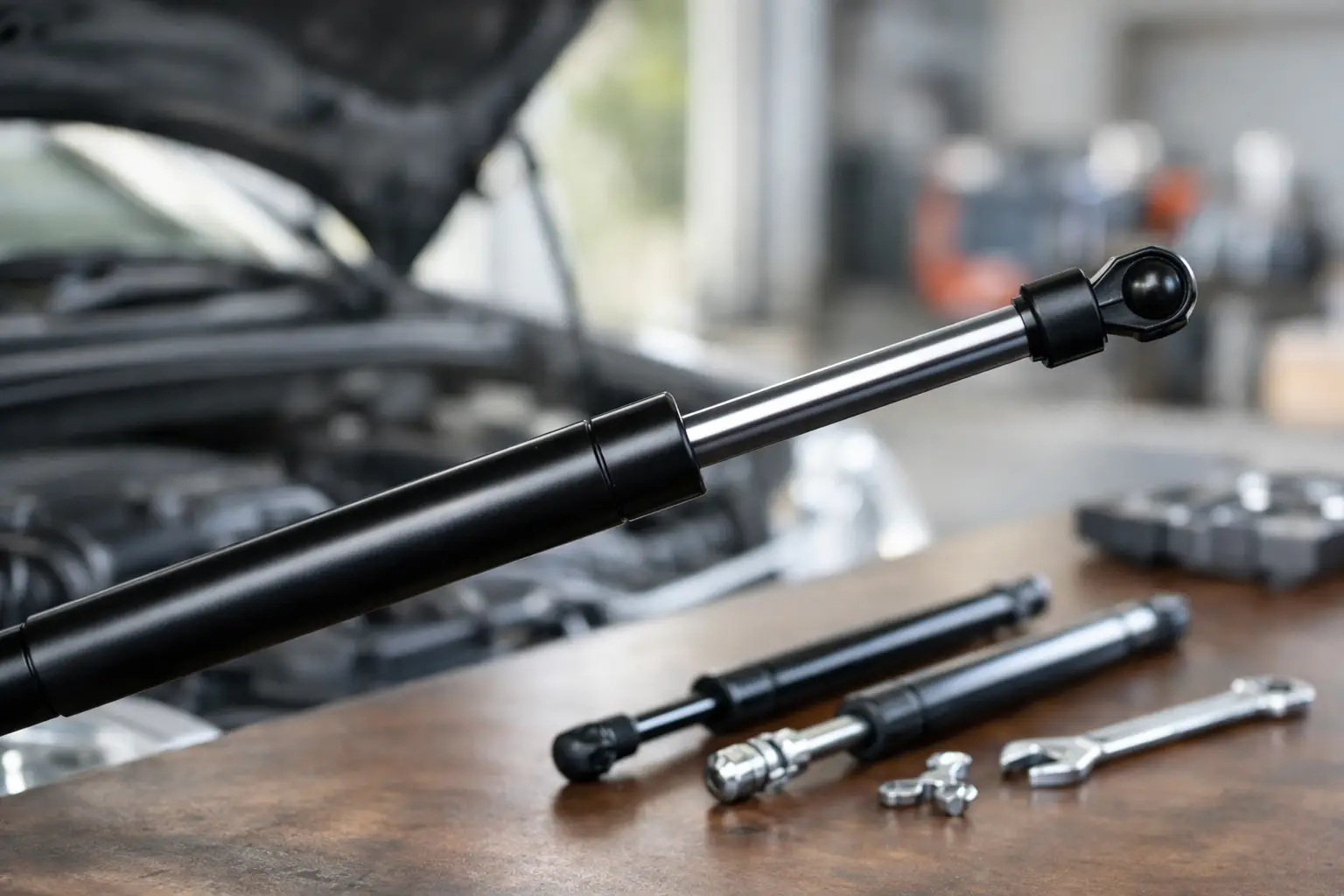
Check the body for the printed Newton rating. This may appear as a number followed by “N”, such as 250N, 500N, or 800N. Then confirm the extended length, compressed length if available, stroke, and end fittings. Ball sockets, eyelets, forks, and threaded ends are not interchangeable without checking bracket compatibility.
If the old strut has no visible markings, do not rely on length alone. Measure centre-to-centre between the mounting points when the strut is extended, note the shaft and tube diameter if possible, and photograph the fittings and brackets. That gives a far better basis for matching.
What if the old strut was wrong?
This happens more often than people expect. A previous owner may have fitted whatever was available, or an application may have been modified since the original struts were installed.
If the old strut never held the lid open properly, or if it launched the panel upward and strained the mounts, copying the same force rating may just repeat the problem. In that case, the right approach is to work from the actual application rather than the old part number.
For custom or uncertain jobs, the useful details are straightforward: lid or panel weight, hinge position, open and closed dimensions, mounting point locations, and a few clear photos. That is usually enough to narrow down the correct force and strut size with much better accuracy than trial and error.
Signs your petrol strut pressure is too low or too high
A low-force strut usually shows itself quickly. The panel feels heavy through the lift, drifts downward, or needs a prop to stay open. On a vehicle canopy, toolbox or engine bay application, that becomes a safety issue as much as a convenience problem.
A high-force strut creates a different set of problems. The lid may spring open too hard, refuse to close cleanly, twist the panel, or overload hinges and brackets. In lightweight aluminium lids and composite panels, excess force can lead to cracking around the mounting points over time.
The best result is controlled movement with enough support to hold open reliably, without turning closure into a wrestling match.
Measurements you should have ready
If you need help selecting the correct unit, a few accurate measurements save time and avoid ordering the wrong part. Extended length is the main one, measured centre-to-centre between the mounting points. Stroke length is also important because it determines the travel the strut can accommodate.
You should also note the fitting type at each end, whether the strut is mounted rod down or rod up, and whether the application uses one or two struts. For custom-fit advice, panel weight and photos of the open and closed positions are often the missing piece.
For trade, fleet, workshop and maintenance buyers, this is especially important when dealing with machinery covers, access doors, marine hatches and retrofits. Specifying the force without confirming the mounting geometry is where repeat issues tend to start.
Replacement versus custom specification
A direct replacement works well when the original design was correct and the surrounding hardware is still in good condition. It is usually the fastest and most cost-effective path.
A custom specification makes more sense when the application has changed, the lid material is different, the mounting points have moved, or the previous struts were never right in the first place. That includes many caravan upgrades, trailer storage builds, agricultural equipment repairs, and industrial access systems.
This is where specialist support matters. A supplier focused on petrol struts can usually identify whether the issue is force, sizing, fittings, bracket position, or a combination of all four. At Petrol Struts, that is typically the difference between a quick replacement and a custom solution that actually works in service.
When not to guess
Guessing is risky on heavy lids, overhead panels, machinery guards, and any application where a drop could injure someone or damage equipment. It is also worth avoiding on marine and off-road applications where vibration, corrosion, and repeated shock loads add more stress to the setup.
If the strut supports a critical access point, carries significant weight, or has unusual mounting geometry, it is better to get the force checked before ordering. A strut is a simple component, but it has a direct effect on safety, usability, and hardware life.
The right petrol strut should feel like part of the design, not something you have to fight with every time you open or close the lid. If you can provide the dimensions, fittings, and a clear idea of how the panel needs to behave, choosing the correct force becomes a lot more straightforward.