A rear canopy that will not stay up, a toolbox lid that drops without warning, or a machinery cover that opens too fast are not minor annoyances. They are fitment and safety problems. When you need custom petrol struts Australia-wide, the real job is not just finding a strut that looks close. It is getting the force, travel, fittings and mounting geometry right so the lid or panel works properly under load, in real conditions, day after day.
When custom petrol struts make more sense
A standard replacement is often the quickest answer when the original strut part number is known and the application has not changed. But plenty of jobs do not fall into that category. Modified canopies, aftermarket toolboxes, marine hatches, caravan storage, plant guards and fabricated machinery covers often need a strut matched to the actual setup rather than the nearest shelf item.
That is where custom work matters. A strut can be the correct overall length and still perform badly if the force is wrong or the mounting points are in the wrong position. Too much force and the lid can be hard to close, put stress on hinges, or spring open aggressively. Too little force and it will not hold safely at full extension. The right result comes from matching the strut to the moving load and the way that load travels through the opening arc.
What determines the right custom petrol strut
Most buyers start with length and end fittings, which is reasonable, but it is only part of the picture. Petrol struts are specified by extended length, compressed length, stroke, force rating and fitting type. In practice, mounting angle, hinge position, lid weight and where the strut attaches along the lid all affect how the unit behaves.
Force is not just about weight
A common mistake is assuming the lid weight equals the required Newton rating. It does not. A 20 kg hatch mounted close to the hinge may need a different force from a 20 kg hatch mounted further out, because leverage changes everything. The opening angle also matters. Some applications need firm support right near full open. Others need better control through the first part of the lift.
On heavy-use applications such as trailers, mining equipment, agricultural machinery and industrial access panels, there is also the issue of dynamic loading. Vibration, uneven surfaces and repeated cycling can change how a strut needs to perform. That is one reason a measured, application-specific approach gives a better outcome than guessing from weight alone.
Length, stroke and end fittings all need to match
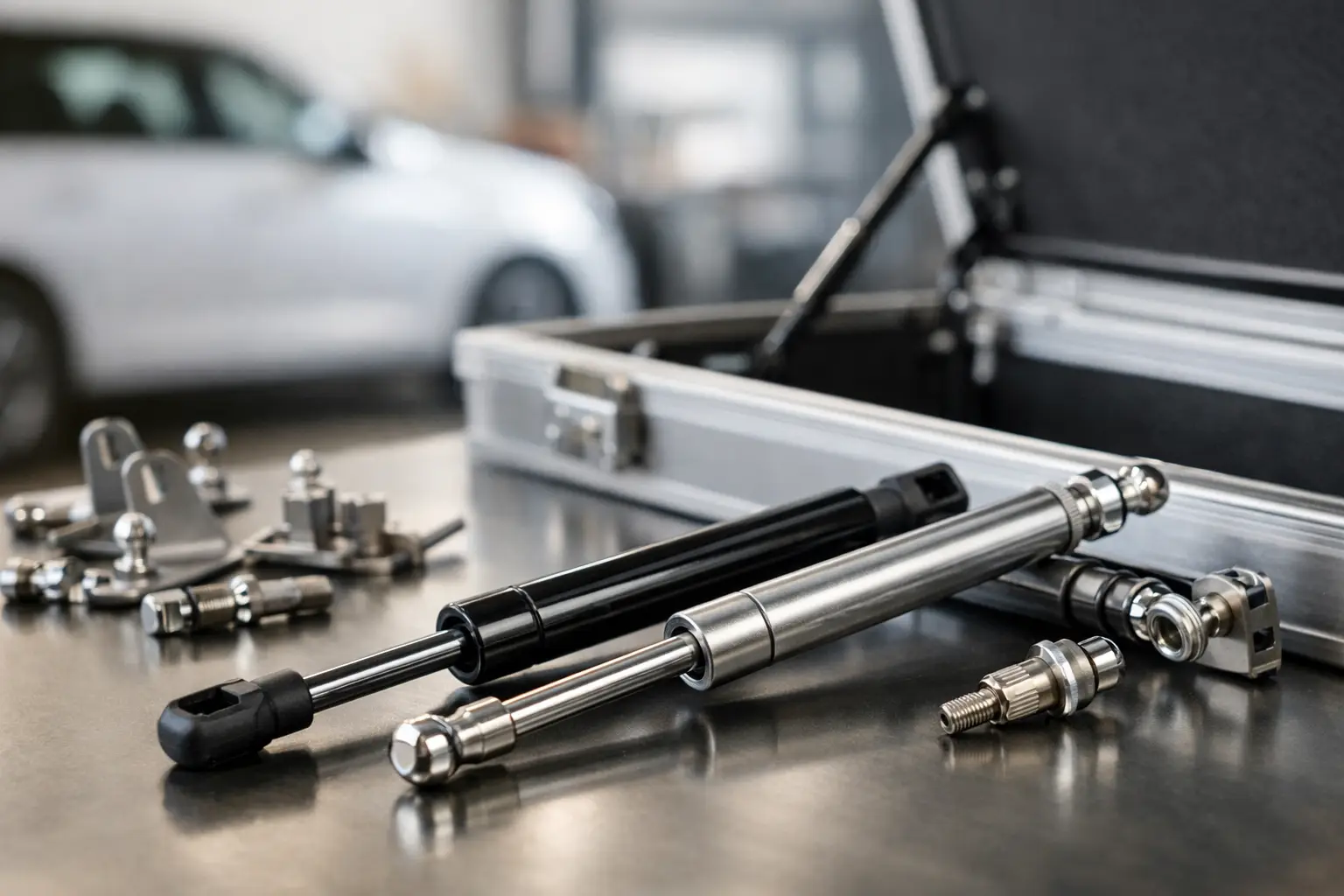
The extended length determines how far the panel can open. The compressed length determines whether the strut can close without binding. Stroke affects travel between the two. Then there are the end fittings – ball sockets, eyelets, forks and threaded ends are common examples – and each needs to suit both the bracket and the clearance available.
Even small differences matter. A few millimetres in compressed length can stop a hatch from shutting cleanly. The wrong end fitting can twist the strut or create side load, which reduces service life. In a marine or off-road setting, that extra strain shows up quickly.
Custom petrol struts Australia-wide applications often require exact details
Across Australian conditions, petrol struts do more than hold up car bonnets. They are used on ute canopies, caravans, horse floats, boat hatches, farm equipment, service bodies, cabinets, seating bases and machine guards. Each application has its own demands.
A caravan tunnel boot, for example, may need compact closed length and moderate force so the door can be opened easily by hand. A heavy checker plate toolbox lid may need a higher force pair with corrosion-resistant hardware. A machinery guard may need controlled, repeatable opening to meet site safety expectations. In marine environments, salt exposure shifts the focus toward materials and long-term corrosion resistance. There is no single strut that suits all of these jobs.
That is why accurate information upfront saves time. If the application is unusual, modified, or safety-critical, custom specification is usually the better path.
What to measure before you ask for a quote
If you want the right strut first go, measure the existing unit if there is one. Record the extended length from centre to centre of the mounting points, the compressed length, the stroke if known, and the end fitting style. If the original force is marked on the tube, note that too. It is usually shown in Newtons, such as 250N or 600N.
If there is no existing strut, or the current setup is wrong, the application details become more important than the part itself. Measure the lid or hatch weight, overall dimensions, hinge position, current mounting point locations and desired opening angle. Photos of the open and closed position help, especially where space is limited or brackets are non-standard.
For trade and maintenance buyers, this is often the difference between a quick quote and a long back-and-forth. The clearer the information, the easier it is to specify a strut that works properly rather than merely fitting in the space.
Details worth supplying
A good enquiry usually includes the application type, whether one or two struts are used, environmental conditions, and whether the panel carries added weight such as racks, lining or mounted hardware. Temperature can matter as well. Gas pressure changes with heat and cold, so an application exposed to harsh weather or engine-bay conditions may need that factored in.
If brackets are damaged or missing, mention that early. In some jobs the strut is not the only issue. Worn hinges, bent mounts and poor alignment can make a correct strut seem faulty when the real problem is elsewhere.
Why quality matters more on working equipment
Cheap petrol struts can look fine on paper and still fail early in service. Seals, rod finish, tube quality and manufacturing consistency all affect life and performance. On a vehicle, trailer or machine that opens every day, those differences are not theoretical. They show up as weak lift, inconsistent motion, oil leakage and premature loss of pressure.
That is why buyers in trade, industrial and fleet settings tend to focus on certified quality and proven construction rather than the lowest ticket price. A strut that lasts and performs properly reduces callbacks, downtime and safety complaints. It also means less time spent pulling apart a lid or hatch for a second replacement.
For customers who need both stocked replacements and custom-built options, specialist suppliers such as Petrol Struts can usually assess whether an off-the-shelf part will do the job or whether the application calls for something more specific. That advice is often as valuable as the part itself.
Getting the fit right the first time
There is always a balance between speed and precision. If your machine or vehicle is down, you want a fast answer. But rushing the spec can create more delay than it saves. A strut with the wrong force, stroke or fittings can arrive quickly and still leave you with a lid that will not open safely or will not shut at all.
The practical approach is simple. Start with the measurable facts. Confirm whether the application is a direct replacement or a changed setup. Flag any harsh conditions, unusual loads or non-standard brackets. Then get the strut matched to the job rather than hoping a near enough option will hold.
That approach works whether you are replacing bonnet struts on a work ute, fitting out a caravan, maintaining mobile plant, or ordering multiple units for fabricated equipment. It is less about buying a gas strut and more about specifying a motion-control part that has to perform reliably every time it is used.
If you are ordering custom petrol struts Australia-wide, the best results usually come from a short, accurate brief rather than a long guess. A few measurements, a few photos and a clear description of the application can save a lot of wasted time – and make sure the next time that hatch opens, it stays exactly where it should.