A gas strut that is 10 mm out in length or 50 N off in force can turn a simple replacement into a lid that will not stay open, a canopy that slams shut, or a hatch that is unsafe to use. This gas strut buying guide is built for people who need the right part the first time, whether that is for a ute canopy, toolbox, caravan bed, machinery guard or marine hatch.
What this gas strut buying guide should help you avoid
Most buying mistakes come down to one of three issues: the wrong dimensions, the wrong force, or the wrong end fittings. Sometimes the old strut has no readable part number, and sometimes the strut that was originally fitted was never right for the job in the first place. Either way, matching by appearance alone is risky.
A proper replacement starts with the application details and the strut specifications working together. If one of those is missing, you can often still identify the correct strut, but you need accurate measurements and a clear picture of how the strut is mounted and used.
Start with the application, not just the old part
If you are replacing a failed strut, the old unit is useful, but it should not be your only reference. Equipment changes over time. Hinges wear. Added accessories increase weight. A canopy door with new shelving or a toolbox lid with extra lining may need a different force from the original fitment.
That is why the first question is simple: what is the strut doing? Holding open a bonnet is different from controlling a heavy horizontal lid. A seat base, access hatch, cabinet flap and engine cover all move differently and load the strut in different ways. Mounting angles, travel, and weight distribution all affect what will work.
For trade and industrial buyers, this matters even more. A strut on a machine guard or service panel is part of safe operation, not just convenience. If the panel lifts too fast, does not open fully, or drops unexpectedly, it becomes a maintenance issue very quickly.
The key measurements that matter
When ordering a gas strut, there are a few measurements that carry most of the weight.
Extended length
This is the centre-to-centre measurement when the strut is fully open, taken from the middle of one end fitting to the middle of the other. It determines how far the lid, hatch or panel can open. If the replacement is too long, it may overextend the mounting points or stop the panel from closing properly. If it is too short, you may lose opening angle.
Compressed length
This is the centre-to-centre measurement when the strut is fully closed. It matters because the strut must fit into the available space without bottoming out before the panel shuts. A compressed length mismatch is one of the most common causes of poor fitment.
Stroke
Stroke is the difference between compressed and extended length. It tells you how far the rod travels. In most cases, if your compressed and extended lengths are correct, the stroke will also be correct, but it is still worth checking.
Shaft and tube diameter
These dimensions help identify the strut series and load range. They are not usually the first measurements a buyer looks at, but they are useful when matching a replacement or confirming compatibility with brackets and fittings.
End fittings
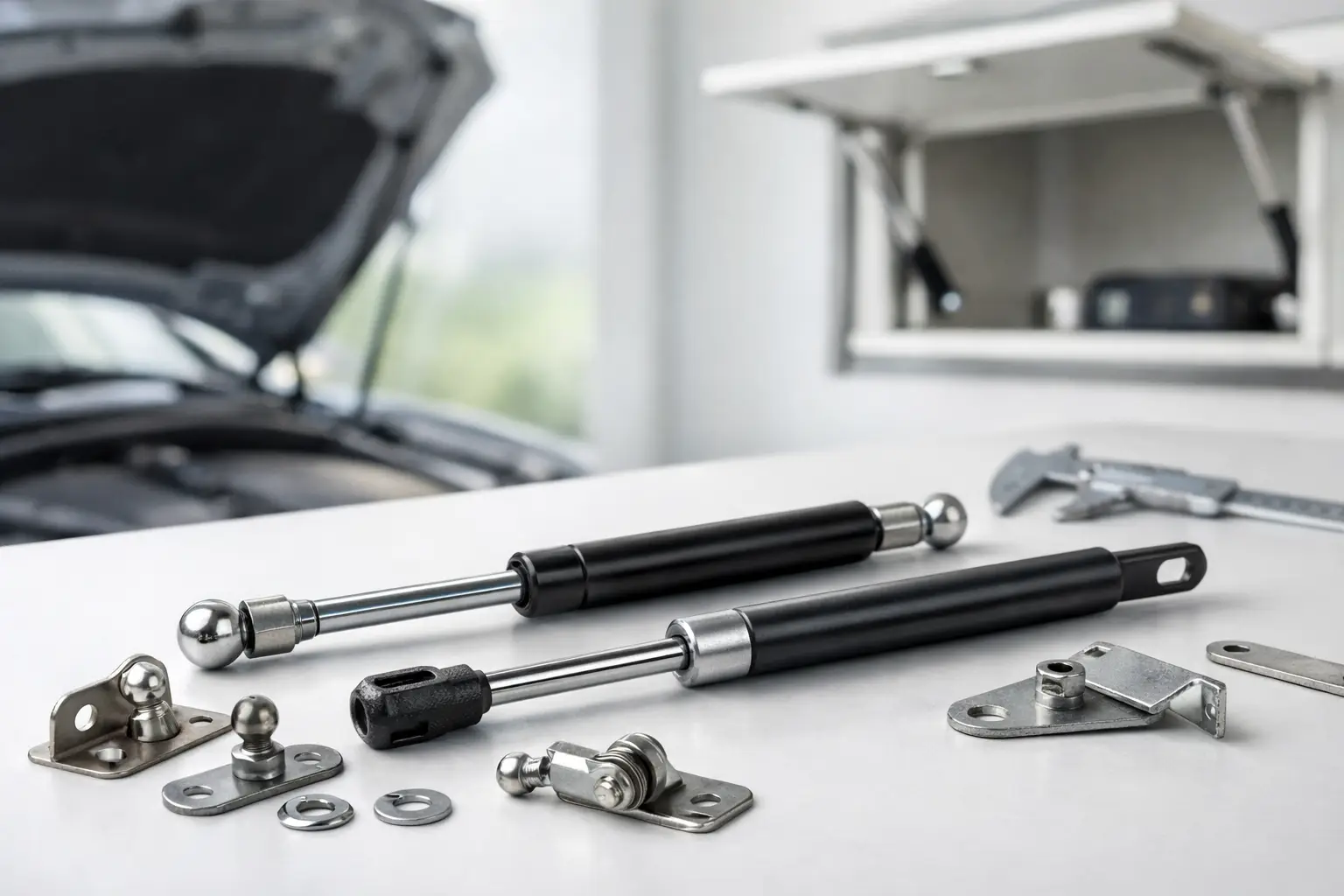
Ball sockets, eyelets, forks and clevis fittings are common, but sizes vary. Even if the strut body dimensions are correct, the wrong fitting can make installation impossible or create misalignment under load.
Understanding force in a gas strut buying guide
Force is usually measured in Newtons, shown as N on the strut body. This number tells you how strongly the strut pushes out. If the old strut still has a printed force rating, that is a good starting point. If it does not, or if the previous setup was not performing well, you need to work from the application.
Too little force and the panel will feel heavy, may not stay open, or may need manual lifting the whole way. Too much force and it can be difficult to close, place stress on hinges and mounts, or kick open too aggressively.
There is no single force that suits a given lid size because the result depends on weight, hinge position, mounting geometry and how many struts are being used. A long lightweight hatch can need less force than a shorter but heavily built lid. Two struts also do not always mean simply splitting the load in half without checking the mounting positions.
This is where buyers often benefit from specialist advice. If you can supply lid weight, overall dimensions, hinge location, and bracket positions, a supplier can usually narrow the correct force much more accurately than guessing from the old strut alone.
Matching by part number versus matching by specification
If the original part number is legible and the application is unchanged, matching by part number is often the fastest path. It reduces guesswork and is ideal for vehicle and machinery replacements where the original fitment is known.
But many struts arrive with faded markings, aftermarket substitutions, or no useful identification at all. In those cases, matching by specification is more reliable. That means measuring the strut, identifying the end fittings, and confirming the force if possible.
For custom applications, there may be no part number to match at all. Caravan conversions, custom toolboxes, fabricated storage systems and industrial builds are specification jobs from the start.
New installation or replacement – the buying approach changes
A replacement job is mainly about identifying what was fitted and whether it performed correctly. A new installation is about design.
For new installs, think beyond the strut itself. You need to consider bracket placement, opening angle, lid weight, centre of gravity and whether the strut is meant to lift, support, dampen, or all three. A badly positioned bracket can make a correctly rated strut feel wrong. The strut may be technically strong enough, but mounted in a way that gives poor leverage.
This is common on canopies, cabinets and service boxes. People often focus on force rating first, when geometry is the bigger issue.
Material and environment matter more than many buyers expect
Not every gas strut is going into a clean, dry workshop environment. Marine applications, agricultural equipment, mining gear and exposed trailers deal with moisture, dust, vibration and corrosion. In those conditions, material quality and sealing matter.
If the strut is working near salt spray, washdown areas or corrosive environments, standard hardware may not last as well as a more suitable option. The same applies to frequent-cycle industrial use where durability is not just about holding force but about long-term consistency.
Quality standards and construction details are worth paying attention to here. Buyers comparing on price alone often end up replacing budget struts sooner, especially where loads are high or the environment is harsh.
Common applications and where buyers get caught out
Automotive buyers often assume bonnet and boot struts are straightforward, but model variations and aftermarket accessories can change what is needed. A canopy window with added racks or a rear hatch with modified hardware may need something different from standard.
In caravans and campers, bed lifts, storage lids and external doors often fail because the strut has been overworked or underspecified from the start. Toolboxes are similar. A steel lid with rubber lining and internal trays is heavier than it looks.
For industrial and machinery use, speed of replacement matters, but so does safety. If a guard or access panel is part of servicing procedures, you need a dependable match, not a close-enough option. The same goes for marine hatches and agricultural equipment where a failed strut quickly becomes a usability problem.
What details to have ready before you order
The fastest way to get the right recommendation is to have the practical details sorted before making an enquiry. That usually means the extended and compressed length, end fitting type, force rating if visible, and clear photos of the existing strut and mounts. For a new application, include lid or panel weight, dimensions, hinge position, and where you intend to mount the strut.
Good photos help more than many buyers realise. A side view of the installation, a close shot of each end fitting, and a readable image of any markings can save a lot of back-and-forth.
If the job is urgent, accuracy still matters. Quick supply only helps if the part you receive actually fits and performs properly.
When custom gas struts make more sense
Sometimes there is no off-the-shelf answer, and forcing a standard part into a non-standard application creates more trouble than it solves. Custom gas struts are often the better option for modified vehicles, specialised machinery, fabricated enclosures and applications with unusual opening geometry or force requirements.
The advantage is not just fit. It is having the strut built around the job instead of compromising on length, force or fittings. For buyers managing fleets, workshops or repeated equipment builds, that can also make future replacements much easier.
One of the strengths of a specialist supplier such as Gas Struts is being able to handle both standard replacements and custom specification work without treating them as separate worlds. That matters when the application is specific and downtime is expensive.
A good gas strut purchase is rarely about finding something that looks close. It is about getting the length, force, fittings and application details working together so the result is safe, reliable and built for real use. If you are unsure, measure carefully, take clear photos, and ask the question before you order. It is the simplest way to avoid fitting the same problem twice.