A tailgate that will not stay up, a caravan hatch that drops unexpectedly, or a toolbox lid that needs two hands to lift usually points to one component: the gas strut. Gas springs are simple in principle, but selecting the wrong length, force or end fitting can leave an application unsafe, difficult to use or prone to premature failure.
For replacement work, the best result usually comes from matching the existing strut specifications exactly. For a new build or modified application, the strut must be selected around the lid, door or panel weight, its hinge position and the movement required. Getting those details right saves time, avoids rework and gives the user controlled, reliable operation.
What gas springs do
A gas spring is a sealed cylinder containing pressurised gas and oil. As the rod moves, the internal pressure provides an outward force that assists with lifting, holding or controlled lowering. In Australia, the terms gas spring and gas strut are often used interchangeably.
They are fitted wherever a heavy moving panel needs support without relying on manual effort alone. Common applications include ute canopies, tailgates, bonnet supports, caravan doors, camper hatches, horse floats, marine lockers, machinery guards, industrial cabinets, toolboxes and adjustable seating.
The purpose is not always to make a panel feel weightless. A correctly specified strut should provide useful assistance through the lift, hold the panel in the required open position, and allow it to close without excessive force. The right balance depends on the application.
Start with the existing strut specification
If you are replacing a failed unit, inspect the original strut before ordering. Many units have a force rating printed on the cylinder, expressed in Newtons, such as 400N, 650N or 1200N. This number is a major part of the specification, but it is not enough on its own.
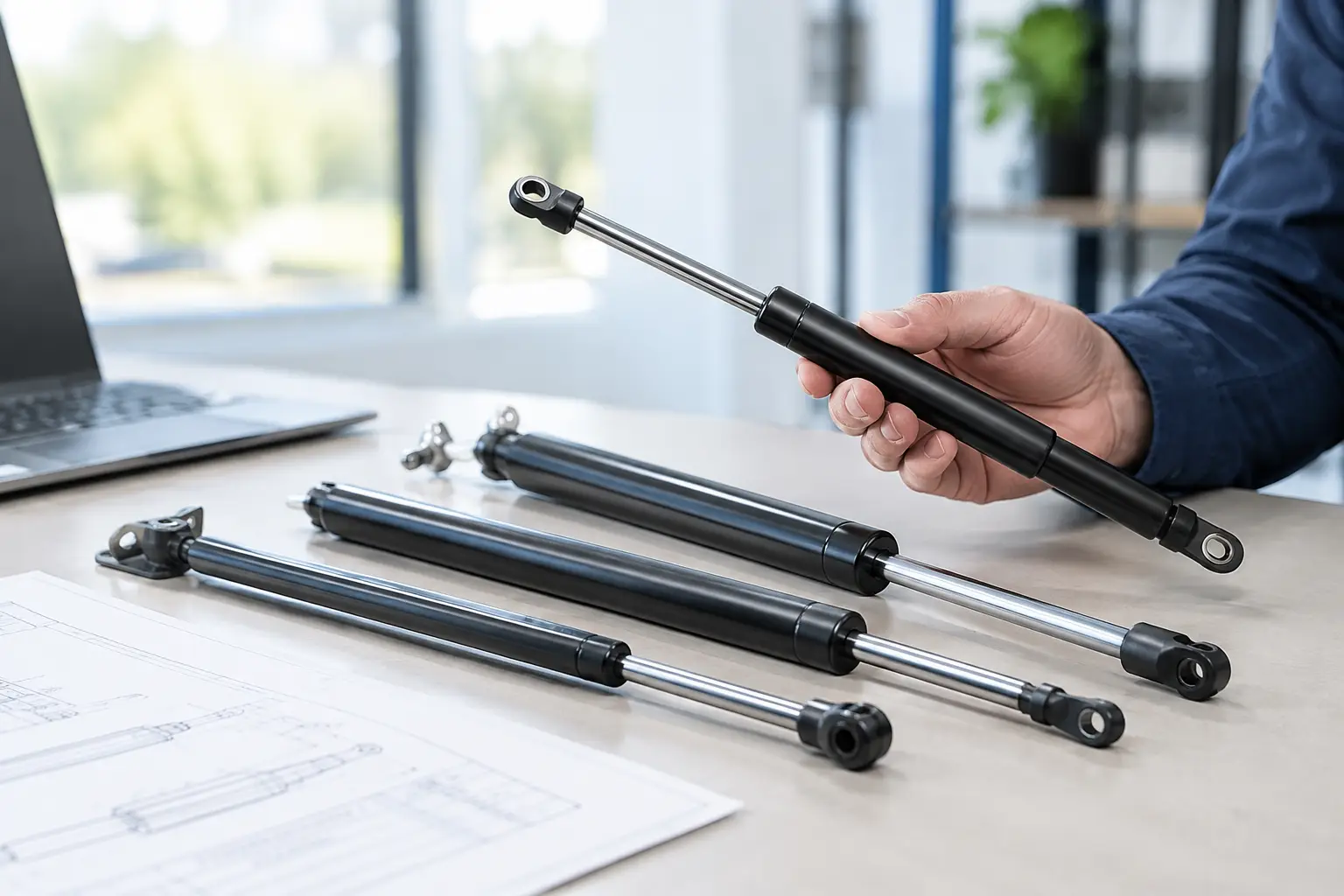
Measure the strut from the centre of one end fitting to the centre of the other when it is fully extended. Then measure the same points with the rod fully compressed. The difference between these measurements is the stroke. You also need the cylinder and rod diameter where possible, plus the type and size of each end fitting.
A replacement should match the original extended length, compressed length, stroke and force rating as closely as practical. Check whether the strut has ball sockets, eyelets, clevis ends, threaded ends or another fitting style. A strut with the correct force but unsuitable ends is not a direct replacement.
Take note of whether both ends use the same fitting. Some applications use different ends at the cylinder and rod side, particularly on machinery, cabinets and custom brackets. Clear measurements and photos of the mounting points make identification much quicker.
Do not assume two struts share the load equally
Paired struts commonly support a bonnet, hatch or wide toolbox lid. While each unit contributes to the overall lift, real-world loading is affected by hinge alignment, lid flex, mounting geometry and friction. Replacing only one weak strut can make the panel twist or lift unevenly.
Where struts work as a pair, replace both together with matching units. This provides even support and avoids placing unnecessary load on the new strut, hinges and mounting brackets.
Force rating is only part of the answer
Gas strut force is measured in Newtons, not kilograms. As a rough guide, 10N is close to 1kg of force, but this should not be treated as a direct conversion for selecting a strut. The actual force required changes with the mounting position and the angle of the panel as it opens.
A heavy lid may need a relatively modest strut if the mounting points provide good leverage. Conversely, a lighter panel may require a higher-force unit if the strut is mounted close to the hinge or must hold the panel at a difficult angle.
Over-specifying force is a common mistake. A strut that is too strong can make a door hard to close, strain hinges, bend mounting brackets or cause a lid to spring open too aggressively. A strut that is too weak may hold briefly when new but fail to support the load in wind, on uneven ground or after normal wear develops.
Temperature also matters. Gas pressure changes with ambient temperature, so a strut can feel firmer on a hot day and softer in cold conditions. For outdoor equipment, caravans, marine applications and exposed machinery, allow for the actual working environment rather than testing only in a sheltered workshop.
Mounting geometry determines performance
For new installations, the mounting position is as important as the strut itself. The lower and upper brackets control the leverage available throughout the opening movement. They also determine whether the strut reaches full extension before the lid is fully open, or bottoms out before the panel is closed.
A suitable design needs to answer several practical questions. How heavy is the moving panel? Where is its centre of gravity? What opening angle is required? Is there clearance for the cylinder, rod and end fittings throughout travel? Will the brackets and hinges handle the load over repeated cycles?
Most standard gas struts are best installed with the rod facing down when the panel is closed. This keeps internal oil around the rod seal and supports lubrication during normal operation. There are exceptions, including certain locking, damped or application-specific designs, so follow the product requirements where they differ.
Avoid side loading the rod. Gas struts are designed to work in line with their movement. Misaligned brackets, twisted mounts or a flexing panel can place lateral load on the rod and seals, shortening service life. Ball joints are useful where small changes in angle occur during opening and closing.
Allow for the full working environment
A gas spring on a clean cabinet indoors works under very different conditions to one on a trailer, mining plant or boat hatch. Dust, vibration, salt spray, high cycle use and impact all affect component choice.
For harsh or exposed applications, consider corrosion-resistant materials, suitable mounting hardware and protective placement. Do not allow the rod to be repeatedly struck, scratched or contaminated with abrasive material. Damage to the rod surface can quickly compromise the seal.
Signs a gas strut needs replacement
Loss of lifting force is the most obvious sign. The lid may drift down, fail to reach its normal open position or need manual support. This is not a repairable condition in a typical sealed strut. Once gas pressure has been lost, replacement is the practical solution.
Other warning signs include oil leakage, corrosion around the rod or cylinder, bent fittings, loose ball studs, damaged brackets and a rod that is scored or pitted. If a strut has been overloaded or forced beyond its intended travel, inspect the surrounding hinges and mounts as well. Fitting a new strut to damaged hardware can create the same problem again.
Never drill, heat, cut open or puncture a gas strut. It is pressurised and must be handled accordingly. Keep hands clear of pinch points while removing or installing units, support heavy panels before disconnecting the old strut, and confirm the new strut is fully secured to its mounts before testing.
When a custom gas strut is the better option
Standard replacements suit many vehicles, cabinets and equipment types. Custom gas springs are often the better choice when an application has unusual dimensions, a non-standard opening angle, modified accessories, heavier cladding or a specific holding requirement.
A canopy with added roof equipment, a fabricated toolbox, a machinery guard or a marine hatch may need more than a stronger off-the-shelf strut. Changing force without checking length and geometry can produce poor operation. A custom solution can match the required force, stroke, end fittings and mounting arrangement as a complete system.
For a quick and accurate recommendation, provide the extended and compressed measurements if replacing an existing unit, the force marking, photos of both mounting points, and details of the application. For a new design, include the panel dimensions, weight, hinge location, desired opening angle and available mounting space. This gives a strut specialist enough information to assess the setup rather than making a guess.
Gas Struts can help identify replacement units and specify custom options for demanding automotive, industrial, agricultural, marine and mobile equipment work. The goal is straightforward: a strut that fits correctly, carries the load it was designed for and keeps working when the equipment is needed.
Before ordering, take the extra few minutes to measure centre-to-centre lengths, confirm the Newton rating and inspect the fittings. Those details are the difference between a quick, dependable repair and a part that does not suit the job.