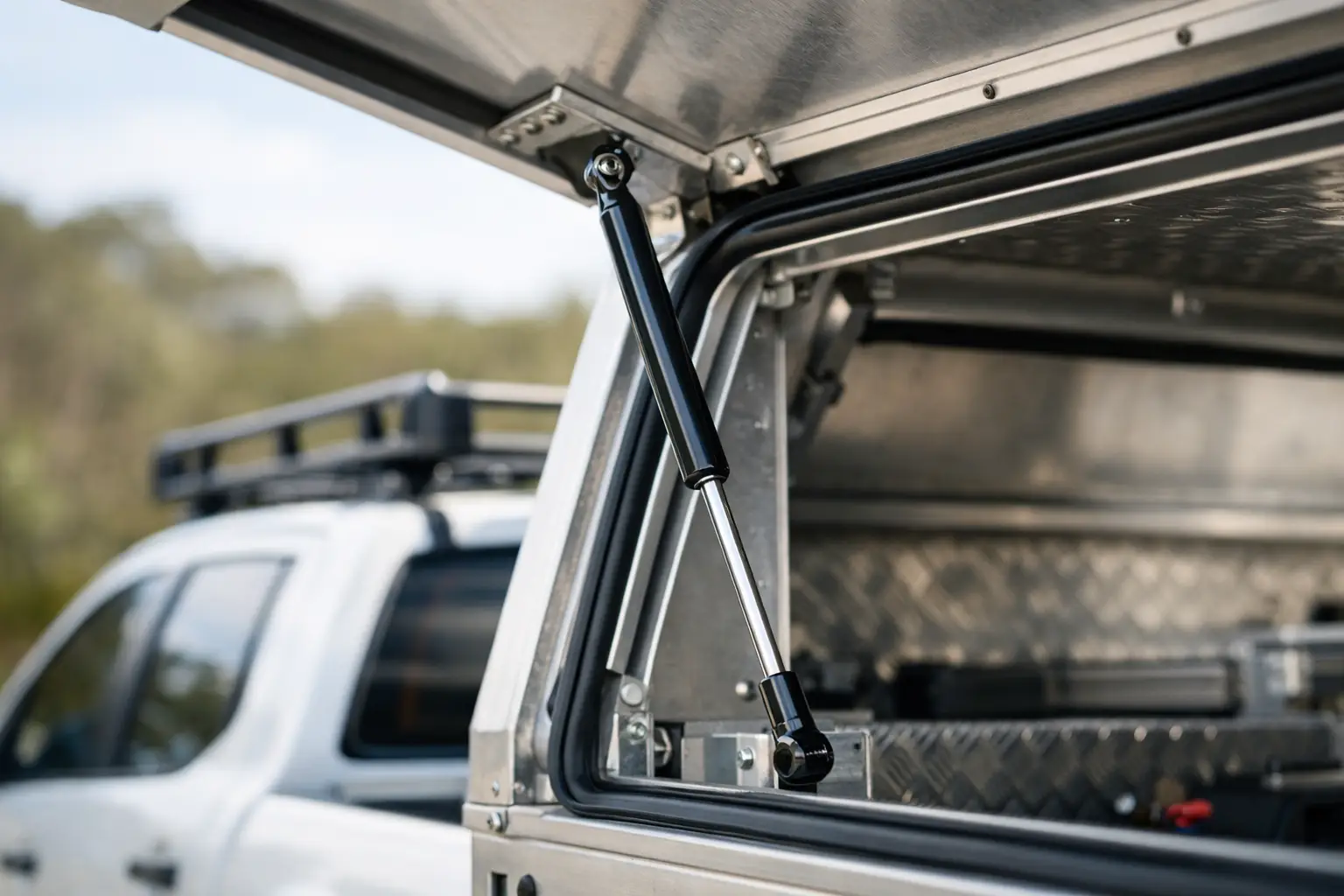
A canopy door that drops without warning is more than annoying. It slows the job down, puts hinges and mounts under extra strain, and can become a genuine safety issue when you are reaching into the back of the ute. That is usually the point where ute canopy petrol struts stop being an afterthought and become a part you need to get right.
Why ute canopy petrol struts matter
On most canopies, the petrol strut does two jobs at once. It helps lift the door or window and then holds it in a stable open position while you load tools, access stock or work out of the tray. When the strut force is correct, the panel opens with control and stays where it should. When it is not, everything feels wrong.
A weak strut makes the door heavy and unreliable. An overpowered strut can be just as frustrating, because it puts unnecessary load on the mounting points and can make the canopy hard to close. In some cases, the issue is not force at all. The extended length, compressed length or end fitting may be wrong, which changes how the panel travels and where it sits when open or shut.
That is why replacing like for like based only on appearance can be a mistake. Ute canopies vary widely in door size, frame material, hinge position and accessory weight. A glazed lift-up window on a recreational canopy has different requirements from a heavy alloy service body door carrying central locking hardware, racks or internal shelving.
The signs your petrol struts need replacement
Most failed struts show themselves pretty clearly in daily use. The canopy door no longer lifts smoothly, drifts down in wind, needs a shoulder to keep it open, or slams shut once the seal breaks. In some cases, one strut has failed and the other is still working, which twists the panel and puts uneven pressure on hinges.
Visible oil around the rod or body is another common sign. So is corrosion on the shaft, bent end fittings, or brackets that have started to oval out because the strut is no longer operating through the correct range. If the canopy has been modified since the original struts were fitted, the problem may not be wear alone. Added weight changes the force requirement, and a previously suitable strut can become under-rated.
Struts also lose performance over time from normal cycling and heat exposure. On vehicles that spend their life in the sun, on worksites, or on corrugated roads, service life can shorten. The failure may feel sudden, but in practice it is often gradual loss that only gets noticed once the panel becomes inconvenient or unsafe.
How to match ute canopy petrol struts properly
The right replacement starts with measurements and markings, not guesswork. If the old strut still has a part number or force rating printed on it, that is the easiest place to start. Force is usually shown in newtons, often as N. But that alone is not enough.
You also need the extended length from centre of fitting to centre of fitting, the compressed length, and the type of end connection used at each side. Ball sockets, eyelets, forks and angled brackets are all common, and a small difference can stop the strut fitting correctly even if the force is close.
The orientation matters too. Many petrol struts are designed to be installed with the rod facing down in the closed position. That helps with lubrication of the internal seal and can improve service life. If a canopy layout forces a different mounting orientation, it is worth checking whether the selected strut suits that application.
Force rating is not the whole story
A common mistake is to focus only on the newton rating. Higher force does not automatically mean better support. The effective lift depends on mounting geometry, hinge position, panel weight, and the angle of the strut through its travel. Two canopies with similar rear windows may need different struts because the brackets are mounted differently.
That is why technical advice can save time. In some jobs, matching the original part is fine. In others, especially where brackets have been relocated or accessories added, a proper application check is the better option.
Measure both sides of the installation
If one side has bent or worn, the geometry may no longer be identical. Measure both mounting points and inspect the brackets before ordering. A fresh pair of struts fitted to damaged hardware will not solve the underlying problem. If the canopy door has dropped out of alignment, fix that first.
When standard struts are enough and when custom is the better option
There are plenty of straightforward canopy replacements where a stocked strut is the right answer. If the original strut dimensions, fittings and force are known, and the canopy has not changed, a standard replacement usually gets the job done quickly.
But some setups need more than a shelf part. Tradespeople often add ladder racks, mesh guards, central locking, internal fit-outs or heavier doors. Fleet vehicles can have application-specific bodies with non-standard opening angles. Workshop builds and service bodies may use custom bracket locations to suit drawers, inverter systems or compressor installs.
In those cases, custom ute canopy petrol struts can be the practical fix rather than a last resort. A strut specialist can work from measurements, panel weights, mounting geometry and intended opening angle to supply a better-matched unit. That matters when the panel is heavy, frequently used or part of a safety-sensitive work setup.
Installation points that affect performance
Even a correct strut can perform poorly if the install is rushed. Worn ball studs, loose rivnuts, cracked fibreglass mounts or fatigued alloy brackets all affect how the load is carried. If the old strut has been forcing the panel for some time, inspect the canopy carefully before fitting new units.
Replace struts in pairs unless there is a very clear reason not to. A new strut on one side and a tired strut on the other usually leads to uneven loading and shortened service life. During installation, support the canopy door properly rather than relying on one remaining strut to hold it up.
Do not grip the rod with multigrips or mark the shaft during fitting. Damage to the rod surface can shorten seal life. Once fitted, cycle the panel several times and check that it opens fully, closes cleanly and does not bind through the stroke.
Choosing for work conditions, not just fitment
Canopy struts on a weekend touring setup live a different life from struts on a service ute opening twenty times a day. Dust, vibration, heat and washdown all affect durability. If the vehicle works in agriculture, mining, marine environments or high-corrosion areas, material quality and seal performance matter as much as dimensions.
That is where product quality stops being a sales line and starts affecting downtime. Cheap struts can look fine out of the box, then lose force early or corrode around the fittings. For trade and fleet use, it pays to source from a supplier that understands heavy-use applications and can back product quality with proper warranty support and technical guidance.
At Petrol Struts, that usually means helping customers confirm dimensions, force and hardware before they order, rather than sending out a best guess and hoping it fits. For busy operators, that reduces repeat freight, wasted labour and vehicles sitting idle with a canopy door tied shut.
What to have ready before you order
The fastest way to get the right strut is to gather the useful details upfront. A clear photo of the installed strut, the markings on the body, centre-to-centre measurements when open and closed, and photos of both end fittings will usually narrow things down quickly. If the old strut is completely dead or missing, a few photos of the canopy door and bracket positions help assess the geometry.
If the canopy has been modified, say so early. Extra weight from glass, shelving, roof systems or internal accessories changes the job. The more accurate the information, the better the fit the first time.
A good petrol strut should make the canopy feel controlled, balanced and predictable. That is what you notice every time the door opens without a fight and stays put while you work. If your current setup does anything else, it is worth fixing properly rather than putting up with it for another season.