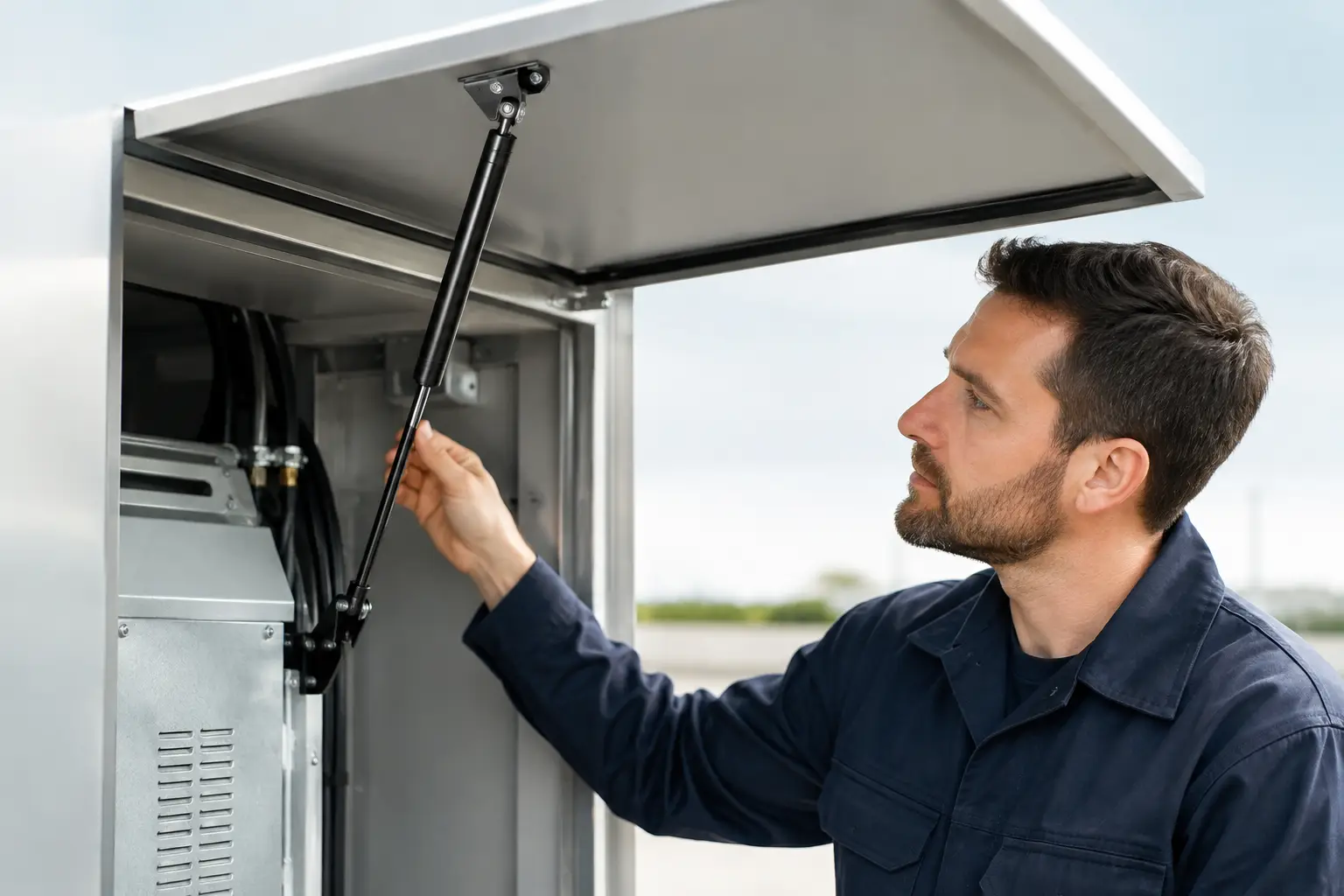
A door that drops halfway through a service job is more than an annoyance. On a toolbox, plant enclosure, generator cabinet or trailer compartment, it can damage hinges, interrupt access and create a genuine pinch hazard. If you are asking which struts suit equipment doors, the answer comes down to the door’s weight, geometry, mounting points and the way it needs to open – not simply the force printed on the old strut.
The correct gas strut should lift the door predictably, hold it securely at the required opening angle and close without excessive effort. Getting those basics right will also reduce stress on the door frame, hinges and mounting brackets.
Start with the door, not the old gas strut
An existing strut is useful as a reference, but it is not always the right specification. It may have been fitted as a compromise, could have lost force over time, or may be the wrong unit from an earlier repair. Before ordering a replacement, assess the equipment door itself.
Measure the door’s overall weight, including any fitted handles, locks, insulation, lining, racks or accessories. A light aluminium cover and a steel generator enclosure of the same dimensions need very different support. Also consider whether the door weight changes in service, such as a compartment door carrying mounted tools or a storage lid with added equipment.
Door geometry matters just as much as weight. A wide, shallow horizontal lid needs more lifting assistance than a narrow vertical access door, even if both weigh the same. The strut works through leverage. Where it mounts in relation to the hinge changes the force required and the opening action.
Measure the existing strut correctly
For a like-for-like replacement that has been working well, record the extended length, compressed length, stroke, force rating and end fittings. Measure centre to centre from one mounting point to the other, rather than from the end of the tube or rod.
The extended length is measured with the strut fully open. The compressed length is measured fully closed. The difference between them is the stroke. All three figures need to suit the available space and the door travel. A strut that is too long may prevent the door shutting. One with insufficient stroke may stop the door before it reaches the desired open position.
Force is normally shown in Newtons, marked as N, on the cylinder label. For example, a 400N strut provides roughly 40 kg of force at full extension, although this is not a direct lifting-capacity figure. Gas strut force acts at an angle and varies through the opening movement, so selecting by door weight alone is unreliable.
Take note of the fitting style as well. Common equipment-door fittings include ball sockets, eyelets, clevis ends, brackets and mounting plates. The mounting thread size and ball-stud diameter must match. If the fittings are worn, corroded or bent, replace them at the same time rather than fitting a new strut to poor hardware.
Choose the right force for the job
The most common equipment-door fault is a strut that no longer holds the door open. The temptation is to fit a much stronger replacement. That can create a different problem: excessive force can make the door difficult to close, pull on the hinges, flex thin sheet metal and put unnecessary load into the frame.
A correctly specified strut provides controlled assistance. It should hold the door open under normal conditions, including reasonable wind exposure where applicable, without launching the door at the start of travel. On a heavy machinery enclosure or a door opened frequently during a shift, smooth operation is as valuable as outright lifting force.
Temperature also affects performance. Gas struts lose some pressure in cold conditions and gain pressure in heat. Equipment used outdoors, in refrigerated areas, near engines or in remote Australian conditions should be selected with its real operating temperature in mind. A marginal strut may work in the workshop and struggle on a cold morning.
Where a door is especially heavy, wide or fitted with a long overhang, a pair of struts is often the sensible choice. Two units share the load and can support the door more evenly. They must be matched units with the same force and length. Mixing one new strut with one tired strut usually produces uneven operation and twists the door during opening.
Mounting position determines how the door behaves
Even the correct force rating will not perform properly if the mounting points are wrong. The position of the fixed bracket and door-side bracket determines the strut angle, leverage and final opening height.
For top-hinged equipment doors, the strut usually needs to be fitted so it delivers useful lifting force near the closed position, where the door is hardest to lift. As the door rises, the mounting geometry changes and the strut guides it towards the open position. Moving a bracket only a small distance can noticeably change the required force and opening angle.
A common installation orientation is cylinder uppermost when the door is closed, with the rod pointing down. This helps keep the internal seal lubricated and supports longer service life. There are exceptions for particular applications, so follow the requirements of the strut design and available installation space.
Allow clearance for the full movement of the strut, including ball sockets and brackets. Check that the body does not foul on internal shelving, wiring, door seals, latches or equipment inside the enclosure. On service bodies, toolboxes and mobile plant, also check that the door remains clear of adjacent panels and work areas when fully open.
When standard struts are suitable
Standard gas struts suit many equipment doors where the measurements, force and mounting style are known. They are commonly used on toolbox lids, cabinet doors, electrical enclosures, agricultural equipment covers, trailer compartments, marine lockers and access panels.
A direct replacement is appropriate when the existing door opens and closes correctly, the mounting points are sound and the original strut specifications are readable. Matching the extended length, compressed length, force and fittings will generally restore normal operation.
Standard units are also a practical option for new builds with straightforward, repeatable door layouts. If you are making several storage boxes or machinery covers to the same dimensions, one tested specification can be applied consistently across the build.
When equipment doors need custom struts
Custom gas struts are worth considering when a standard unit does not provide the right opening action. This is common with unusually large doors, thick insulated panels, doors with offset hinges, limited mounting space or installations where a precise opening height is needed.
A custom solution can match the required force, stroke, extended length and end fittings to the actual layout. It can also address practical requirements such as slow-release operation, locking in the extended position or controlled movement for a door used around personnel.
For industrial, mining, agricultural and marine equipment, correct specification is often cheaper than repeated replacement. A strut that is too weak may lead to damaged hinges or unsafe manual handling. One that is too strong can damage brackets, distort lightweight doors or cause latch problems over time.
Provide these details when requesting advice
A clear set of measurements speeds up selection and reduces the chance of an unsuitable part. Have the extended and compressed strut lengths, stroke, force marking and photos of both end fittings available. Include the door dimensions, estimated weight, hinge position, open angle and a photo showing the current mounting points.
For a new installation, provide the available mounting locations and note any clearance restrictions. If the door is used in high heat, salt air, dust, vibration or frequent cycles, say so. Those conditions affect the best hardware, fitting choice and strut specification.
Gas Struts can assist with standard replacements and application-specific options where the existing part number does not tell the full story. The goal is not merely to fit a strut that reaches between two points, but to fit one that works safely throughout the door’s travel.
Check the installation before putting it back into service
After fitting, open and close the door several times while supporting it by hand. It should lift smoothly, remain stable at the intended open position and close without requiring excessive force. Check that the brackets remain tight and the strut does not bind at either end of travel.
Never drill new mounting holes or increase strut force without considering the strength of the door skin and frame. Thin aluminium, fibreglass and light sheet-metal panels may need backing plates or reinforced brackets to carry the load properly.
The best equipment-door strut is the one that suits the complete installation: door weight, hinge geometry, opening angle, environment and mounting hardware. Measure carefully, replace worn fittings and treat questionable door movement as a specification issue rather than something to solve with the highest Newton rating available.