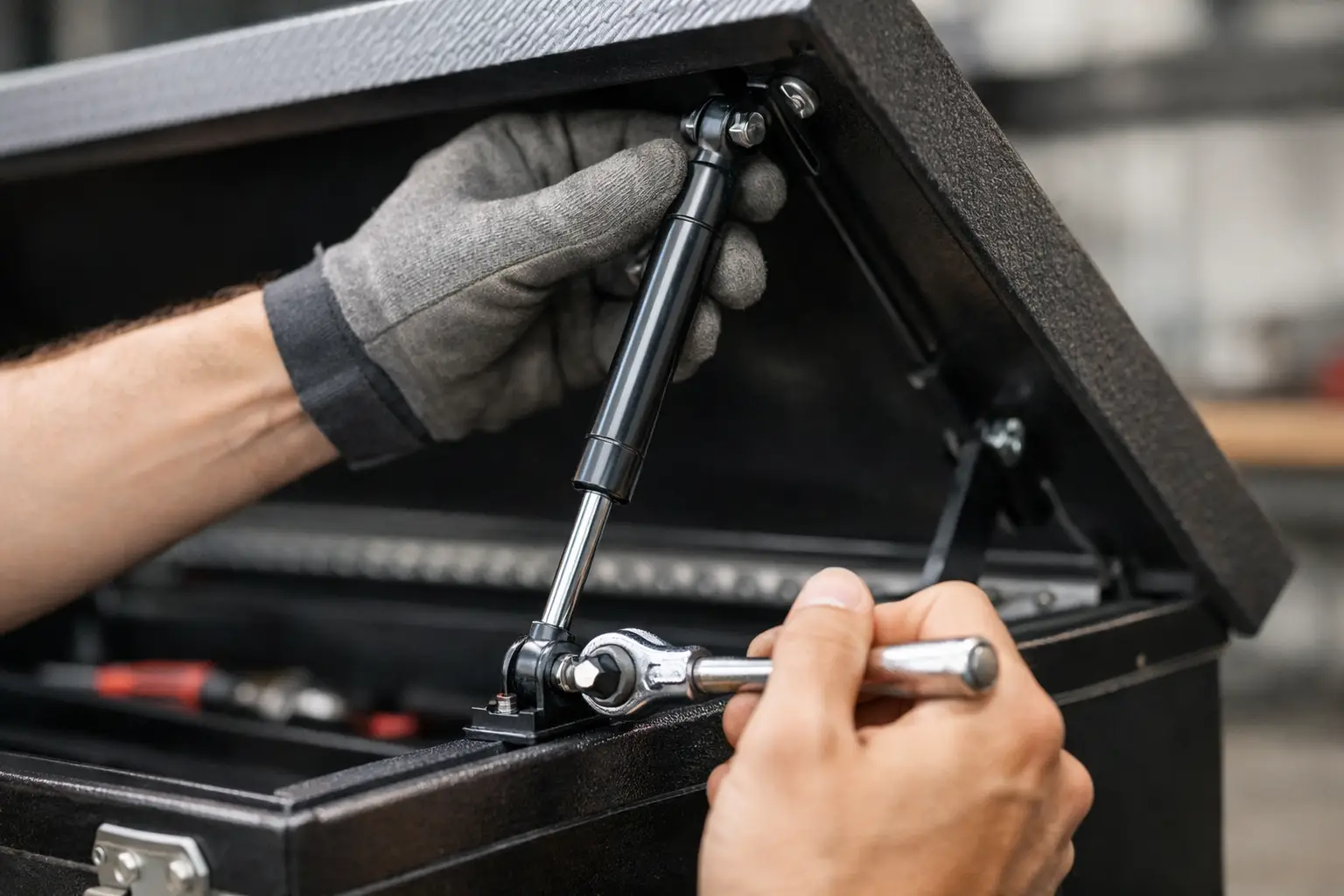
A toolbox lid that drops without warning is more than annoying – it is a hand injury waiting to happen. If you are working out how to fit toolbox struts, the job is not just about bolting on a pair of petrol struts and hoping for the best. Fitment, force, mounting position and lid weight all have to work together, otherwise the lid can bind, sit too high, refuse to stay shut or fly open too hard.
For ute toolboxes, trailer boxes, canopy compartments and workshop storage, the right strut setup makes access safer and faster. The wrong setup usually shows up straight away. You will feel it in the first few opens and closes.
What toolbox struts actually do
Toolbox struts support the lid through its opening arc and control how the weight behaves as it lifts and closes. A correctly fitted petrol strut reduces the effort needed to open the lid, helps hold it open at the right angle and limits sudden drop on the way down.
That sounds simple, but every toolbox is a bit different. A checker plate lid with no lining behaves differently from a heavy steel lid with seals, internal trays or added racks. Hinge position matters too. Even two boxes of similar size can need different strut lengths and force ratings.
Before you fit toolbox struts, check these basics
The first step in how to fit toolbox struts properly is confirming whether you are replacing an existing pair or setting up a new installation.
If you are replacing old struts, inspect the current setup before removing anything. Measure the extended length from centre to centre of the mounting points, check the end fitting style and note how the body and rod are oriented. If the old setup worked well, matching those dimensions will usually keep the geometry correct. If the old struts failed because the lid was too heavy or the opening angle was poor, it is worth reassessing the force and bracket positions rather than copying a bad setup.
For a fresh fit-out, you need four practical details: lid weight, lid dimensions, hinge position and the opening angle you want. These figures determine strut force and where the brackets should sit on the lid and the box body.
Measuring up for the correct strut
Good measurements save time. Poor measurements usually lead to lids that do not open fully or put too much load into the hinges.
Start by measuring the lid itself. Record the width, depth and approximate weight. If you cannot weigh the lid directly, estimate it as accurately as possible based on material and construction. A lightweight aluminium lid is one thing. A reinforced steel lid with carpet lining and hardware is another.
Next, measure from the hinge line to the point where you expect the strut to attach on the lid. Then measure the available space inside the toolbox when the lid is closed. This matters because the compressed strut must fit without bottoming out or fouling on internal trays, seals or stored gear.
You also need the open position. Most toolbox lids work well somewhere around 80 to 100 degrees, but there is no universal number. A shallower opening may suit a low-clearance installation under a canopy. A wider opening can make sense on a deep toolbox where access is the priority.
How to fit toolbox struts in the right position
Bracket location is what makes or breaks the job. The strut needs enough leverage to help lift the lid, but not so much that it overpowers the closing action.
In most toolbox applications, one bracket mounts to the fixed box body and the other to the underside of the lid. When closed, the strut should sit in a controlled, slightly compressed position. When open, it should be close to full extension without hitting its hard limit.
As a general rule, the body of the strut is usually mounted at the upper end and the rod at the lower end when the lid is closed. That orientation helps keep the internal seal lubricated and can improve service life. There are exceptions depending on space and bracket arrangement, but if you reverse the unit without a good reason, do not expect the best long-term result.
The mounting points must also allow the strut to move through the full arc without twisting. If the brackets are misaligned, the ball joints or eyelets can bind and wear prematurely. That side load is one of the more common causes of early failure.
Choosing the correct force
This is where many toolbox installs go wrong. People often assume stronger is better. It is not.
If the struts are overpowered, the lid may spring open aggressively, sit proud when shut or place unnecessary stress on the hinge and mounting points. If they are underpowered, the lid will still feel heavy and may not stay open safely. On a worksite or around a trailer, that is not a small issue.
Force is measured in Newtons. The right rating depends on lid weight, lid size, hinge geometry and where the strut brackets are mounted. Two 250N struts do not automatically suit every mid-sized toolbox. In some cases one strut is enough. In others, a pair is the only stable option, especially on wider lids where you want even support across the span.
If the box is used constantly, it is worth allowing for real-world use rather than just theoretical weight. Dust seals, added accessories and heavy daily cycles all affect how the lid behaves over time.
Fitting the struts step by step
Once you have the correct struts and brackets, support the lid securely before starting. Do not rely on one old strut, a loose prop or your shoulder while trying to line up fittings.
Fit the brackets first. Make sure the mounting surface is solid enough for the load. Thin sheet can need reinforcement, especially on larger lids. Fasteners should suit the material and application. Rivets may be fine in some lighter setups, but bolts with washers or backing plates are often the better option where repeated load is involved.
With the lid in the closed or near-closed position, clip or fasten the strut onto the brackets. Do not force it into place at an angle. If the strut is too short or too long to line up cleanly, stop and recheck the geometry. Forcing it will only mask a fitment issue.
Open the lid slowly and watch the strut travel. It should move freely through the arc, with no contact against toolbox walls, seals, drawer systems or stored equipment. Then close it again and confirm the lid seats properly without needing excessive pressure.
If you are fitting a pair, install both sides symmetrically. Uneven bracket placement can rack the lid, create hinge stress and make the opening feel rough.
Common fitment problems and what causes them
A lid that will not stay shut usually points to too much force, poor bracket position or a strut that is too long in the closed position. A lid that opens only part way can mean the extended length is too short or the lid-side bracket is mounted too close to the hinge.
If the lid feels heavy at the start of the lift but easier near the top, the geometry may be giving you poor initial leverage. Moving the mounting point can change that. If the lid twists during opening, one side may be mounted out of line or the lid itself may need two struts instead of one.
Noise, binding or jerky movement usually means misalignment, worn brackets or interference somewhere in the opening path. Petrol struts should operate smoothly. If they do not, something is off in the setup.
Replacement jobs versus new installations
Replacement is normally simpler if the original system was correct. Match the extended length, compressed length, end fittings and force rating as closely as possible. Check bracket wear while you are there. There is no point fitting new struts onto loose or cracked mounts.
New installations take more planning because there is no proven geometry to copy. This is where technical advice matters. A toolbox with unusual dimensions, a thick lid or limited internal clearance may need a custom approach rather than an off-the-shelf guess.
That is especially true for tradespeople who rely on the box every day. A cheap mismatch can cost more in downtime and frustration than getting the correct strut from the start.
When to ask for help
If you know the lid weight, dimensions, hinge type and the opening angle you want, a strut specialist can usually narrow the options quickly. If you do not know the weight, photos and measurements of the toolbox and current bracket positions can still help.
For unusual setups, including side-opening boxes, oversized lids or custom canopies, it is often better to get fitment guidance before drilling anything. Suppliers such as Petrol Struts deal with these applications every day, and that can save a lot of trial and error.
A toolbox lid should open cleanly, stay where it is meant to stay and close without a fight. If it does not, the answer is usually not a stronger strut – it is a better fit.