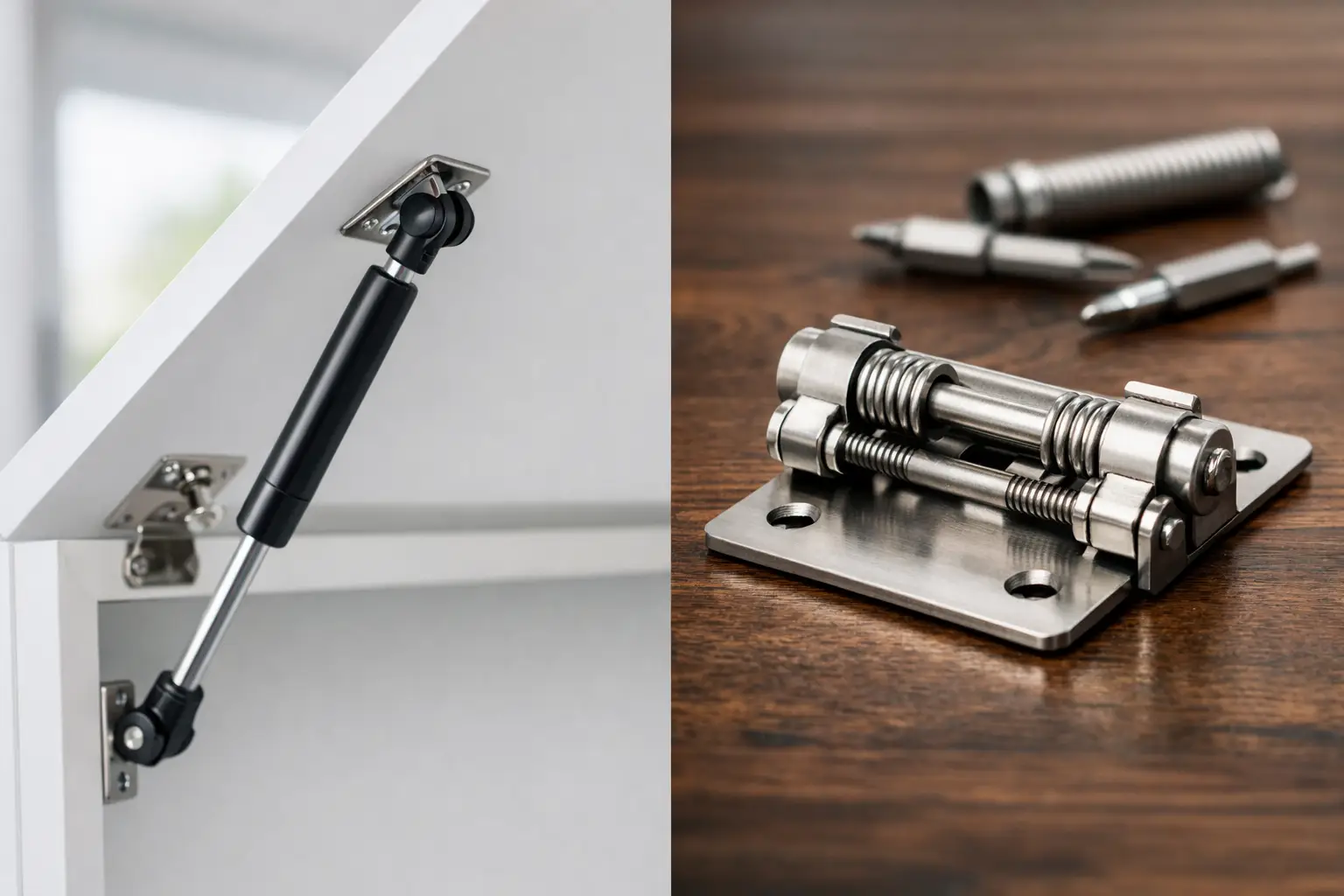
A toolbox lid that slams shut or a hatch that will not stay open is not just annoying – it is a safety and usability problem. When people compare petrol struts vs spring hinges, they are usually trying to solve one of two issues: they either need controlled lift and hold-open support, or they need a simple hinge mechanism that helps a panel return to position. The right choice depends less on price alone and more on load, movement, access, and how the part will be used in the real world.
Petrol struts vs spring hinges: the basic difference
Petrol struts are motion-control components. They use compressed petrol to assist lifting, slow movement, and hold a lid, hatch or panel in an open position. In practical terms, they do more than connect two surfaces – they help manage weight and movement.
Spring hinges are different. They are still hinges first, with a spring built in to provide return force or resistance through the arc of movement. They are commonly used where a door, flap or panel needs to self-close or maintain tension, but they do not usually provide the same controlled lift support or open-position holding that a petrol strut does.
That distinction matters. If the application involves a heavy canopy window, caravan bed base, machinery cover or marine hatch, a spring hinge on its own is often not enough. If the application is a lighter door or access flap that simply needs closing tension, a petrol strut may be unnecessary.
Where petrol struts make more sense
Petrol struts are generally the better option when the panel has noticeable weight, the opening arc needs control, or the user needs both hands free once the panel is open. That is why they are widely used on ute canopies, trailers, engine covers, storage compartments, seating bases and industrial enclosures.
The main advantage is controlled motion. A properly specified petrol strut helps lift the load, resists sudden dropping and supports the panel at the top of travel. That improves safety, especially on heavier lids or in commercial settings where the same compartment is opened repeatedly throughout the day.
They also allow more precise tuning. Force rating, extended length, compressed length, stroke, end fittings and mounting position all affect how the panel behaves. This is useful when the load is awkward, the opening angle is limited, or the available mounting space is tight.
In harsh environments, that control becomes even more valuable. On work vehicles, agricultural equipment, marine fit-outs and mining applications, vibration and frequent use can expose the limits of basic hinge hardware fairly quickly.
Where spring hinges are the better fit
Spring hinges suit simpler jobs. If you need a panel or door to return toward closed without relying on manual effort every time, they can be an effective and compact solution. They are often used on lighter cabinetry, small access doors, gates, and utility compartments where a closing action matters more than assisted opening.
They also have fewer variables than petrol struts. In the right application, that can mean easier selection and less concern about force matching. You are not trying to calculate lift assistance against panel weight in the same way.
That said, simplicity can be a limitation. A spring hinge does not usually slow a heavy lid through its travel, and it will not hold a hatch open the way a petrol strut can. If the goal is safe access to a storage area, service bay or overhead opening, spring tension alone may leave the user still supporting the load by hand.
Load, control and safety
This is where the petrol struts vs spring hinges comparison becomes practical rather than theoretical. Think about what happens during opening and closing, not just at rest.
A spring hinge applies tension through rotation, but it does not necessarily counterbalance a heavy panel well across the full range of motion. Depending on geometry, the force may feel different at different points of travel, and on heavier lids it can still allow quick or uneven closing.
A petrol strut, when correctly sized and mounted, is designed to work with that geometry. It can provide a more useful force curve through the lift cycle and reduce the effort needed to open the panel. More importantly, it can stop the panel from dropping sharply.
For workshops, service vehicles and industrial equipment, that safety factor should not be treated as an extra. If a lid opens above head height or covers tools, batteries, pumps or service points, controlled support is usually the safer option.
Installation and space considerations
Spring hinges can be attractive because they are compact and mechanically straightforward. If the panel already needs a hinge and there is limited room for extra hardware, they may fit the layout more easily.
Petrol struts need space to operate. You have to account for extended length, compressed length, stroke and bracket positions. Mounting geometry is critical. A strut with the right force but the wrong mounting points can perform poorly, over-centre, or fail to hold the load open at the required angle.
This is one reason strut selection should be based on measurements, not guesswork. Panel weight, hinge position, centre of gravity, required opening angle and available fixing points all matter. On custom builds and replacements where the original part is missing, technical advice saves time and avoids ordering a unit that is close, but not correct.
Maintenance, durability and replacement cycles
Neither option is immune to wear. Spring hinges can lose tension over time, especially in high-cycle or corrosive environments. Hinges also carry rotational load directly, so if alignment shifts or mounting points wear, performance drops.
Petrol struts are wear items too. Seals age, pressure declines and lift assistance reduces over time. The difference is that failure is often easier to identify in use. If a hatch no longer stays up or the opening effort has clearly increased, the strut is usually the part to replace.
For demanding applications, build quality matters. Cheap hardware may fit initially but perform poorly under repeated use, vibration, dust or moisture. In trade and fleet settings, downtime and call-backs cost more than the part itself, so it makes sense to choose components built for regular service rather than occasional domestic use.
Cost: cheaper upfront is not always cheaper overall
Spring hinges are often less expensive to buy, and for light-duty jobs that may be the correct decision. If the panel is small, the movement is simple and open-position support is not required, there is no point overcomplicating the setup.
But on heavier lids, replacing proper lift support with a cheaper hinge solution can create other costs. You may end up with difficult access, user fatigue, damaged lids, bent mounting points or avoidable safety risks. In some cases, people fit stronger spring hinges to compensate, only to find the panel still behaves poorly because the mechanism is not designed for controlled support.
A petrol strut system usually costs more than a basic hinge, but it can deliver better function, safer operation and less stress on the rest of the assembly. That is particularly relevant for commercial vehicles, caravans, trailers and industrial equipment where the hardware gets used often and failure is more than a minor inconvenience.
How to choose between petrol struts and spring hinges
Start with the application, not the part name. Ask what the panel needs to do. If it must lift smoothly, stay open reliably and close under control, petrol struts are generally the right direction. If it simply needs a return action on a lighter door or flap, spring hinges may be enough.
Then look at the load and layout. Heavy horizontal lids, overhead hatches and access covers usually benefit from petrol struts. Light vertical doors and simple closures often suit spring hinges better. There are also jobs where both are used together – a hinge for pivot and a strut for assistance and hold-open control.
Finally, think about who is using it and how often. A once-a-month cabinet access panel has different demands from a toolbox on a service ute or a machinery cover opened several times a shift. Frequency of use, environment and risk level should influence the choice.
If you are replacing an existing part, match the original function before you match the hardware style. If the old setup used petrol struts, there was usually a reason. If you are designing from scratch, accurate measurements and application details will point you to the safer and more reliable option.
Good hardware should make the job easier, not create a workaround. When the panel is heavy, awkward or used every day, getting the support system right pays off every time it opens.