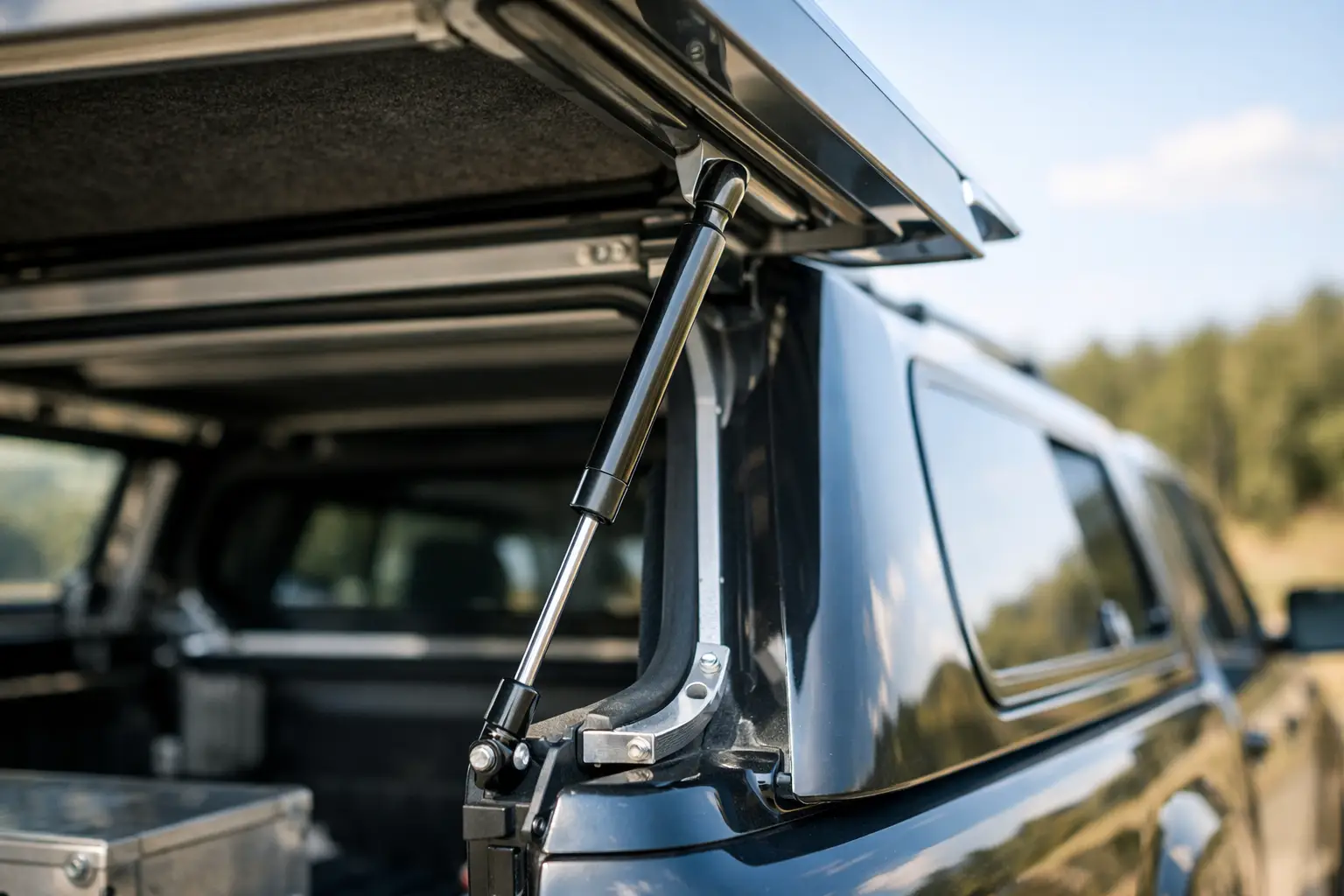
A canopy door that drops without warning is more than an annoyance. On a work ute, it slows access, risks damage to tools and can turn a simple grab-and-go job into a safety issue. That is why choosing the right petrol struts for ute canopies matters – not just for lift assistance, but for reliable daily use in dust, heat, corrugations and constant opening cycles.
Not all canopy struts fail for the same reason, and not all replacements should match what came off the vehicle without question. In plenty of cases, the original strut was under-specced, the canopy weight changed after fit-out, or the mounting geometry was never quite right. If you want the lid or side door to open cleanly, stay up properly and close without a fight, the details matter.
What petrol struts do on a ute canopy
Petrol struts support the weight of a canopy door, hatch or window through its opening and closing movement. They reduce the effort needed to lift the panel, control the motion and hold it in the open position. On side-opening doors and rear hatches, they also help prevent sudden drop-off once the panel passes its balance point.
On a ute canopy, the working environment is usually harder than on a passenger vehicle. There is vibration, dust ingress, weather exposure and frequent loading around the mounting area. Add ladder racks, roof loads, shelving or internal fit-outs, and the way a door opens can change significantly. That is why canopy applications often need closer attention to strut force, stroke and end fittings than people expect.
How to choose petrol struts for ute canopies
The first thing to check is whether you are replacing like-for-like or correcting a problem. If the existing struts worked well for years and the only issue is loss of pressure, matching the original specifications is often the right move. But if the canopy door never stayed up in wind, needed two hands to close, or twisted under load, copying the old strut may just repeat the same fault.
Start with the key measurements. Extended length is the distance from centre of one mounting point to the centre of the other when the strut is fully open. Compressed length is the same measurement when closed. Stroke is the difference between those two. These figures affect both opening angle and whether the strut will fit without bottoming out or overextending.
Force is the next major factor, usually measured in Newtons. Too little force and the canopy door will sag, especially when loaded with central locking hardware, internal trim or a heavier glass panel. Too much force and the door may spring open too aggressively, place unnecessary load on hinges, or become difficult to shut. On dual-strut canopy doors, the total support comes from both struts together, so each unit must be selected with the pair in mind.
Mounting position also changes performance. A strut fitted a few millimetres differently can alter leverage enough to affect opening effort and holding force. That is one reason a strut with the same length and force as another application is not always a true match.
Common signs your canopy struts are wrong or worn
When petrol struts are at the end of service life, the symptoms are usually obvious. The hatch drops in cool weather, the side door no longer reaches full height, or the panel slowly creeps down while you are working out of the canopy. Oil mist around the rod seal, visible corrosion, bent rods and damaged end fittings are all signs replacement is overdue.
There are also signs the strut specification is wrong rather than simply worn out. If a new set makes the panel hard to latch, pushes the door out of alignment, or opens with excessive force, the Newton rating or geometry is likely off. The same applies when one side carries more load than the other and the door twists during movement.
In trade and fleet use, these issues are not minor. Repeated shock loading can damage brackets, crack fibreglass mounting areas and shorten hinge life. Replacing failed struts without checking the surrounding hardware can leave the same problem waiting to happen again.
Measuring petrol struts for ute canopies properly
If there is a part number on the old strut, that is the easiest starting point. Even then, it is worth confirming the measurements and end fittings before ordering. Labels fade, previous replacements may have been incorrect, and some imported canopies use non-standard fittings.
Measure the strut centre-to-centre in both open and closed positions if possible. Check the diameter of the rod and tube, note the style of end fitting, and look at how the brackets are mounted. Ball sockets, eyelets, forks and angled ends are not interchangeable in every setup. You should also check whether the strut is fitted rod-down in the closed position, which is generally preferred for seal lubrication and service life.
If the old strut is missing or the canopy has been modified, the best approach is to measure the door size, estimate or weigh the panel, and record the bracket positions. Photos of the open and closed arrangement help identify geometry issues quickly. For custom applications, that information makes the difference between a close guess and a strut that actually works.
Standard replacement or custom struts?
A standard replacement suits many ute canopies, especially where the canopy brand and door layout are common and unchanged. If the original setup was sound, a quality direct replacement is usually the fastest fix. This is often the case for rear lift-up glass, side access doors and service body compartments.
Custom struts are the better option when the canopy has been altered, the door material is heavier than standard, or the application has a known weakness. Aluminium canopies with added racks, toolboards or dual-skin doors can end up outside the range of an off-the-shelf match. The same goes for older canopies where brackets have shifted or replacement hardware is no longer available.
This is where specialist support matters. A supplier that deals with automotive and industrial applications every day can assess whether you need a simple replacement, a revised force rating or a full custom setup. That saves time, avoids trial-and-error ordering and reduces the risk of damaging the canopy through poor fitment.
Why quality matters on working vehicles
Ute canopies live a harder life than many strut applications. Heat cycling, coastal air, red dust, washdowns and rough roads all work against seals and moving parts. Cheap struts can look the same on the shelf, but poor seal quality, inconsistent force and weaker finish tend to show up quickly in service.
For workshop operators, tradies and fleet managers, the cost of a failed canopy strut is rarely just the part itself. It is downtime, call-backs, damaged hinges, interrupted jobs and avoidable safety risk. Better struts last longer, operate more consistently and are less likely to lose pressure early.
It is also worth checking the broader quality picture – manufacturing standards, warranty backing and whether the supplier can support both standard and custom requirements. A dependable supplier should be able to help with technical selection, not just dispatch a box.
When installation details make the difference
Even the correct strut can perform badly if installed poorly. Worn ball studs, loose brackets and misaligned mounts can create side load on the rod, which shortens seal life. Over-tightened hardware or a bracket mounted on thin unsupported panel material can also lead to failure under repeated use.
If you are replacing both struts on a canopy door, replace them as a pair. Mixing an old weak unit with a new one often causes uneven lift and panel twist. Check hinge condition while you are there, because a stiff or sagging hinge changes the load on the strut and can make a good part look faulty.
Where fitment is uncertain, getting advice before ordering is the better move. Petrol Struts supports both replacement and custom enquiries, which is useful when the canopy setup is non-standard or the original markings are gone.
What to have ready before you order
The fastest way to get the right result is to supply clear details from the start. A part number is ideal, but measurements, photos, end fitting type and canopy make are often enough to identify a match. If the door has been modified, mention any added weight such as internal lining, shelving, glass, central locking or external racks.
If you are dealing with a fleet or multiple canopies, it helps to confirm whether all vehicles use the same strut and bracket arrangement. Small production changes between model years can matter. Taking the time to verify one unit properly usually saves rework across the rest.
A good canopy strut should do its job quietly and consistently. You should not have to prop the door with your shoulder, wrestle it shut, or wonder whether it will stay up over your head. Get the measurements right, be honest about the load, and choose quality over guesswork. That is usually the difference between another short-term fix and a canopy that works properly every day.