
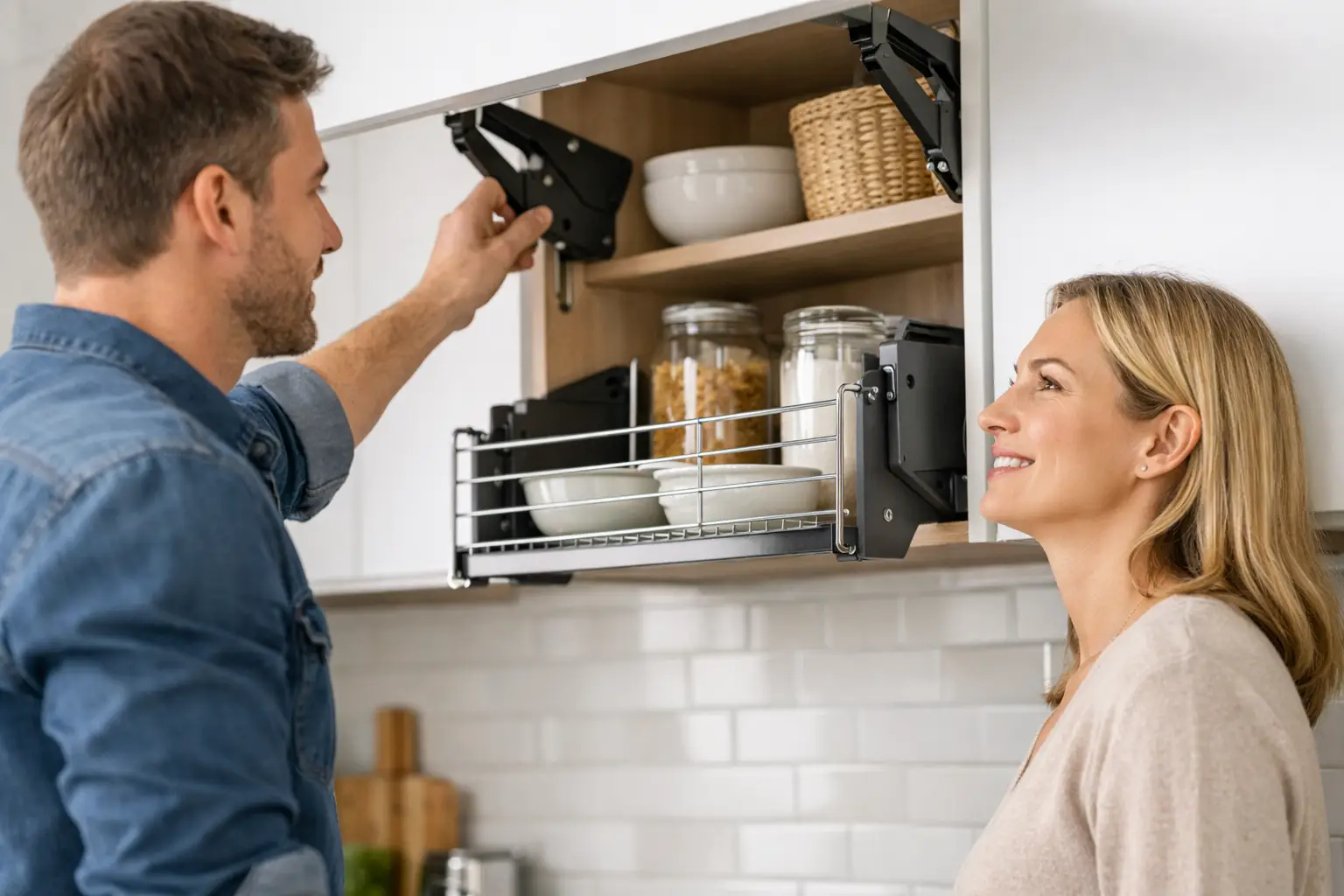
An overhead cabinet door that drops, will not stay open, or needs two hands to hold is more than an inconvenience. On a work vehicle, caravan, site box or workshop cabinet, it creates a genuine pinch and head-strike risk. Knowing how to install cabinet lifts starts with selecting the right gas strut and mounting geometry – not drilling the first bracket into the cabinet.
This guide covers gas strut cabinet lifts for upward-opening doors, lids and access panels. If you are fitting a powered actuator, scissor hinge or counterweight mechanism, its mounting requirements will differ. The same principle still applies: confirm the load, travel and mounting positions before installation.
Start with the door, not the old strut
A replacement strut is only correct if it suits the cabinet door and its movement. Matching the old strut by appearance alone can cause problems, particularly where a previous installation was poorly specified. A strut that is too strong can bend hinges, distort light cabinet frames and make the door difficult to close. One that is too weak will not hold the door safely at full opening.
First check that the hinges are sound and the door opens freely through its full arc. Gas struts support the door; they do not repair worn hinges, loose screws or a twisted lid. Tighten hinge fasteners, inspect the cabinet substrate and make sure the door does not foul a shelf, frame or weather seal.
Measure the door height and width, its approximate weight including handles, locks and lining, and the opening angle required. Record the existing strut’s extended length, compressed length, rod diameter, cylinder diameter, end fittings and force rating in newtons, shown as N. Also identify where each fitting sits: one mount is on the fixed cabinet body and the other is on the moving door.
For a new installation, these details are needed to calculate a suitable force and position:
- door or lid weight, including added hardware
- hinge type, hinge position and desired opening angle
- available fixing area on the cabinet and door
- distance from the hinge to each proposed mounting point
- whether one or two struts will be fitted
- the available clearance when the door is fully closed and fully open.
Two struts are generally the better choice for wider or heavier doors. They share the load, reduce twist across the panel and give more consistent opening. A narrow, light door may only require one, provided the hinges and mounting structure are strong enough.
Choose mounting hardware that suits the cabinet
Most cabinet lift gas struts use ball joints and ball studs, although eye ends, clevis ends and brackets are also available. The end fitting must match the strut connection and provide enough movement through the full door arc. A ball joint is useful because it accommodates changing angles as the door opens.
The bracket is only as secure as the material behind it. Solid timber, steel frames and reinforced aluminium sections provide reliable fixing points. Thin particleboard, unreinforced sheet metal and lightweight caravan cabinetry may need a backing plate, spreader plate or purpose-made mounting bracket. Do not rely on short screws driven into a thin panel where a loaded door can pull directly against them.
Use corrosion-resistant hardware where moisture, wash-down, marine air or outdoor exposure is likely. In mobile applications such as caravans, trailers and service bodies, allow for vibration as well as the static door weight. Nylock nuts, washers and correctly sized bolts are often a better long-term option than screws alone.
How to install cabinet lifts step by step
Before fitting any hardware, support the door at the intended open height with a prop, adjustable stand or a second person. Never use the gas strut itself as the temporary support while you are working out its mounting position.
Mark the closed and open positions
With the door closed, hold the strut or use a layout template to confirm it will fit without bottoming out. A gas strut must not be fully compressed before the door reaches its closed position. Leave a small compression margin so the internal components are not used as a hard stop.
Then move the door to the required open angle and check the extended length. The strut should not reach full extension before the hinge or a separate mechanical stop limits the door. A fully extended strut should not be the only stop for a heavy cabinet door, as repeated impact loading can shorten its service life.
The mounting geometry must also provide useful leverage. Fitting the strut too close to the hinge reduces its lifting effect and often demands excessive force. Fitting it too far away can cause binding, over-extension or a door that springs open aggressively. Manufacturer drawings or application-specific advice are worth using here, particularly for heavy lids and non-standard hinge layouts.
Fit the cabinet-side bracket first
Mark the fixed-side bracket location, check for wiring, plumbing and internal shelves, then drill suitable pilot holes or bolt holes. Position any backing plate before fastening the bracket. Tighten the hardware firmly, but avoid crushing timber or stripping threads in aluminium.
If the cabinet is mounted in a vehicle, trailer or machinery enclosure, check the rear of the panel before drilling. Hidden wiring, insulation, fuel lines and structural members are common issues. A few minutes of inspection avoids an expensive repair.
Fit the door-side bracket with the door supported
Set the door at the planned angle and mark the moving-side fitting position. Confirm that the bracket will clear the hinge, handle, latch and surrounding frame throughout travel. Fasten it into reinforced material wherever possible.
For twin struts, measure from a common reference point so both sides are installed symmetrically. Uneven positions can make the door rack, placing extra stress on hinges and causing one strut to carry more load than the other.
Attach the gas strut in the correct orientation
Where the application allows it, fit a standard gas strut with the rod pointing down when the door is closed. This helps keep the internal seal lubricated and supports long service life. Some applications require another orientation due to space or motion constraints, so always follow the strut supplier’s specification where it differs.
With ball-socket fittings, press the socket squarely over the ball stud until it clicks into place. Do not lever hard against the rod, scratch the polished rod surface or grip it with multigrips. Damage to the rod can compromise the seal and lead to early failure.
Keep any retaining clips correctly seated. If clips were removed during installation, refit them after the socket is fully engaged. They stop the fitting from releasing during operation.
Test slowly before putting the cabinet into service
Remove the temporary support while holding the door securely. Open and close it several times, slowly at first. Check that it closes without excessive force, stays open at the required angle and does not hit the cabinet, roof lining or adjacent equipment.
Look for side loading, where the strut is being forced sideways rather than pivoting freely at both ends. Side loading wears fittings and can bend brackets. Also check that the strut does not bottom out at closure or top out before the door reaches its stop.
Common cabinet lift installation faults
The most common fault is assuming more force is safer. It is not. An over-rated gas strut can make a door hard to shut and place constant load on the hinge line. This is especially problematic with lightweight caravan cabinetry and thin aluminium hatches.
Another issue is fitting a new strut to a door with no positive stop. The gas strut should assist and hold the door, not absorb the full force of the door at the end of every opening cycle. Add or retain suitable mechanical stops where required.
Uneven twin-strut placement is also easy to miss. If one strut begins working before the other, the door can twist and eventually loosen its mounts. Recheck measurements, fastener tightness and hinge alignment if the door does not rise evenly.
Finally, do not release gas pressure, heat, drill or dismantle a gas strut. It is a pressurised component and should be replaced if damaged, leaking, bent or no longer holding its rated load.
When a standard strut is not enough
A standard cabinet lift works well for many overhead doors, but some applications need a more specific setup. Heavy steel lids, unusually deep doors, angled cabinet fronts, high-cycle workshop storage and mobile equipment can require custom force ratings, extension lengths or specialised brackets. Temperature also matters: gas strut force changes between cold mornings and hot enclosed vehicle interiors.
If you are unsure, provide the door weight, hinge-to-mount measurements, opening angle, available space and photos of the installation area to a strut specialist. Gas Struts can help identify a suitable replacement or develop a practical arrangement for a non-standard cabinet application.
A correctly fitted cabinet lift should feel controlled rather than dramatic: the door opens without a sudden jump, remains safely where you need it, and closes without fighting the latch. That balance is the sign that the strut force, mounting points and cabinet structure are working together.