A seat base that drops without warning, a bolster that will not stay raised, or a heavy sunpad that takes two hands to lift is more than an inconvenience on a boat. Correctly specified gas struts for marine seating make access safer, reduce strain on hinges and upholstery, and keep day-to-day operation practical in a wet, corrosive environment.
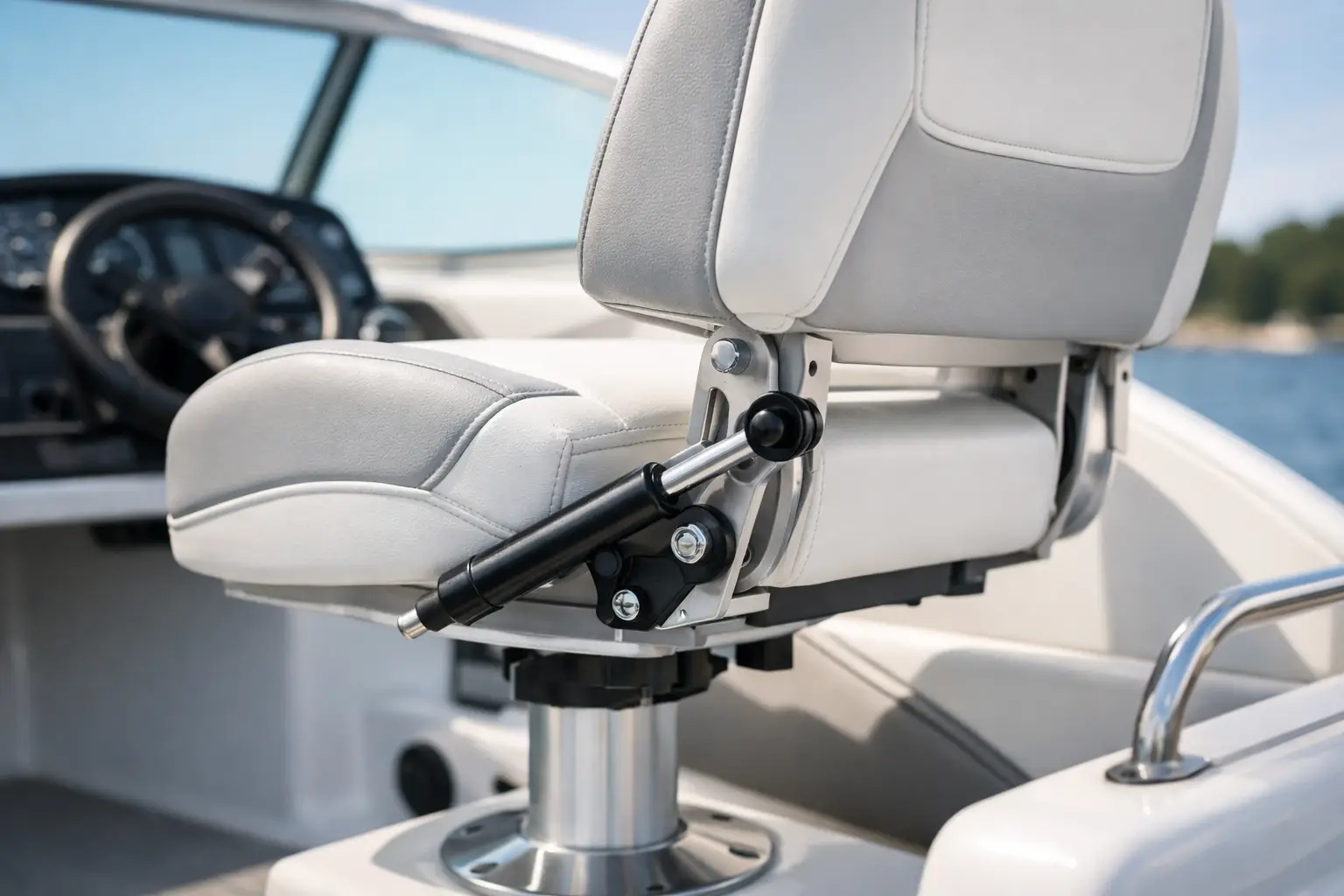
Marine seating covers more than a simple folding seat. Gas struts are commonly used on flip-up helm bolsters, under-seat storage lids, lounge bases, engine-box seating, rear bench seats and sunpads. Each application has a different load, opening angle and mounting position. That is why selecting a replacement by appearance alone often causes problems.
Choosing gas struts for marine seating
The right strut is determined by geometry as much as weight. A gas strut provides force along its own line of travel, while the seat or lid pivots around a hinge. The further the strut is mounted from the hinge, and the more favourable its angle at the start of the lift, the less force may be needed. Move the mounting points even slightly and a strut that worked on one seat can be too weak or too strong on another.
For a like-for-like replacement, start with the markings on the existing strut. The force is usually shown in Newtons, such as 300N or 600N, together with a part number. Matching that information is the quickest route where the original mounting points and seat construction have not changed.
If the label is worn, the strut has been fitted previously, or the seating is being built or modified, record the key details before ordering. The following measurements give a supplier enough information to identify a suitable standard part or advise on a custom solution:
- Extended length, measured centre-to-centre between the end fitting sockets when the strut is fully open.
- Compressed length, measured centre-to-centre when fully closed.
- Stroke, which is the difference between extended and compressed lengths.
- Force rating in Newtons, if it can be read from the old unit.
- End fitting type and thread size, such as ball sockets, eyelets, clevis ends or brackets.
- The seat or lid weight, hinge location, opening angle and the position of both mounting points.
Photos of the open and closed installation are also useful. They show whether the strut is near full extension when the seat is raised, whether it is bottoming out before the seat closes, and whether the brackets are aligned correctly.
Why force rating is not a simple weight match
A common mistake is to choose a strut based on the total weight of the cushion or lid. A 20 kg seat base does not automatically need a strut rated to 200N. The pivot point, leverage and opening angle all affect the force required. In many layouts, the strut has the least mechanical advantage when the seat is nearly closed, which is where more lift force may be needed.
Too little force means the seat will not open fully or stay up. It may also place the user in the position of holding a heavy lid while reaching into storage. Too much force can be just as troublesome. The seat can spring up hard, stress hinges, pull mounting screws from timber or composite panels, and become difficult to close.
Temperature also changes performance. Gas pressure rises in hot conditions and falls in cooler weather. A strut that is only just adequate on a cool morning may struggle as seals age, while an over-specified unit can feel noticeably stronger in the Australian summer. Allow for normal operating conditions rather than selecting the highest possible force.
For wide seat bases and sunpads, two struts are often used to share the load and prevent twisting. They must be matched as a pair. Replacing only one can leave unequal forces across the lid, causing it to rack, bind or place extra load on hinges.
Select fittings and brackets for the actual seat structure
The strut is only one part of the system. Marine seating often combines vinyl cushions, marine ply, aluminium framing, fibreglass mouldings and stainless hardware. The mounting brackets need a sound substrate and enough reinforcement to carry repeated opening loads.
Ball studs and ball sockets are popular because they allow the strut to articulate through its travel. They must be the correct ball diameter and secured with compatible retaining clips. Eyelet or clevis fittings may suit fixed bracket arrangements, but they still need freedom to pivot. A strut forced to work out of alignment can side-load the rod and shorten seal life.
Check the fixing method before increasing strut force. Screws driven into thin ply, unreinforced fibreglass or soft backing material may have held a low-force original strut but fail after an upgrade. Through-bolting with suitable backing plates can be the better option on a frequently used, heavy seat base.
Marine corrosion resistance matters
Salt spray, wash-down water, humidity and wet cushions create conditions that are harder on gas struts than most vehicle applications. Corrosion on the rod can damage the seal each time the strut cycles. Corroded fittings can seize, and bracket fasteners can become the weak point even when the strut itself remains functional.
Choose components suited to marine exposure, particularly where seating is in an open cockpit or near a transom. Stainless steel fittings and marine-grade fasteners are worthwhile, but material grade and application still matter. Not every item described as stainless has the same corrosion resistance. Where dissimilar metals meet, consider isolation and suitable fasteners to reduce the chance of galvanic corrosion.
A practical installation position is rod-down when the seat is closed, where the design allows it. This helps keep internal seal lubrication in the working area of the strut. It is not possible in every seating layout, so do not compromise mounting geometry or safe operation simply to achieve this orientation.
Rinse exposed struts and brackets with fresh water after saltwater use, then wipe the rod clean. Avoid spraying grease, oil or harsh cleaners onto the rod. Dirt and abrasive residue can be carried into the seal, while some chemicals can affect seal materials. If the rod is pitted, bent or showing corrosion, replacement is generally the sensible repair.
When a locking strut is the better choice
A standard gas strut assists lifting and holds a lid open through gas force. It is not a positive safety lock. On a heavy engine-box seat, access hatch or large sunpad, a manual or automatic locking gas strut may be appropriate where a person could be working beneath the raised section.
Locking options have trade-offs. They require a release mechanism, need enough clearance for the cable or lever, and must be fitted so the lock can engage correctly. They are not a substitute for properly rated hinges, sound mounting points or a separate mechanical support where the consequences of a drop are serious.
Consider how the seat is used. A lightly loaded storage lid that is opened occasionally may suit a standard strut. A commercial vessel, fishing boat or family boat where people regularly access batteries, lifejackets or equipment under a heavy seat deserves closer attention to retention and safe release.
Fitment checks before drilling or ordering
Before fitting new brackets or altering an existing installation, cycle the seat through its full range by hand. Confirm that cushions, grab rails, seat backs and nearby hardware do not interfere as it opens. The strut should not reach full extension before the seat reaches its intended open position, and it must not be compressed solid before the seat is fully closed.
Do not use a gas strut as a stop where the seat needs a defined opening limit. Use a hinge stop, strap or purpose-designed mechanical stop if required. The strut should work within its stroke, not absorb repeated impact at either end of travel.
During installation, support the seat independently. A gas strut can extend with substantial force, and a seat base can fall if the old strut is removed without support. Fit the end connections squarely, confirm retaining clips are engaged, then test the operation slowly before allowing normal use.
For unusual seating layouts, a custom strut solution is often more economical than repeated trial and error. Gas Struts can assess dimensions, mounting geometry, force requirements and fittings to help specify a practical replacement or new installation.
A well-matched marine seat strut should feel controlled rather than dramatic: enough assistance to lift the load, enough holding force for the intended position, and no fight to close it. Measure carefully, account for the marine environment, and treat the brackets and hinges as part of the same working system.