A tailgate that will not stay up and a hatch that will not pull shut can look like the same problem. They are not. The difference between compression struts vs tension struts is the direction in which the gas spring applies its force. Get that direction wrong and even a correctly sized, high-quality strut will work against the application.
For vehicle, marine, industrial and mobile equipment work, the right choice comes down to how the panel moves, where the mounting points sit and what the strut must do through its full travel. Force rating matters, but it is only one part of a safe, reliable setup.
Compression Struts vs Tension Struts: The Main Difference
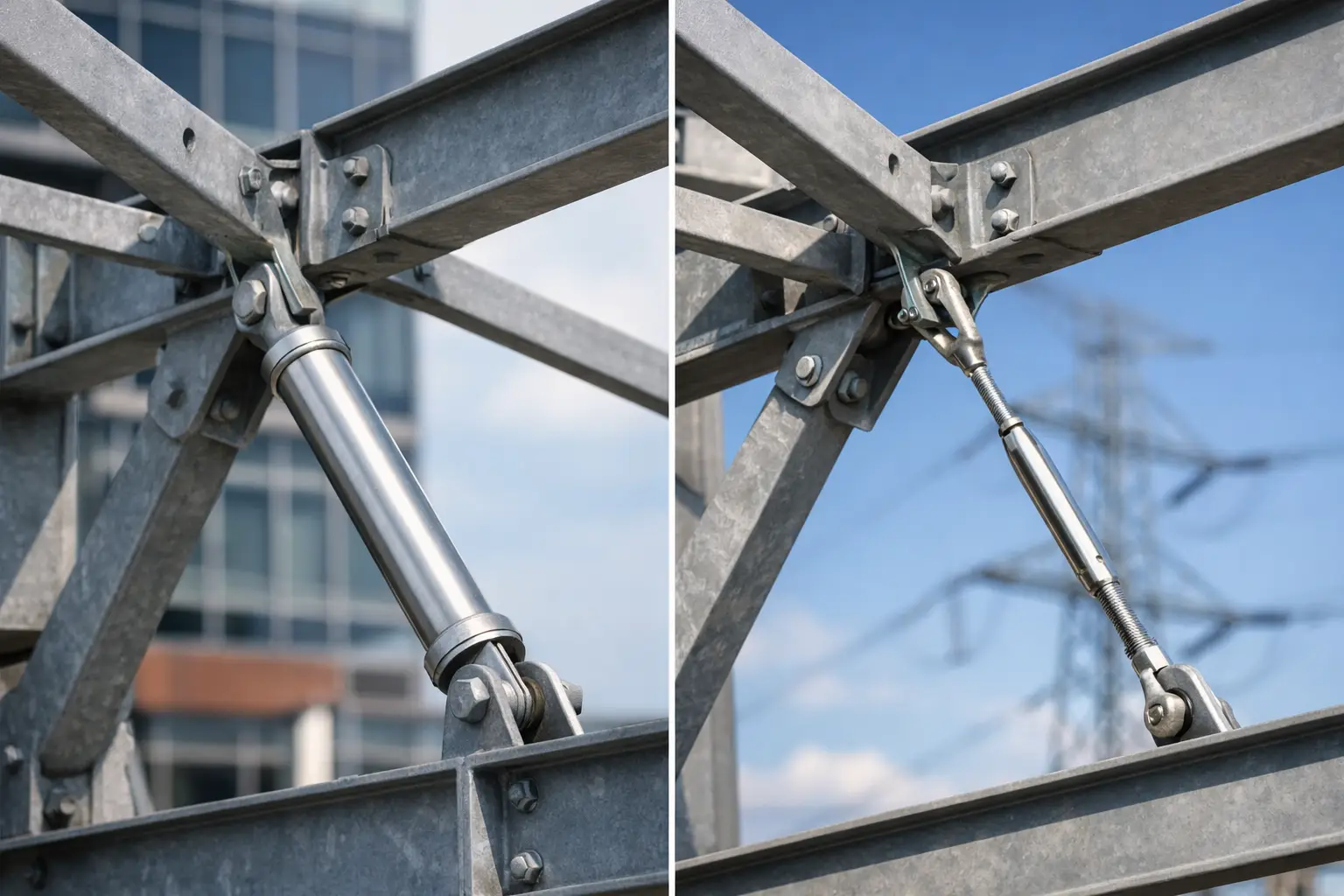
A compression gas strut is designed to push. Its internal gas pressure extends the rod, creating an outward force between the two mounting points. This is the familiar style used to lift and hold a bonnet, canopy door, toolbox lid, caravan hatch or machinery guard.
A tension gas strut is designed to pull. Instead of extending under pressure, it retracts to create a pulling force. It is used where the mechanism needs assistance closing, lowering, drawing in or holding a component in its closed direction. Typical examples include certain machine covers, access panels, sliding mechanisms and applications with restricted mounting geometry.
Neither design is automatically better. A compression strut suits a panel that needs lift assistance. A tension strut suits a component that needs controlled pull assistance. The correct selection follows the motion required, not the name used for the part.
How Compression Gas Struts Work
A compression strut contains pressurised nitrogen gas and oil within a sealed cylinder. When the rod is pushed in, the gas is compressed. Once released, the gas pressure pushes the rod back out.
That outward action is useful when gravity is pulling a lid or door down. The strut offsets part of the panel weight, reducing the effort needed to open it and helping keep it in the raised position. It does not necessarily lift the item on its own from fully closed. Many installations need an initial manual lift before the strut becomes mechanically effective.
Compression struts are widely used because they suit common lifting applications, including:
- ute canopies, tailgates and rear windows
- toolboxes, service body doors and trailer lids
- caravan, camper and horse float hatches
- boat lockers and engine covers
- cabinets, display lids and seating compartments
- guards, access doors and covers on industrial equipment
The mounting position has a major effect on performance. A strut mounted close to a hinge has less leverage, so it may need more force than the same strut mounted further out. This is why matching a strut by Newton rating alone often produces poor results.
Rod-Down Installation Matters
Most standard compression gas struts should be installed with the rod pointing down when the lid or door is closed. This keeps internal oil at the rod seal, helping lubricate the seal and support service life.
There are exceptions, particularly with specialised dampers or designs made for unusual mounting positions. But for a conventional lift strut, rod-down mounting is the normal starting point. If the fitting layout forces the rod up, confirm the product is suitable before installation.
How Tension Gas Struts Work
A tension gas strut uses gas pressure to pull the rod into the cylinder. In practical terms, it applies force in the opposite direction to a compression strut.
This makes tension units useful where a door, cover or mechanism needs help returning towards its closed position. They can also be used where the layout does not allow a conventional pushing strut to be fitted, or where a pulling action provides better control through the working arc.
A tension strut should not be treated as a compression strut installed backwards. Its internal design, seals and working direction are purpose-built for tension. Fitting the wrong type can cause unreliable operation, shortened seal life or a component that moves unexpectedly.
Tension struts are less common in general vehicle and toolbox work, which is why they are sometimes overlooked during replacement. If an existing strut pulls a mechanism closed, check the original part markings and observe its action before ordering a replacement.
Why Force Ratings Do Not Tell the Whole Story
Gas strut force is normally stated in Newtons, marked as N on the cylinder. A 500 N strut provides approximately 500 Newtons of force under standard conditions, but that number does not tell you whether it will suit your application.
The required force changes with panel weight, centre of gravity, hinge position, mounting angle and the amount of opening needed. A long, heavy lid with its weight concentrated away from the hinge needs more assistance than a short lid of the same total weight. Two struts also share the load, but not always equally if the lid flexes or the mounting points are uneven.
Temperature affects gas pressure as well. A strut that feels acceptable in a cool workshop can be firmer in direct summer sun. This is particularly relevant for canopy windows, caravan doors and enclosed machinery working across Australian conditions.
Too little force leaves the lid heavy, unstable or unable to stay open. Too much force can make it difficult to close, strain hinges, bow lightweight panels or create a sudden opening action. The aim is controlled movement and dependable holding, not the highest possible Newton rating.
Measure Before Replacing a Strut
For a like-for-like replacement, start with the original strut whenever possible. Record the details stamped on the cylinder, then measure it fully extended from centre of fitting to centre of fitting. Measure the stroke as well – this is the difference between the extended and compressed centre-to-centre lengths.
You also need the fitting type at each end. Common options include ball sockets, eyelets, threaded ends, clevis fittings and brackets. A correct-length strut with the wrong end fitting will not install properly, and improvised adapters can alter geometry or introduce wear points.
For a new or modified installation, provide the panel weight, hinge location, opening angle and clear photos of the available mounting area. It also helps to know whether the component needs to self-open, stay open once lifted manually, close under assistance or simply move with damping. This information allows a strut specialist to assess the geometry rather than guessing from the panel size.
Check the Full Range of Motion
A strut must not bottom out before the lid is fully closed or fully open. Bottoming out transfers load into the cylinder, brackets and panel, which can damage all three. It must also avoid over-extending at full opening.
Cycle the mechanism slowly after fitting. Check for interference with seals, frames, handles, wiring and nearby equipment. On dual-strut setups, make sure both units engage at the same stage of travel and that the lid is not twisting as it opens.
Choosing the Right Strut for Heavy-Use Equipment
For a lightly used cabinet door, standard sizing may be enough. For a work ute canopy, mine-site enclosure, agricultural machine or marine hatch, the operating environment deserves more attention.
Consider corrosion exposure, dust, wash-down requirements, vibration, repeated cycles and the consequence of failure. Stainless steel components or corrosion-resistant finishes may be appropriate around saltwater. Protective tubes can help shield rods from grit and damage in demanding environments. Locking gas struts may be worth considering where a raised panel needs positive holding rather than reliance on gas force alone.
Bracket strength matters as much as strut quality. Thin sheet metal, timber and plastic panels may need reinforcing plates to spread the load. Fasteners should be suited to the material and load path, not selected simply because they fit the bracket hole.
Gas Struts can assist with standard replacements and custom configurations where the original part is unavailable or the mounting geometry has changed. For custom work, accurate measurements and photos usually save more time than trial-and-error ordering.
When a Gas Strut Is Not the Right Answer
A gas strut is not a substitute for a damaged hinge, warped lid or cracked mounting point. Fix those faults first. A stronger strut may hide the issue briefly while increasing stress on the remaining hardware.
It may also be the wrong choice where a mechanism requires very slow, precisely controlled movement, constant force over a long travel or positive mechanical locking at multiple positions. Depending on the application, a hydraulic damper, mechanical stay, counterbalance spring or powered actuator may be more suitable.
Do not drill into pressurised gas struts, heat them, repaint the rod or attempt to recharge a sealed unit. Replace worn struts in pairs where both sides support the same lid, particularly when the remaining older unit has lost force. Secure a heavy hatch before removal, because a failed strut can no longer be relied on to hold the load.
The practical test is simple: choose a compression strut when the job needs a push to lift or hold open, and a tension strut when it needs a pull to close or return. Confirm the dimensions, fittings and mounting geometry before ordering, and the finished installation will be safer, easier to use and built for the work it has to do.