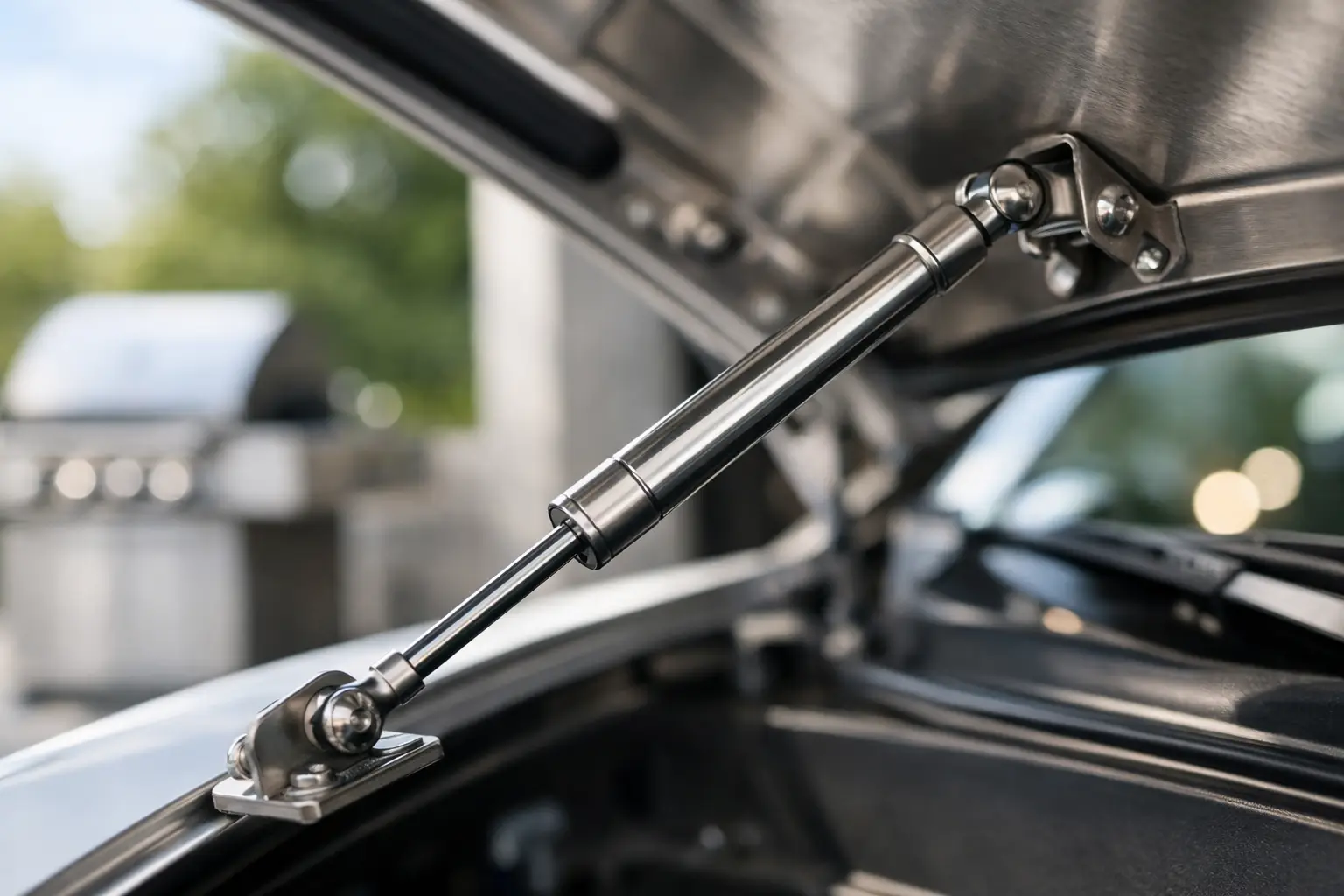
Salt spray, washdowns, road grime and constant outdoor exposure will sort a decent strut from a short-lived one very quickly. That is why a proper stainless gas strut review matters if you are fitting out a boat hatch, toolbox, canopy, caravan locker or any application where corrosion is not just cosmetic – it affects safety, motion and service life.
The short answer is that stainless gas struts are usually worth the extra cost when the application lives outside, sees moisture regularly, or works in corrosive conditions. They are not automatically the right choice for every job, though. If the strut sits inside a cabinet in a dry workshop, the premium may not return much value. The decision comes down to environment, load accuracy, mounting geometry and how expensive a failure would be.
Stainless gas strut review: where stainless earns its keep
A stainless gas strut is built for applications where standard painted or black nitride units can start to deteriorate early. Marine fit-outs are the obvious example, but they are far from the only one. Trailers, ute canopies, service bodies, agricultural equipment, outdoor cabinets, food processing equipment and washdown areas all create conditions that attack ordinary finishes.
The main advantage is corrosion resistance across the body, rod and end fittings. Once corrosion starts on a rod surface, seal wear follows. That can lead to gas loss, inconsistent force and eventual failure. In real use, this is often the difference between a hatch that lifts smoothly for years and one that starts sticking, sagging or dropping unexpectedly.
Stainless also makes sense where appearance matters over time. On boats, caravans and exposed vehicle storage, surface rust can make otherwise serviceable hardware look tired well before the component is actually finished. If the equipment is customer-facing or part of a premium build, stainless helps maintain a cleaner result.
That said, not every so-called stainless setup offers the same protection. A quality strut needs the full assembly considered properly, not just one visible part made from stainless steel. If the tube is stainless but the fittings, brackets or fasteners are not suited to the environment, corrosion can still become the weak point.
What actually makes a good stainless gas strut
This is where many buyers get caught. They compare force rating and extended length, then assume the material upgrade alone guarantees durability. It does not.
A good stainless gas strut needs consistent sealing, accurate gas charge, reliable end fittings and proper manufacturing quality. The rod finish matters because the seal rides on that surface every time the strut cycles. If the finish is poor, contamination and wear show up faster. Build quality also affects how smoothly the strut moves under load and how well it holds force over time.
For trade and industrial buyers, this is where certification and manufacturing standards deserve attention. The material grade matters, but so does process control. If the application is safety-critical or difficult to access once installed, the cheapest stainless option on paper can end up being the most expensive one in service.
It is also worth checking whether the strut is suited to regular cycling or mostly static support. Some applications open a few times a week. Others cycle all day on machinery covers, compartments or seating systems. The duty pattern changes what “good value” really means.
Stainless is not the whole story
A stainless body will not fix poor sizing. If the force is wrong, the hatch may not stay open, may fly up too aggressively, or may put extra stress on hinges and mounts. If the stroke or compressed length is wrong, the strut may bottom out or fail to open the panel to the required angle.
This is why fitment details matter as much as material choice. On a marine hatch, for example, the right stainless strut still needs correct mounting points and enough leverage to support the panel through the full opening arc. On a toolbox lid, incorrect geometry can twist the lid or overload one side.
Performance in real applications
In marine use, stainless gas struts generally justify themselves quickly. Salt air, deck wash and direct weather exposure are hard on hardware, and replacing failed struts on hatches or lockers is not just inconvenient. It can become a safety issue, particularly where access panels are heavy or overhead.
For caravans, campers and trailers, the value depends on how the unit is stored and used. If it spends most of its life outdoors, gets coastal travel, or sees plenty of road spray, stainless is a sensible upgrade. If it is mostly under cover and used occasionally, a standard strut may still give acceptable life, provided the quality is sound.
On industrial and agricultural equipment, the answer is more mixed. Dusty inland conditions are not always as corrosive as coastal ones, but fertilisers, chemicals, washdowns and exposure to mud can be rough on coatings. In those cases, stainless often performs better over the long term. In enclosed machinery guarding inside a factory, the premium may be harder to justify unless hygiene or washdown requirements apply.
For toolboxes, canopies and service vehicles, stainless often pays off because these are exposed to weather, road contamination and frequent opening. Tradespeople do not need a lid support that is fine in theory but unreliable on site six months later.
The trade-offs in any stainless gas strut review
The obvious trade-off is price. Stainless gas struts cost more than standard equivalents, and if you are replacing multiple units across a fleet or fit-out, that difference adds up.
The less obvious trade-off is lead time if the application is unusual. Common sizes are straightforward, but non-standard lengths, end fittings or force requirements may need a custom solution. That is not necessarily a downside if the result is correct, but it is something to factor in if the job is urgent.
There is also the risk of over-specifying. Buyers sometimes assume stainless means “best” in every circumstance. In practice, “best” means suited to the application. For a dry indoor cabinet or enclosed compartment, a quality standard strut may perform perfectly well and free up budget for other components.
How to assess whether stainless is right for your job
Start with the environment. If the strut is exposed to salt, moisture, washdowns, chemicals or regular outdoor weather, stainless should be high on the list. If failure would create a safety issue or frequent maintenance problem, that pushes the case further.
Then look at the panel itself. Weight, hinge position, opening angle and mounting space all affect the required force and stroke. Two hatches of similar size can need very different struts depending on geometry. This is why old part numbers help, but accurate measurements are often more useful.
You should also consider how the strut is used. A rear canopy window that opens a few times a day has different demands from a machinery guard cycled repeatedly during every shift. More cycles usually justify better materials and tighter quality control.
What details matter when ordering
For a correct replacement or quote, the essential details are the extended length, compressed length, stroke, end fitting type and force rating in Newtons. Photos of the application and mounting points are often useful, especially where the original strut has no readable markings.
If the old strut has failed completely, the panel weight and dimensions can help determine the right force. In custom applications, it is often worth getting advice before ordering rather than trying to solve the geometry by trial and error. That approach usually costs more in the end.
Final verdict
A fair stainless gas strut review comes down to this: stainless is not a gimmick, and in the right environment it is money well spent. It reduces corrosion-related failures, helps preserve smooth operation and generally makes more sense the harder the conditions become.
If the application is exposed, safety-relevant or expensive to revisit, stainless is often the better long-term decision. If the strut works indoors in a clean, dry setting, a standard unit may be the more practical buy. The best result is not picking the most expensive strut. It is getting the right force, the right dimensions and the right material for the job. If you are unsure, the fastest way forward is to match the application properly before you fit anything.