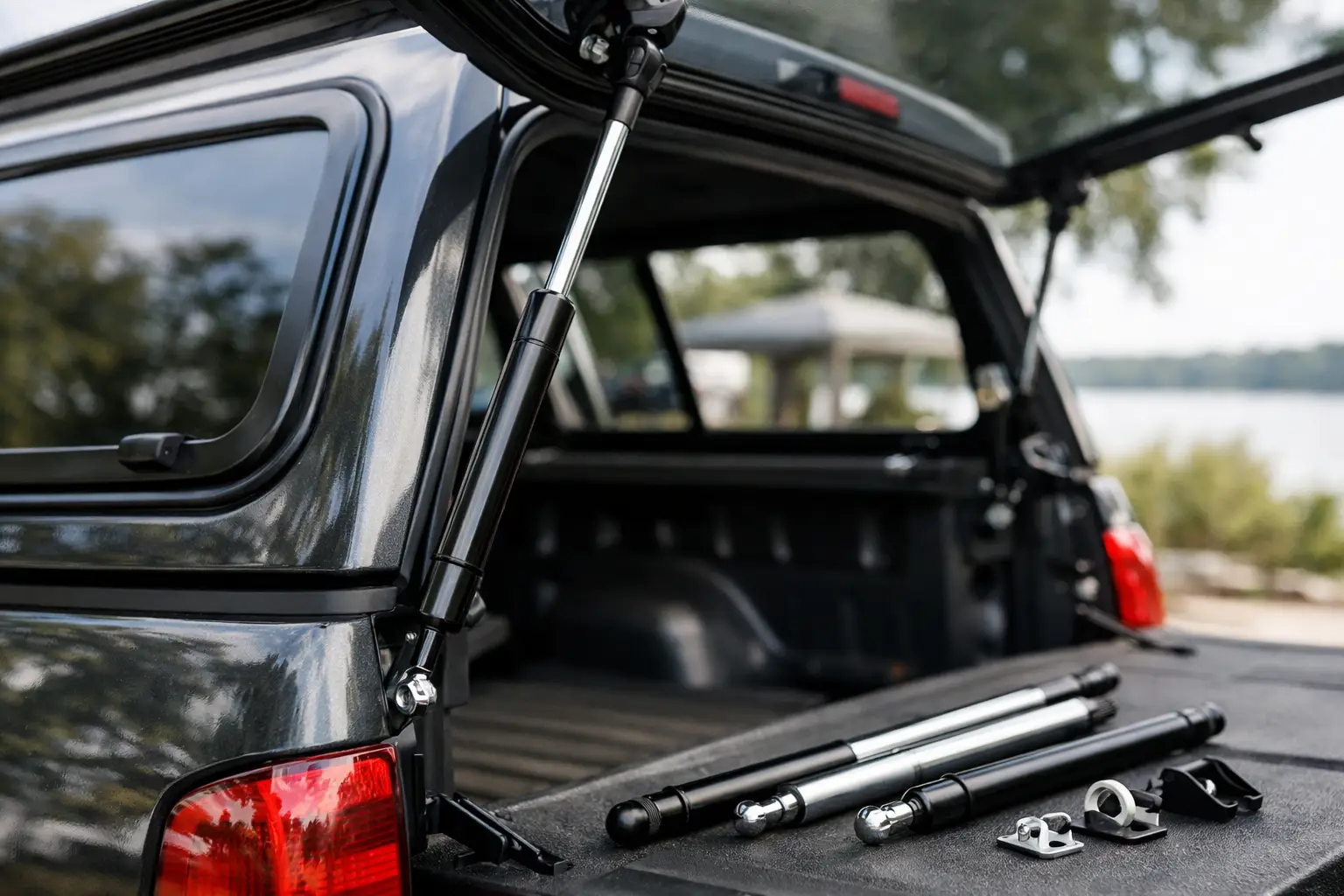
A canopy door that drops without warning is more than an annoyance. It slows down a job, makes loading awkward and can put hands, heads and expensive gear at risk. The best lift supports for canopies are not simply the strongest struts available. They are correctly sized to the door, hinge position, mounting points and the way the vehicle is used.
For a ute canopy, service body, trailer canopy or work vehicle compartment, the right gas struts should raise the door smoothly, hold it securely at full opening and close without excessive force. Getting that result starts with specification, not guesswork.
What makes the best lift supports for canopies?
A lift support, also called a gas strut or gas spring, uses pressurised gas to assist with lifting and holding a canopy door. Its performance is determined by more than the Newton rating stamped on the cylinder. A strut with the same force can behave very differently when its length, stroke or mounting angle changes.
The correct support has enough force to hold the door open in normal conditions, including when the vehicle is parked on a slight slope. It should not be so overpowered that the door snaps open, strains hinges or becomes difficult to pull shut. This balance matters particularly on large aluminium gullwing doors, doors fitted with shelves or central-locking hardware, and rear canopy doors carrying spare-wheel or accessory weight.
Most canopy applications use two gas struts, one per side. This shares the load and keeps lifting even. A single strut may suit a narrow or lightweight compartment door, but it can twist a wider door if the mounting arrangement is not designed for it.
Start with the canopy door, not the old strut
Replacing like-for-like is often the quickest option when the original struts performed properly. Read the markings on the cylinder first. Useful details may include the force rating in Newtons, extended length, part number and manufacturer code.
However, an old strut is not always proof of the right specification. It may have been fitted as a compromise, it may be incorrect from a previous repair, or the canopy may have been modified since it was installed. Added roof-rack supports, internal shelving, tool holders, mesh, ladder racks and door-mounted equipment can all change the lifting requirement.
Measure the door and assess how it behaves with the struts disconnected and safely supported. A door that is very heavy to lift by hand generally needs more force or a revised mounting position. A door that feels manageable but falls during the final part of opening may need a different geometry rather than a major increase in strut pressure.
Force rating: the Newton figure that matters
Gas strut force is measured in Newtons, shown as N. Common canopy lift supports can range from roughly 200N for a light access door to 1,200N or more for heavier doors and specialised fit-outs. There is no universal canopy rating because door weight alone does not tell the full story.
The strut’s leverage changes throughout the opening cycle. When a door is closed, the strut typically has less mechanical advantage. As the door rises, its angle improves and it can provide more effective lift. Mounting points that are a few centimetres out can change opening effort, final opening height and holding strength.
Do not automatically increase the Newton rating because a worn strut no longer holds. Gas struts lose pressure over time. If the original strut had the correct operation when new, matching its specification is usually the sensible first step. If the door has changed or has always been difficult, a specialist calculation is safer than trial-and-error fitting.
Extended length, compressed length and stroke
Measure gas struts centre-to-centre between the mounting points. Take one measurement with the door fully open and a second with it fully shut. The extended length controls whether the door reaches the required open position. The compressed length must allow the door to close fully without bottoming out the strut.
Stroke is the difference between extended and compressed length. It needs enough travel for the full door movement, with a margin so the strut is not forced hard against either end of its travel. A strut that bottoms out can damage its internal seals, brackets, hinges or the canopy door itself.
Where possible, measure with the vehicle on level ground and have another person support the door. Large canopy doors can be heavy and unstable once the struts are removed.
Choose fittings that match the mounting hardware
The ends of a gas strut are just as important as the cylinder. Common canopy fittings include ball sockets, eyelets, clevises and threaded ends. Ball sockets are widely used because they allow the strut to pivot as the door moves, but ball stud diameter and thread size must still match.
Check whether the current ends are removable. Many replacement struts accept interchangeable end fittings, allowing serviceable brackets to remain on the canopy. This can make replacement straightforward, but only if thread type and size are confirmed before ordering.
Inspect brackets and ball studs while the struts are off. A loose ball stud, cracked rivet, fatigued bracket or worn socket can cause rattles and premature strut failure. Replacing the strut without addressing damaged hardware can leave the door unsafe.
Canopy use changes the right specification
A weekday work ute and a touring canopy may use similar doors, yet need different support choices. Frequent opening at worksites, exposure to dust and salt air, and heavy door-mounted accessories all affect the selection.
For trade canopies, durability and repeatable operation are usually the priority. Quality gas struts with reliable seals and corrosion-resistant components are worth specifying where doors are opened repeatedly through the day. On a canopy used near the coast, for marine work or on off-road vehicles, corrosion resistance is particularly relevant.
For touring setups, consider how the canopy is used when loaded. A rear door may open easily when the drawers are empty but need more support once accessories are mounted. Also check clearance around awnings, jerry-can holders, tyre carriers and rooftop equipment. The door needs to reach a useful opening angle without contacting other gear.
For trailers and mobile workshops, vibration deserves attention. Correctly secured ball sockets, suitable brackets and struts matched to the door’s travel reduce the chance of fittings working loose on rough roads.
Installation details that affect strut life
Gas struts are generally fitted with the rod pointing down when the door is closed. This keeps the internal seal lubricated and helps maximise service life. There are exceptions where the mounting geometry requires a different orientation, so follow the application design rather than forcing a standard arrangement.
Fit matched struts as a pair. Replacing only one support can make the door lift unevenly and transfer extra load to the stronger side. Even if one strut has obviously failed, the other may be close behind after the same service life and exposure.
Do not drill new mounting points or move brackets casually to make an available strut fit. Small mounting changes have large effects on force and travel. If brackets need relocating, calculate the new setup or seek technical advice with the door dimensions, weight and desired opening angle.
Never puncture, heat, repaint heavily or attempt to refill a gas strut. These are pressurised components and should be replaced when worn or damaged.
Information to have ready before ordering
The fastest way to source a correct canopy lift support is to provide the existing strut details where available, plus clear measurements and photos of the mounting points. For a custom or uncertain application, the useful information includes:
- extended and compressed centre-to-centre measurements
- force rating marked on the old strut, if known
- type and size of fittings at both ends
- door width, height and approximate weight
- hinge location and desired open angle
- any accessories or modifications fitted to the door
Photos taken with the door open and closed help identify geometry issues that measurements alone may miss. For unusual canopy doors, Gas Struts can assist with selecting a stocked replacement or specifying a custom solution suited to the application.
When a standard replacement is enough – and when it is not
A standard replacement is usually suitable when the old struts are clearly labelled, the canopy is unmodified and the door opened and held correctly before the struts wore out. Matching the force, length and end fittings will generally restore normal operation.
A custom calculation is the better option when a canopy is newly built, a door has been reinforced, accessories have been added, mounting brackets have moved, or the door has never behaved properly. It is also worthwhile for heavy gullwing doors and commercial bodies where repeated use makes downtime costly.
The best result is a canopy door that feels controlled rather than aggressive: easy to begin lifting, stable at full height and straightforward to close. Measure carefully, replace supports in pairs and treat the mounting hardware as part of the system. That approach keeps access safe and makes the canopy work the way it should every day.