A toolbox lid that needs a simple, reliable lift does not need the same solution as a machine guard that must open at the push of a button. When comparing gas struts vs electric actuators, the right choice comes down to more than lifting force. You need to consider control, duty cycle, mounting space, environmental exposure, safety requirements and what happens if power is unavailable.
For many automotive, trailer, caravan, cabinet and access-panel applications, a correctly specified gas strut is the practical answer. Where controlled powered movement, automation or remote operation is required, an electric actuator may justify its higher cost and added complexity.
How gas struts work
A gas strut uses pressurised nitrogen gas and oil damping to assist with lifting, lowering and holding a load. Once fitted between fixed mounting points, it provides force through its stroke without wiring, switches, motors or external power.
The familiar examples are vehicle tailgates, canopies, bonnet supports, toolboxes, caravan beds, boat hatches and machinery covers. A gas strut can reduce the effort needed to open a heavy panel, hold it securely in position and slow its closing action.
The key point is that a standard gas strut is a passive component. It assists movement, but it does not decide when to move. The operator still lifts or lowers the panel, and the strut supplies the supporting force.
Its performance is determined by the selected force rating, extended and compressed length, stroke, mounting geometry, fitting type and the weight distribution of the lid or panel. Get those details right and the result is simple, dependable motion control with very little to maintain.
How electric actuators work
An electric linear actuator converts motor rotation into straight-line push or pull movement. It can extend and retract under power, usually through a screw-drive mechanism, and is controlled by a switch, relay, remote, sensor or programmed system.
Electric actuators are used where manual operation is unsuitable or where a movement must be repeatable. Common examples include automated machinery guards, adjustable seating, powered access doors, agricultural equipment, marine systems and specialised vehicle fit-outs.
Most units need a suitable power supply, wiring, switches and mounting hardware. Depending on the application, they may also need limit switches, overload protection, position feedback or a control system. This makes them capable of more, but it also adds parts that need to be specified, installed and protected.
Gas struts vs electric actuators: the practical differences
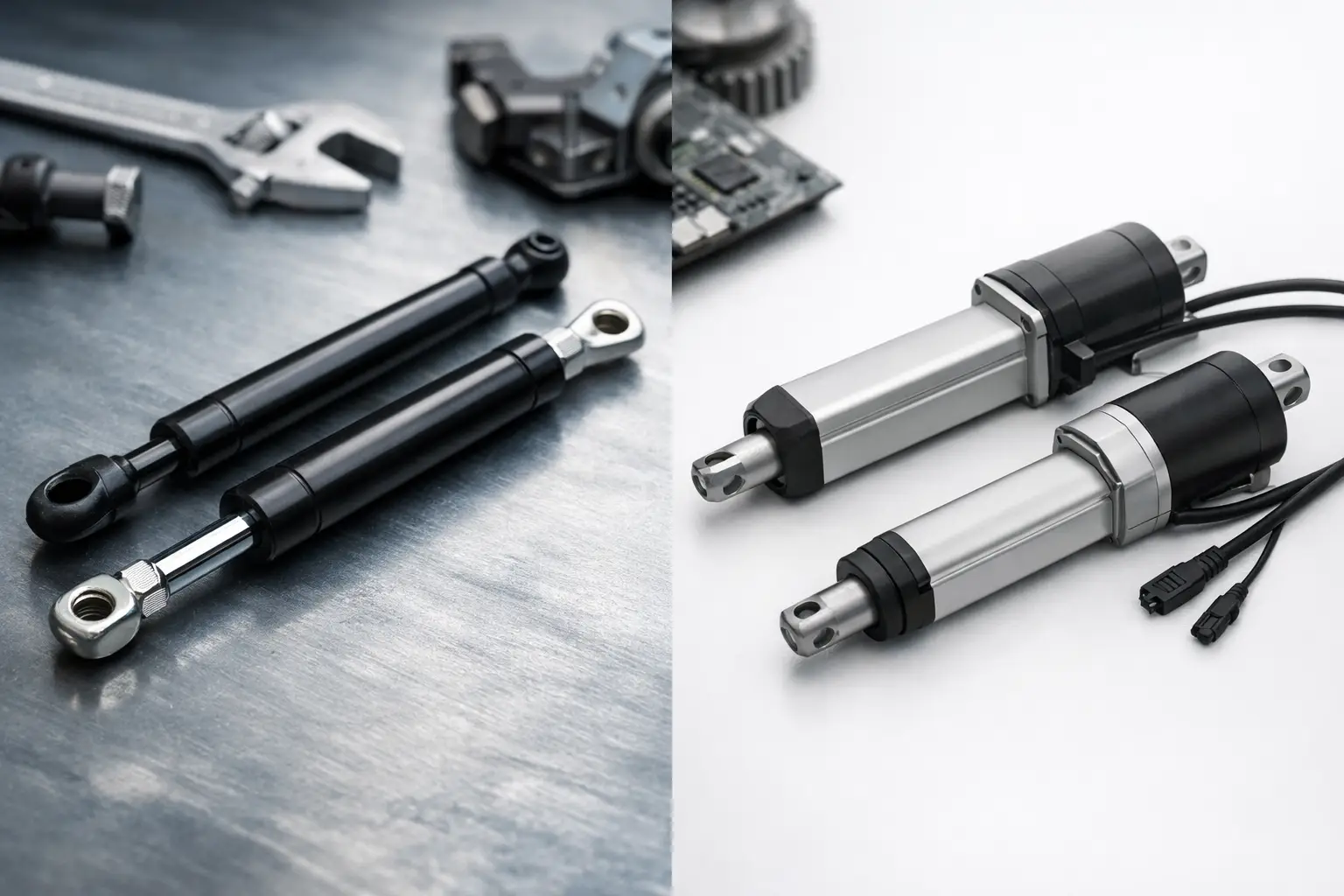
The main difference is control. Gas struts assist a person opening and closing a panel. Electric actuators create the movement themselves. That distinction affects every part of the buying decision.
Force and movement
Gas struts provide a set force that changes slightly through the stroke. Their job is usually to counterbalance a load, not to lift it from a fully closed position without human assistance. Mounting position has a major effect on how the panel feels to operate, particularly at the start of opening.
An electric actuator is rated for push and pull load, typically stated in newtons or kilograms-force equivalent. It can move a load through a defined stroke at a specified speed. It is a better fit where the load must travel automatically, repeatedly and with a controlled sequence.
Neither option should be selected on force alone. A 1000N strut and a 1000N-rated actuator are not interchangeable. Their force delivery, mounting requirements and intended operating conditions are different.
Position holding
A gas strut can hold a hatch or lid open when its force and geometry are correctly matched to the load. However, it is not generally intended to provide precise positioning at any point in the stroke. Temperature also affects gas pressure, so the lift can feel firmer in hot conditions and softer in cold weather.
Electric actuators with self-locking screw drives can hold position when power is off. Models with feedback can also stop at programmed points. This is useful for adjustable equipment, controlled openings and systems where repeatable positioning matters.
For a simple upward-opening toolbox lid, holding fully open is usually enough. For an adjustable machine component or powered hatch that must stop at several positions, an actuator is the more suitable technology.
Speed and control
Gas struts move at the speed set by the operator, with oil damping helping to prevent abrupt extension or closing. The action is immediate and intuitive, with no waiting for a motor to run through its stroke.
Electric actuators move at a fixed speed that is often slower than manual operation. This is not necessarily a disadvantage. Controlled speed can improve safety and prevent impact loads, especially on heavier equipment. But it needs to suit the job. A slow actuator may frustrate an operator opening a frequently used access door, while a fast unit may be inappropriate around personnel.
Installation and maintenance
Gas struts are relatively straightforward to install when the mounting points and specifications are known. They normally use ball joints, eye ends, brackets or clevis fittings. The cylinder should usually be mounted rod-down where practical, helping keep the internal seal lubricated.
Electric actuators need mechanical mounting plus electrical installation. Wires must be routed clear of moving parts, protected from abrasion and sized correctly. Outdoor, marine, agricultural and mining applications also require suitable ingress protection and corrosion resistance. A poorly protected electrical system can become the weak point, even when the actuator itself is correctly rated.
Gas struts are sealed units and should not be drilled, heated, opened or regassed by the user. When they lose force, leak oil or no longer hold the load safely, replacement is the normal remedy. Electric actuators may require inspection of wiring, connectors, mounts and controls as part of routine maintenance.
Cost and system complexity
A gas strut system is usually lower cost because it needs fewer components. For a pair of canopy doors, a caravan bed base or a cabinet lid, this can deliver the required result without adding electrical work or failure points.
An electric actuator costs more than the actuator alone. Allow for controls, wiring, switches, brackets, fuses, power supply and installation time. The additional investment makes sense when it eliminates manual handling, enables remote access or supports a required operating sequence.
When a gas strut is the better choice
Choose gas struts when the load is opened manually and needs lift assistance, controlled closing and secure open support. They are particularly effective for lids, hatches, doors and panels that are used regularly but do not require powered operation.
They are also well suited to remote locations or mobile equipment where simplicity matters. A gas strut does not rely on a battery, vehicle electrical system or control circuit. That can be a real advantage on trailers, utes, field equipment and basic site storage where reliability and easy replacement are priorities.
A quality strut specified for the application can provide years of service. However, do not simply fit a stronger strut to compensate for a weak or worn one. Excess force can make a lid difficult to close, overload hinges, distort mounting brackets or create a safety risk.
When an electric actuator is the better choice
An electric actuator is worth considering when the application needs hands-free operation, a controlled sequence, remote activation or adjustable positioning. It is also useful where the load cannot reasonably be lifted by hand, or where manual lifting creates an ergonomic or safety concern.
For example, a heavy machinery enclosure may need an interlocked powered opening system. A specialised agricultural or marine installation may require movement from a protected control position. An adjustable seat, platform or equipment mount needs a level of precision that a gas strut cannot provide on its own.
Before selecting an actuator, check the required load across the full travel, not just at one point. Confirm stroke length, retracted length, speed, duty cycle, voltage, mounting alignment, environmental rating and the consequences of a power failure. Some applications also need a manual override or a safe emergency-release arrangement.
Specification details that prevent costly mistakes
Whether you choose a strut or actuator, measure the existing installation and understand the load before ordering. For gas struts, record the extended length from centre to centre of the end fittings, compressed length, stroke, force rating if marked, end fittings and mounting orientation. Photos of the unit, brackets and full application are often useful where no part number is available.
For an electric actuator, add the required load in both directions, voltage, travel speed, duty cycle, control method and exposure conditions. Check that the actuator will not bind through its travel. Side loading can quickly damage a screw-drive unit, so pivoting mounts and correct alignment matter.
If a lid has been modified with extra cladding, spare-wheel mounts, solar equipment or heavier hardware, its original struts may no longer be suitable. The same applies when changing a manual system to powered operation. Reassess the complete geometry rather than assuming the original mounting points will work unchanged.
Choose the component that matches the job
Gas struts are hard to beat for straightforward lifting and holding. They are compact, cost-effective and well suited to the practical demands of vehicles, trailers, cabinets, marine hatches and equipment covers. Electric actuators suit jobs where movement must be powered, controlled or repeatable.
The safest decision is based on the actual load, travel, environment and operating method, not on what looks similar. If you can provide the measurements, mounting details and a clear description of the application, a strut specialist can help confirm whether a standard gas strut, a custom-force option or a powered actuator system is the right way forward.