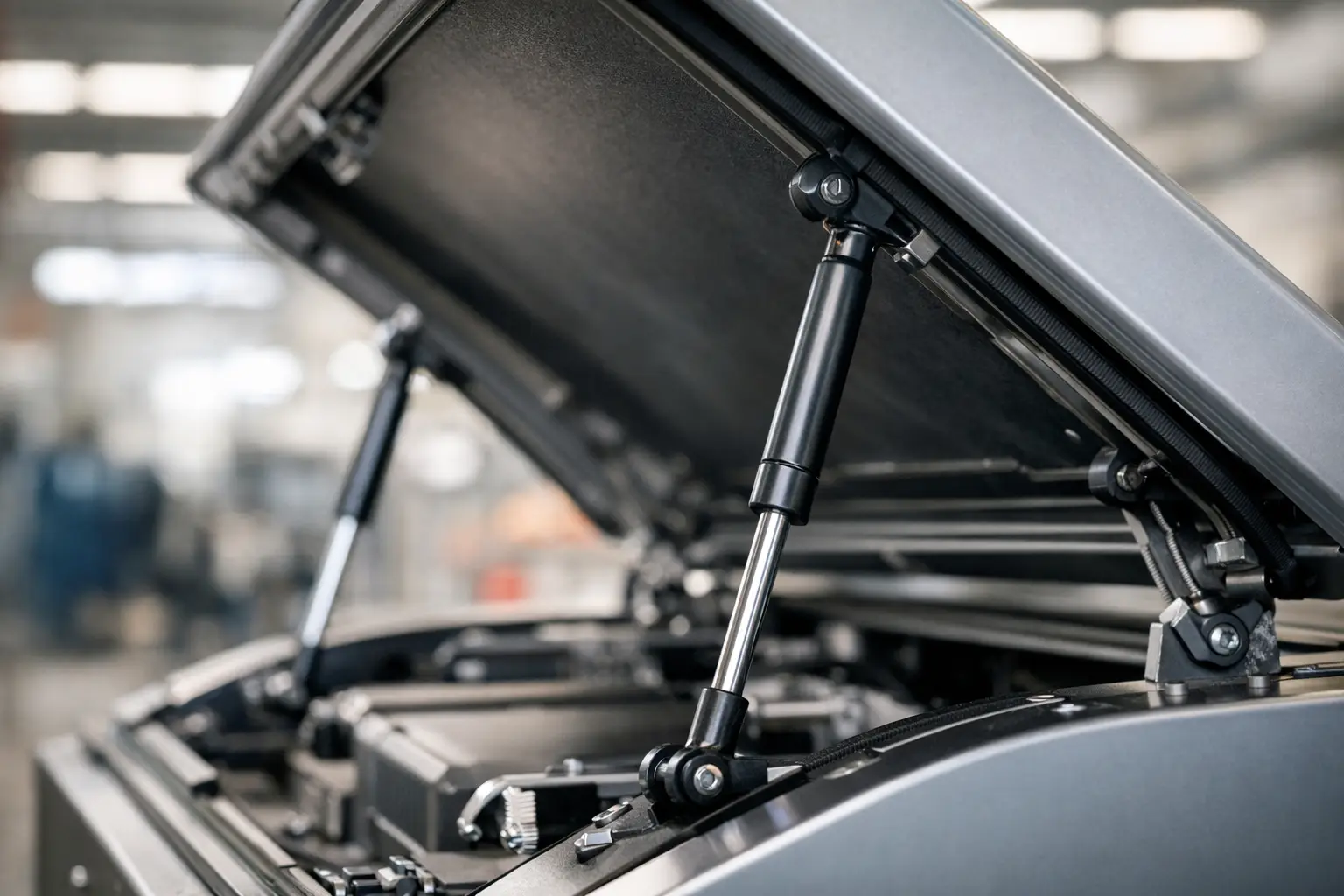
A machinery cover that drops without warning is more than an inconvenience. It slows maintenance, puts operators at risk and often points to a support system that was underspecified from the start. Choosing the right gas struts for machinery covers means getting the lift force, stroke, mounting points and operating conditions right so the cover opens safely and stays controlled through daily use.
This is one of those components that looks simple until it starts failing in service. On workshop equipment, processing machinery, plant enclosures and access hatches, the strut has to do more than hold weight. It has to manage movement, suit the geometry of the lid or guard, and keep performing in heat, dust, vibration and repeated cycling.
Why gas struts for machinery covers need proper specification
A machinery cover usually has a harder job than a standard lid on a toolbox or cabinet. Covers can be wide, awkwardly hinged, lined with insulation, fitted with viewing panels or exposed to oil mist and washdown. In some applications they are opened several times a shift. In others they sit shut for long periods, then need to open reliably during servicing.
That matters because gas strut performance is application-specific. A strut that is too weak will not support the cover through its travel. One that is too strong can make the cover hard to close, overload brackets or force the panel upward too aggressively. Neither result is acceptable on working equipment where safe access and predictable operation matter.
This is why a like-for-like replacement is usually the safest option when the original setup worked properly. If the existing strut never performed well, or the cover has been modified, the better approach is to check the actual dimensions and load requirements rather than guessing based on appearance.
The main factors that determine strut performance
Force is usually the first figure people look at, but it is only one part of the job. The Newton rating must suit the weight of the cover and the leverage created by the hinge and mounting points. Two covers with the same mass can require different strut forces if one is longer, has an off-centre load, or uses a different opening angle.
Extended length and compressed length are just as important. They determine whether the cover reaches the right open position and whether the strut fits without bottoming out when closed. Stroke length affects the range of movement. If the stroke is wrong, the cover may stop short, over-open or place stress on the hardware.
Mounting orientation also affects service life. Many gas struts are designed to operate rod-down when closed so the internal seal remains lubricated. On machinery, space constraints sometimes make this harder, but the installation angle still needs attention if you want consistent damping and seal durability.
Then there is the question of balance. Larger machinery covers often use a pair of struts, but that does not automatically halve the complexity. Bracket spacing, panel stiffness and hinge alignment all need to be considered so the load is shared properly. If one side binds or carries more weight, failure tends to come early.
Measuring existing gas struts for machinery covers
If you are replacing a failed unit, accurate measurements save time. The useful starting points are the extended length from centre to centre of the mounting points, the compressed length, the stroke, the end fitting type and any part number or force marking on the body.
It also helps to note where the strut is mounted when the cover is shut and open. A photo of both positions can be valuable, especially on machinery where clearances are tight or the brackets are not standard. If there is no visible force marking, cover weight and dimensions become more important.
For new builds or modified equipment, the strut cannot be selected on dimensions alone. You need the cover mass, hinge position, desired opening angle and likely mounting zone. That information lets a specialist work through the geometry rather than treating the strut as a generic part.
Common mistakes when selecting gas struts
The most common mistake is matching only the length. A strut might physically fit while being completely wrong in force. That usually shows up as covers that slam shut, lift unevenly or need excessive effort to latch.
Another regular issue is ignoring application conditions. Machinery covers in food processing, mining, agriculture or marine-adjacent settings can face corrosion, contamination and frequent cleaning. In those environments, material quality and sealing matter as much as raw lift force.
Bracket choice is another area where shortcuts cause trouble. Weak or poorly placed brackets can twist under load, especially on larger steel covers. If the mounting points flex, the strut is forced out of alignment and wear accelerates.
There is also a tendency to overcompensate for a heavy lid by choosing a stronger strut. That sounds sensible until the cover becomes difficult to close or pushes upward too hard near the start of travel. In machinery applications, controlled movement usually matters more than brute force.
When a standard strut is enough – and when it is not
For many machinery covers, a standard replacement works well if the original dimensions and force are known and the operating conditions are reasonable. This is often the case on workshop machinery, equipment guards and service panels where the manufacturer used common lengths and fittings.
Custom supply becomes more relevant when the cover has unusual dimensions, non-standard mounting geometry or demanding environmental conditions. The same applies when the machinery has been repaired or altered over time. Added guarding, thicker panels or changed hinge positions can all affect the force needed.
In those situations, getting technical advice early usually saves money. A cover that does not stay open or closes unpredictably leads to downtime, repeat orders and extra labour. A correctly specified custom strut setup is often cheaper than trying two or three near matches and hoping one works.
Materials, durability and service conditions
Not all gas struts are built for the same duty. On machinery covers, durability depends on internal seal quality, rod finish, cylinder quality and resistance to contamination. Frequent vibration, airborne dust and temperature swings all work against a low-grade strut.
If the equipment operates outdoors or in corrosive conditions, the finish and hardware materials need closer attention. Stainless options, protective treatments and application-suitable end fittings can make a real difference to service life. That is particularly relevant where struts are exposed on agricultural, marine or washdown equipment.
Cycle life matters too. A cover opened once a month has very different demands from one opened twenty times a day in a production setting. In higher-cycle applications, better component quality is not an extra. It is part of keeping maintenance intervals sensible.
Getting the right information before you order
The fastest way to source the correct strut is to gather the practical details before making an enquiry. In most cases that means the existing part number if available, centre-to-centre measurements when extended and compressed, end fitting type, and the force rating in Newtons. If the strut is missing or unreadable, include the cover weight, cover size, hinge location and a few clear photos.
For trade buyers, maintenance teams and OEM work, it also helps to mention the operating environment and whether the current setup is failing by dropping, over-lifting or wearing out too quickly. Those details point to the real problem. Sometimes the answer is a direct replacement. Sometimes it is a change in force, fittings or bracket position.
A specialist supplier can usually narrow the options quickly when the information is complete. That matters when equipment needs to get back into service without a long back-and-forth over basic dimensions.
A practical approach to safer cover operation
Gas struts are not just there to make a lid feel lighter. On machinery, they are part of safe access, service efficiency and day-to-day reliability. The right strut supports the cover through its full movement, reduces strain on hinges and brackets, and gives operators more control when opening and closing.
If you are replacing gas struts for machinery covers, treat the job as a specification exercise rather than a rough match. Check the measurements, confirm the force, consider the environment and ask for guidance if the setup is unusual. A few accurate details at the start usually mean fewer problems on the floor later.