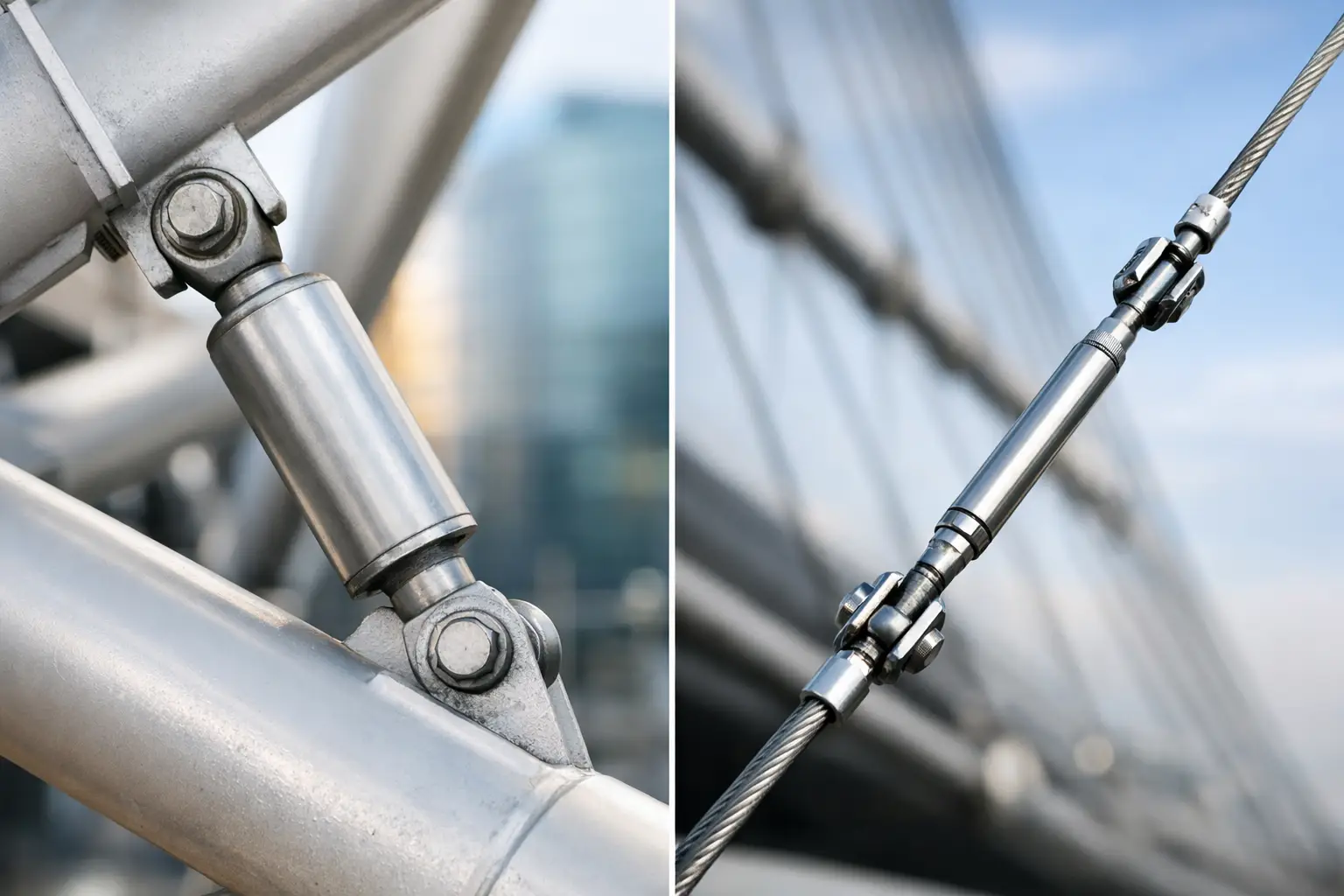
A strut that looks right on the bench can still be wrong once it is mounted. That is usually where the question of compression vs tension struts stops being technical theory and starts affecting safety, access and service life.
If you are choosing struts for a canopy, toolbox, hatch, cabinet, engine cover or machinery guard, the basic difference matters. Compression vs tension struts is not just about force direction. It affects how the lid opens, how stable it feels, how the hardware loads up and whether the strut will actually support the job over time.
What compression and tension struts actually do
A compression strut works by pushing outward as it extends. This is the standard style most people know from bonnets, boots, access hatches and storage lids. When fitted correctly, it provides lifting assistance and helps hold the panel open by applying force in compression through the rod and tube assembly.
A tension strut does the opposite job. It works in pull rather than push. Instead of resisting closure by extending against the load, it supports movement where the application requires tensile force across the mounting points. These are less common in everyday vehicle and cabinet fit-outs, but they are useful in specialised motion-control setups where the geometry demands a pulling action.
That sounds simple enough, but the real decision comes down to how your panel moves through its arc and how the mounting positions behave during opening and closing.
Compression vs tension struts in practical applications
In most automotive, marine, caravan, trailer and industrial applications, compression struts are the default choice because lids, doors and covers generally need assistance lifting away from a closed position. A toolbox lid opening upward, for example, benefits from a strut that pushes the lid open and controls the weight through the opening range.
Tension struts come into play when the structure or hinge layout means the support member needs to pull rather than push. Some machine guards, specialised access panels and engineered assemblies are built around this requirement. In those cases, fitting a standard compression unit because it is easier to source can create poor motion, bad leverage or premature bracket failure.
The important point is that the application decides the strut type, not the other way around. If the geometry calls for tension, a compression strut is not an acceptable substitute.
Why the mounting geometry matters more than the label
A lot of fitment problems are blamed on force rating when the real issue is geometry. The position of the hinge, the distance between mounting points, the opening angle and the centre of gravity of the lid all determine whether the strut is doing useful work.
With compression struts, the aim is usually to create enough leverage near the closed position to start lifting the panel, while still avoiding excessive force when fully open. If the lower bracket sits too close to the hinge or too far out of line, the strut may struggle at the start of lift or snap the lid open too aggressively.
With tension struts, the same principle applies in reverse. The bracket positions must allow the strut to remain in the correct pulling relationship through the movement cycle. If the line of force shifts too far off axis, the strut can load unevenly and the assembly may not control the panel properly.
This is why measurements matter. Extended length, compressed length, stroke, end fittings and bracket placement all need to work together. Force alone will not fix poor geometry.
Where compression struts are usually the better option
For most replacement jobs, compression struts are the right answer. They suit upward-opening lids and covers in vehicles, trailers, caravans, toolboxes, cabinets and plant equipment. They also suit many heavy-use applications where reliable opening support and hold-open performance are the main requirement.
They are common because they are practical, proven and easy to integrate into hinged assemblies. When matched correctly, they reduce lifting effort, improve access and help prevent slamming. That matters on anything from a ute canopy to a marine hatch or a machinery enclosure.
They also offer more familiar design pathways for replacement. If you are matching an existing strut, you can usually identify the required force, length and end fittings from the current unit or from measured dimensions and panel weight.
Where tension struts make sense
Tension struts are more specialised, but not rare in engineered equipment. They are useful where available space, hinge direction or load path makes a pushing strut impractical. In some assemblies, a pulling action gives better control or allows the strut to sit in a protected location.
They can also be useful where a designer needs to keep components clear of adjacent hardware during movement. On some industrial and agricultural equipment, for example, the available mounting area may make a tension setup cleaner and more durable than trying to package a compression unit into a tight space.
The trade-off is that tension applications usually need more careful specification. They are less forgiving of guesswork, and replacements should be selected against actual dimensions and operating conditions rather than appearance alone.
Common mistakes when choosing between the two
The first mistake is assuming any gas strut can be mounted either way and still do the same job. It cannot. Compression and tension struts are built for different load directions and operating conditions.
The second is focusing only on the weight of the lid or panel. Weight matters, but it is only part of the calculation. A long, light lid can need more effective support than a shorter, heavier one because of leverage. The mounting distance from the hinge changes everything.
The third mistake is overlooking the environment. Dust, vibration, salt exposure, heat and repeated cycling all affect service life. A strut on a mine-site enclosure or offshore hatch has a different duty profile from one on a kitchen cabinet or caravan locker.
Another common issue is replacing both struts with a higher force rating to compensate for worn hinges or poor bracket placement. That can overload the mounts and twist the panel. If the geometry is wrong, stronger is not better.
How to specify the right strut
Start with the function. Do you need the strut to push and assist opening, or pull through the movement path? That is the first filter.
Next, record the key dimensions. Measure the strut centre-to-centre length when extended and compressed, confirm the stroke, and identify the end fittings. Then check the mounting brackets and the opening angle of the panel. If this is a new design rather than a replacement, panel weight and centre of gravity become critical.
After that, look at force requirement in context. A toolbox lid used a few times a day is different from a plant guard cycled constantly in a production setting. Material quality, seal performance and overall build standard matter just as much as nominal force.
For custom applications, it often makes sense to work from the actual installation details rather than trying to choose from a generic chart. A specialist supplier can usually narrow it down quickly if provided with clear measurements, photos and a description of how the panel moves.
Compression vs tension struts and service life
Correct selection improves service life because the strut works through its intended load path. Misapplied struts fail earlier, not always because the internal unit is poor, but because the assembly forces it to operate under side load, over-extension or incorrect leverage.
Compression struts generally perform very well in mainstream lifting applications when mounted with proper alignment and suitable hardware. Tension struts can be equally dependable in the right setup, but they are less tolerant of rough substitution and improvised bracket changes.
That is why quality and fitment should be treated together. A certified, well-built strut is only as good as the way it is specified and mounted.
When expert advice saves time
If the application is unusual, heavily loaded or safety-critical, getting advice before ordering is usually faster than trial and error. That applies to machinery covers, marine installations, custom canopies, caravan fit-outs and industrial access systems where panel behaviour affects both safety and productivity.
A supplier that deals with both standard replacements and custom strut solutions can usually identify whether the job calls for compression or tension, then work through force, dimensions and fittings without guesswork. For many customers, that is the difference between fitting the right part once and burning time on returns, bracket modifications and unreliable operation.
At Gas Struts, that practical approach is often what matters most. People do not need theory for its own sake. They need the correct strut for the job, supplied with measurements and mounting details that make sense.
If you are weighing up compression vs tension struts, start with how the panel moves, not what the old part looked like. The right answer is the one that matches the load path, the geometry and the way the equipment is actually used.