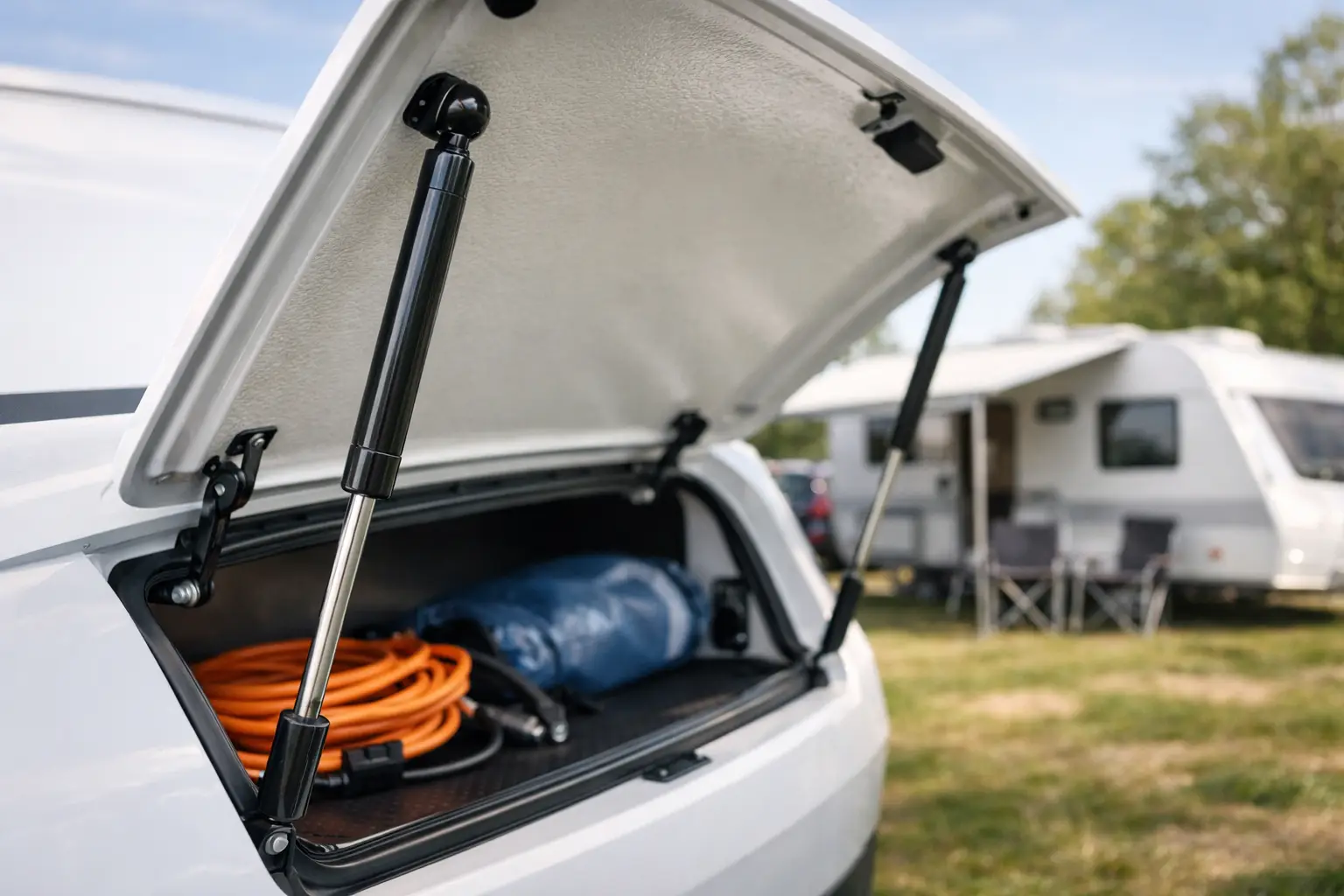
A caravan hatch that drops without warning is more than annoying. It is a quick way to damage a door, crack a fitting or cop a hand injury on a windy day. Choosing the best gas struts for caravans comes down to more than buying the same length and hoping for the best. The right strut needs the correct force, stroke, end fittings and material for the way your van is actually used.
For most caravan owners and repairers, the problem starts when the old struts have faded labels, weak lift, or no obvious part number. That is where a lot of replacements go wrong. A strut can look close enough on the bench and still perform badly once fitted. Too much force can twist hinges, bow lightweight doors and make a hatch hard to close. Too little force means sagging lids, poor support and a setup that feels unsafe from day one.
What makes the best gas struts for caravans?
The best strut is the one matched to the application, not the one with the highest force rating or the cheapest price. Caravan fitments vary widely. Front boots, tunnel boots, bed lifts, kitchen access doors and external hatches all place different loads on the strut and on the mounting points.
A good caravan gas strut should hold the panel open reliably, allow controlled closing, and work without overstressing the frame. It also needs to handle vibration, dust, weather and long periods parked up between trips. In practical terms, that means looking at five things together – extended length, compressed length, stroke, force in Newtons, and the style of end fitting.
Material quality matters as well. Outdoor caravan use is hard on plated components, especially around the coast or on corrugated roads where dust and moisture get into everything. If the strut body, rod finish or seals are poor, performance falls away quickly. A better-quality unit costs more upfront but usually saves you from replacing the same part again next season.
Start with the application, not the catalogue
If you are replacing an existing strut, measure what is on the van before you shop. Do not rely on visual similarity. The two key dimensions are the extended length from centre to centre of the mounts, and the stroke, which is the travel of the rod between fully closed and fully open. Then check the force rating marked in Newtons, usually shown as N on the tube.
That gives you a starting point, but it is not the full answer. Caravan manufacturers sometimes fit struts that are technically workable rather than ideal, particularly where door weights or accessory loads changed during production. If the hatch was always hard to shut, never opened fully, or failed unusually quickly, matching the old strut exactly may just repeat the same problem.
This is where application details matter. The size and weight of the hatch, hinge position, opening angle and mounting geometry all affect the force required. A long, lightweight composite door can need less force than a smaller checkerplate hatch because leverage changes everything. Two 250N struts are not always interchangeable if one setup uses different bracket positions.
Common caravan strut applications and what changes
Front storage boots are one of the most common caravan jobs. These hatches often cop road grime, water spray and repeated opening at campsites and stops. They need enough force to hold steady in a breeze, but not so much that they flex the lid or strain the frame. Where the lid carries a spare wheel, toolbox or extra cladding, the required force goes up fast.
Tunnel boots are similar, but the door shape and hinge layout often create different leverage. A strut that lifts well for the first half of travel may still fail to support the door at full extension if the geometry is off. That is why matching only the Newton rating can mislead.
Bed lifts inside caravans are a different job again. Here, smooth operation matters more than weather resistance alone. Too much force can make the bed base jump up or refuse to stay shut with bedding in place. Too little and the platform falls back while you are trying to access storage. These installations often benefit from recalculating force rather than copying a worn original.
External kitchen doors and service hatches usually need compact struts with reliable hold-open performance. Because these panels are opened frequently and sometimes one-handed, consistent feel matters. A strut that is technically strong enough but jerky in operation is not a great result.
How to choose the right force
Force is where most mistakes happen. Gas strut force is measured in Newtons, and more is not better unless the application demands it. Over-specifying force can damage the panel, brackets or hinge line. It can also make the hatch difficult to close, especially for smaller users.
Under-specifying force is just as bad. The hatch may lift slightly and then sag, or fail when the temperature drops. Gas struts are pressure-based, so performance can vary with conditions. A marginal strut that seems acceptable in warm weather may feel weak on a cold morning.
If you know the hatch weight, mounting points and opening angle, force can be calculated properly. That is the best approach for new caravan builds, modified hatches or any application where the old struts were clearly wrong. If those details are not available, clear measurements and photos of the setup are usually enough for a specialist supplier to narrow it down accurately.
Best gas struts for caravans often come down to fitment details
The strut itself is only part of the job. End fittings, brackets and mounting angles affect how the unit performs and how long it lasts. Ball sockets, eyelets and clevis ends are all common, but they are not universally interchangeable. Even a small mismatch can create side loading, and side loading is one of the quickest ways to shorten strut life.
Mounting orientation matters too. In many applications, fitting the rod downward when closed helps keep the internal seal lubricated. That improves service life. There are exceptions depending on the design, but it is a detail worth checking rather than assuming.
Bracket condition should not be ignored either. If the old strut failed after a hatch was forced shut or left to slam, the mounting points may already be bent or fatigued. Replacing the strut without addressing worn hardware often leads to another failure that gets blamed on the new part.
When standard struts are fine and when custom is smarter
A standard replacement works well when the measurements, force and fittings are known and the application has not changed. That covers a lot of caravan boot doors and service hatches. If the existing strut gave good service life and the hatch operation was right, a direct replacement is usually the most efficient option.
Custom struts make more sense when the hatch has been modified, accessories have been added, or the original setup was clearly compromised. Extra cladding, bike racks, stone guards and altered storage doors can all shift the load enough to require a rethink. Customising the force or fitting arrangement can turn an awkward hatch into one that opens and closes properly every time.
This is also useful for older vans where the original part is no longer easy to source. Matching the application rather than chasing an obsolete part number is often the better path.
Signs you have the wrong strut
A caravan strut that is wrong for the job usually tells you quickly. The obvious signs are a hatch that will not stay open, a door that needs too much effort to close, uneven lifting from side to side, or brackets that start loosening in the panel. Less obvious signs include seals wearing early, hinge distortion, and a hatch that opens too aggressively near the top of travel.
If one side has failed and the other still seems passable, replacing both is generally the sensible move. Gas struts wear over time, and pairing a new unit with a tired one often creates uneven load and poor operation.
What to have ready before ordering
A fast, accurate replacement starts with the right information. Measure the extended length centre-to-centre, the compressed length if possible, the stroke, and the force marking on the old unit. Note the end fittings, the bracket style and where the strut mounts on the hatch and frame. A few clear photos save time, particularly if labels are missing.
If the original strut has no readable markings, mention what the hatch is used for, whether any accessories have been added, and whether the old setup ever worked properly. Those details matter. A specialist supplier can usually identify whether a standard caravan replacement will do the job or whether a custom option is the safer bet.
Quality support is part of the product in this category. The best suppliers do not just dispatch a strut that is close enough. They help verify fitment, force and application so you are not wasting time removing and refitting parts that were wrong from the start.
A good caravan strut should feel boring in the best possible way. It should lift cleanly, hold where it should, and keep doing that trip after trip without drama. If you are choosing carefully now, you are not just replacing a worn part – you are fixing how the hatch works every time you open it.