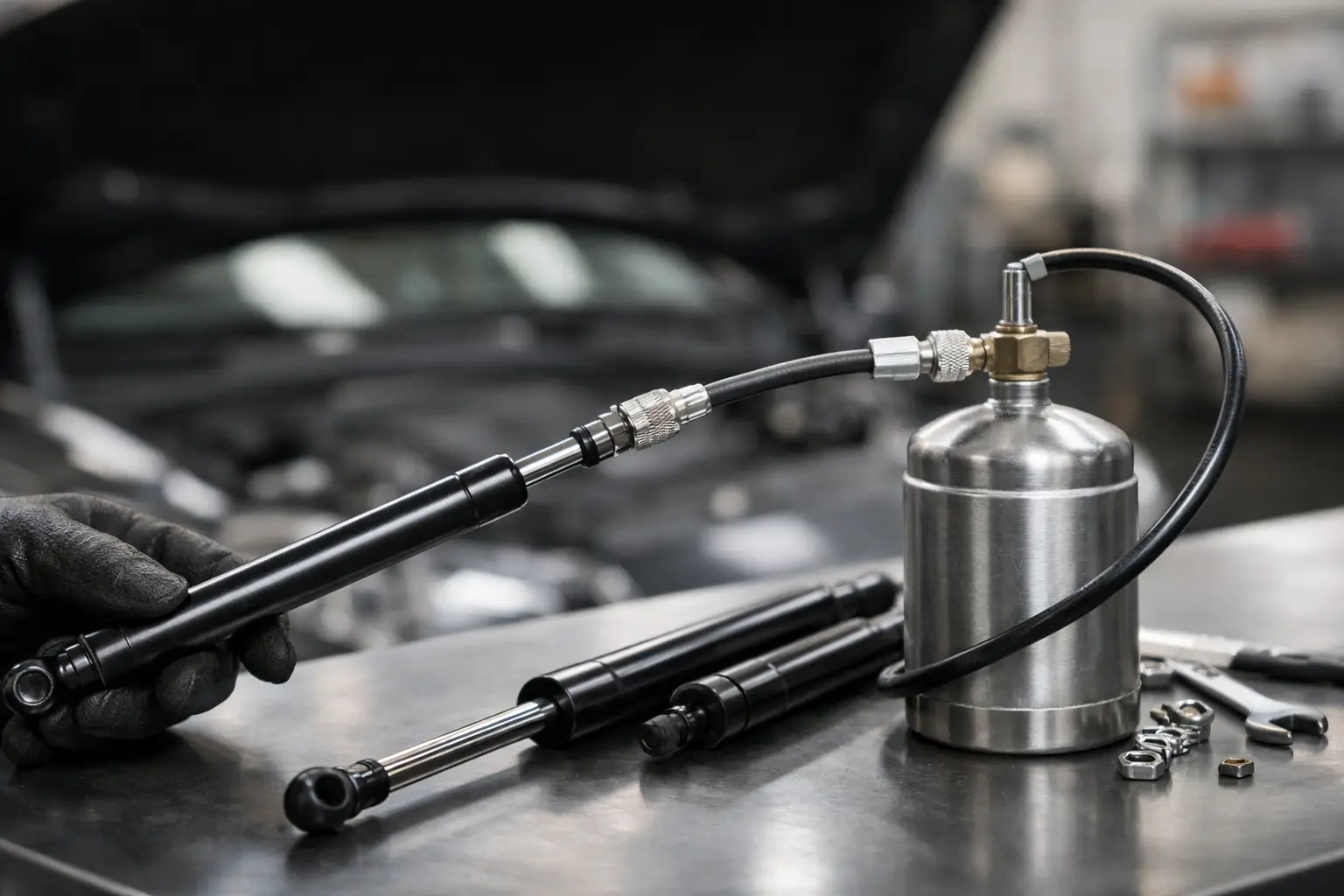
A bonnet that won’t stay up or a toolbox lid that drops without warning usually leads to the same question – can gas struts be re-gassed? The short answer is sometimes, but in most working applications, replacement is the more reliable option. Whether re-gassing is possible depends on how the strut was built, why it has lost force, and whether the rest of the unit is still in sound condition.
Can gas struts be re-gassed in practice?
Technically, some gas struts can be re-gassed. In practice, many cannot, and many that can be recharged are still not worth doing. Most standard gas struts are sealed units charged with nitrogen at the factory. They are designed to deliver a specific force over a long service life, not to be routinely topped up like a tyre.
Once a strut starts losing force, the gas loss is often only part of the problem. Seal wear, rod damage, internal oil loss, corrosion, or mounting misalignment may already be present. If you only add gas pressure back into a worn strut, you can end up with a unit that still performs poorly, leaks again, or creates unsafe movement.
That is why trade users, workshops, and equipment operators usually treat weak gas struts as replacement items unless the unit is a known serviceable type.
Why gas struts lose pressure
Gas struts do not normally fail all at once unless there has been physical damage. More often, they lose performance gradually. A rear canopy window might stop lifting cleanly. A caravan bed base may start sagging. A machine guard may no longer hold safely at full extension.
The most common cause is seal wear over time. Every cycle puts the rod, seals, and internal surfaces under load. Heat, dust, moisture, vibration, and side loading all shorten service life. In heavy-use environments like mining, agriculture, marine work, and industrial machinery, that wear can happen faster than many people expect.
Corrosion on the rod is another common issue. Even light pitting can damage the seal each time the rod moves. Once that happens, re-gassing does not fix the root cause. The same applies if the rod is bent, the end fittings are worn, or the strut has been operating outside its intended angle or stroke.
When re-gassing might make sense
There are situations where re-gassing is possible and sensible. The main one is when the strut was specifically designed to be serviceable. Some specialised units include a valve or charging point and are built for adjustment or maintenance. These are more common in engineered systems, niche industrial uses, or custom motion-control applications.
Re-gassing may also be considered where the strut body, rod, seals, and end fittings are all in good condition, and the only confirmed issue is reduced gas pressure. Even then, the job should be done with the correct equipment and the correct nitrogen charge. Gas strut force is not guesswork. Overcharge the unit and the lid or hatch may become difficult to close, stress the mounts, or open too aggressively. Undercharge it and you are back where you started.
For unusual applications, especially where the strut length, force, fittings, or damping are not easy to replace off the shelf, an assessment can be worthwhile before deciding.
When replacement is the better option
For most standard automotive, caravan, trailer, cabinet, canopy, toolbox, and machinery struts, replacement is usually the better call. It is faster, more predictable, and often more cost-effective than trying to recover an ageing sealed unit.
A new strut gives you known performance. You can match the extended length, compressed length, stroke, end fitting type, and force rating to the job. That matters because struts are not interchangeable just because they look similar. A few millimetres in length or a modest difference in Newton force can change how a panel opens, where it stops, and how safely it holds.
Replacement also removes the uncertainty around hidden wear. If an old strut has already lost pressure once, the internal condition is rarely as good as new. In a safety-critical application, that matters.
Safety matters more than saving one strut
A weak gas strut is inconvenient on a small cabinet. On a heavy hatch, engine cover, service panel, plant guard, or storage lid, it can be a hazard. If the supported load can fall, pinch, or strike someone, replacing suspect struts is generally the safer and more practical decision.
This is especially true when struts are fitted in pairs. If one has weakened, the other is usually not far behind. Replacing only one side often creates uneven lift and twisted loading through the mounts.
Can gas struts be re-gassed at home?
For most users, no. Gas struts are charged to high pressure and need the right equipment, handling process, and specification data. Attempting to drill, heat, puncture, or modify a sealed strut is unsafe. It can damage the unit, injure the operator, and leave you with a strut that no longer behaves in a controlled way.
There is also a common misunderstanding that any compressed gas will do. It will not. Gas struts are generally charged with nitrogen because it is stable and dry. Using the wrong gas or an uncontrolled charging method can affect force consistency and service life.
If your strut has no service valve and no manufacturer guidance confirming it is rechargeable, assume it is a sealed replacement unit.
How to tell whether your strut should be replaced
Start with a basic inspection. If the rod is rusty, scored, oily, bent, or dirty with embedded grit, replacement is the likely answer. If the strut no longer supports the load through the full movement, if it sticks, or if the end fittings have play, there is little value in chasing a re-gas alone.
It also helps to look at the markings on the body. Most struts are labelled with a force rating in Newtons, a part number, and sometimes the extended length. If you can still read those details, you are already well on the way to sourcing a correct replacement.
If the label is gone, the next step is measurement. You need the extended length centre-to-centre, the compressed length, the stroke, the end fitting type, and ideally the original mounting orientation. Load details help too, especially if the old struts were never quite right or the application has changed.
Signs the existing setup may have been wrong from the start
Not every failed strut has simply worn out. Some were underspecified, over-pressurised, or badly mounted from day one. If the panel has always slammed open, been hard to close, or twisted during movement, there may be a sizing or geometry issue rather than just age.
In those cases, replacing like-for-like may only repeat the same problem. A proper specification check can save time and avoid repeated failures.
The cost question
People often ask about re-gassing because they want the cheapest fix. That is understandable, especially when several struts need attention at once. But the cheapest option on paper is not always the cheapest in service.
If re-gassing is available but the strut fails again soon after, you have paid for labour and still need a replacement. If downtime matters, that delay costs more. If the application is on a work vehicle, trailer, machine cover, or frequently used storage system, reliability usually matters more than squeezing a little more life out of a tired component.
For standard applications, a correctly matched new strut is often the cleaner solution. For custom or hard-to-source units, assessment first makes more sense.
What to have ready before you ask for advice
If you need to work out whether a gas strut can be re-gassed or should be replaced, the most useful information is straightforward. Have the part number if it is visible, the force in Newtons, the extended and compressed lengths, photos of the end fittings, and a photo of the strut installed on the application. If the supported item is unusually heavy or mounted off-centre, mention that too.
That level of detail makes it easier to tell whether you need a standard replacement, a force adjustment, or a custom solution. It also avoids the common mistake of ordering a strut that is close enough in appearance but wrong in performance.
For most people asking can gas struts be re-gassed, the practical answer is this: if the unit is a standard sealed strut and it has gone weak, replace it with the correct specification. If it is a serviceable or unusual unit, get it assessed properly before deciding. A gas strut is there to control movement safely, not just to hold something up, so the right fix is the one you can rely on every time you open the lid.