A rear canopy door that will not stay up, a toolbox lid that drops without warning, or a bonnet that suddenly feels heavier than it should usually points to one thing – it is time to learn how to replace petrol struts properly. The job is often straightforward, but only if you match the right strut, fit it the right way, and work safely around any load the strut is supporting.
Replacing a strut is not just a matter of swapping one cylinder for another that looks similar. Extended length, compressed length, force rating, end fittings and mounting orientation all matter. Get one of those wrong and you can end up with poor lift, binding, premature wear, or a lid that becomes unsafe in service.
Before you replace petrol struts, check the basics
A failed petrol strut is usually easy to spot. The lid, hatch, seat base or access panel will not stay open, opens unevenly, or needs extra force to lift. In some cases the strut may show oil residue around the rod seal, corrosion on the shaft, or bent end fittings after heavy use.
That said, the strut is not always the only issue. Worn brackets, misaligned mounts, seized hinges and overloaded lids can all mimic strut failure. If the panel has twisted, the hinges are dragging, or someone has fitted a heavier canopy window, replacing the struts alone may not solve the problem. It pays to inspect the full setup before ordering parts.
If the existing struts still have legible markings, note the part number, force in Newtons, and any sizing data. That can save time and remove guesswork. If the label is gone or the strut is not original, measure it manually and confirm the application.
How to replace petrol struts safely
The biggest mistake in this job is removing a strut before the lid or panel is properly supported. Petrol struts often carry more load than people expect, especially on canopies, caravan boots, marine hatches and industrial access covers. Once one strut is removed, the remaining support may not be enough.
Use a prop, support stand or a second person to hold the panel securely in the fully open position. On heavier applications, support both sides evenly so the structure does not twist. If you are working on machinery or plant, isolate the equipment first and make sure no stored movement can occur while the strut is off.
Wear eye protection and gloves if access is tight or the mounting area is dirty. Keep hands clear of pinch points near hinges and brackets. A strut under normal service pressure should never be punctured, heated, crushed or modified.
The tools you usually need
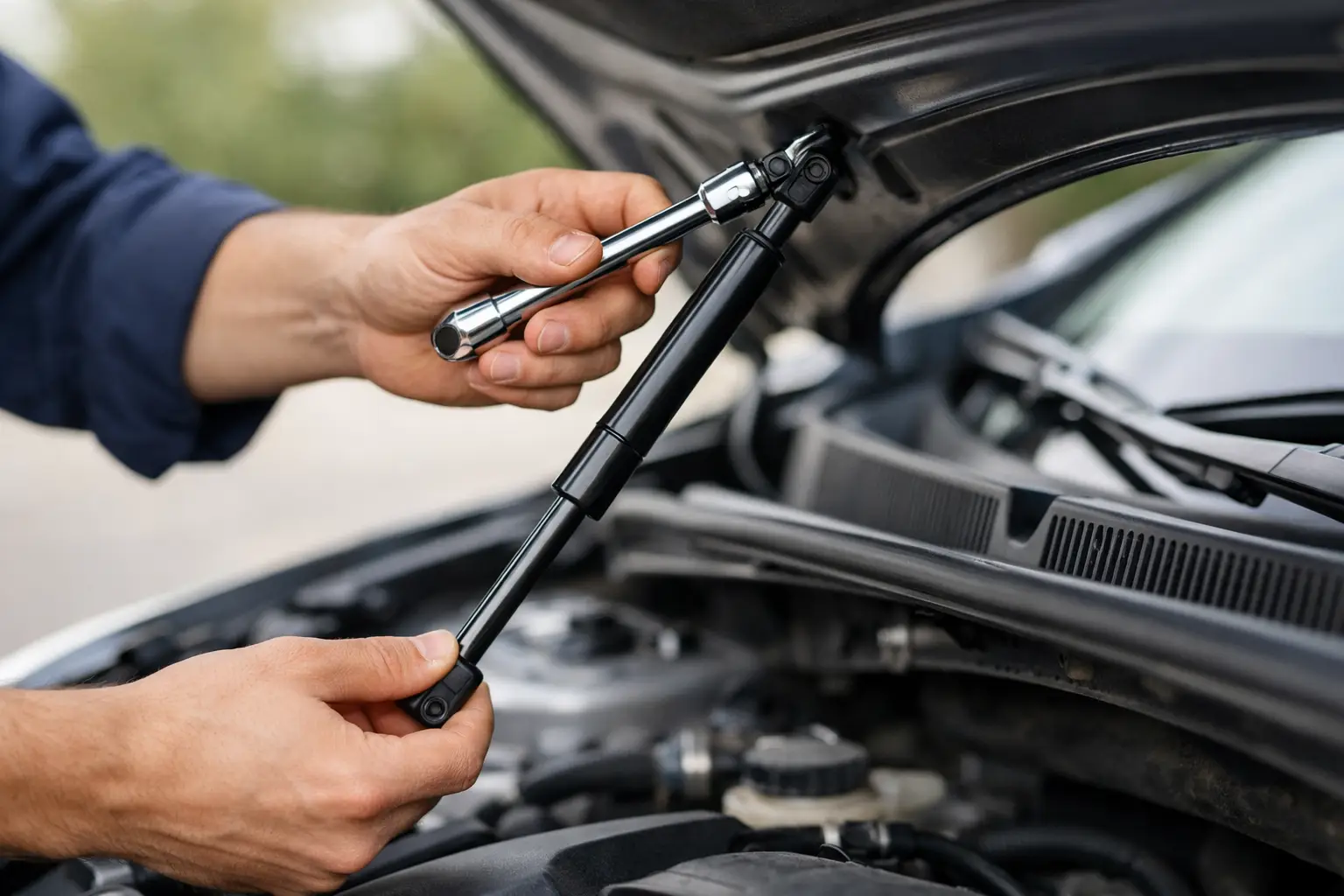
Most replacements only require basic hand tools. A small flat screwdriver is commonly used to lift the retaining clip on socket-style end fittings. Some setups use bolts, nyloc nuts, washers or clevis pins instead, so you may also need spanners or sockets.
You do not usually need to fully remove the retaining clip from a ball socket fitting. In most cases, lifting it slightly is enough to release the socket from the ball stud. Forcing the clip right out can make refitting harder and increases the chance of losing it.
Measuring the old strut before ordering
If you want to know how to replace petrol struts without repeat downtime, measurement is the part to get right. A close-looking substitute is not necessarily a correct replacement.
Measure the extended length from the centre of one end fitting to the centre of the other when the strut is fully open. Then measure the compressed length centre-to-centre with the strut closed, if it is still operable. You should also note the rod diameter, tube diameter, and the exact style of end fitting on each end.
Force rating is just as important. This is usually marked in Newtons, often shown as N. If the original says 400N, 500N or 800N, that figure should not be treated as a rough guide. Too little force and the panel will not stay up. Too much force and it may be difficult to close, place stress on hinges, or cause the lid to spring open too aggressively.
Where the strut has no visible rating, the application details become critical. The lid weight, hinge position, mounting point geometry and opening angle all affect the force required. This is where specialist guidance matters, particularly for custom canopies, toolboxes, machinery guards and marine fitouts.
Removing the old strut
Once the panel is safely supported, remove one strut at a time. That helps preserve alignment and makes it easier to compare the new unit with the old one during fitment.
On ball socket ends, use a flat screwdriver to lift the retaining clip just enough to release the socket, then pull the fitting off the ball stud. Start at the easier end to access. On bolted or pinned ends, remove the fastener while keeping the strut from twisting against the bracket.
As soon as the old strut is free, compare it directly with the replacement. Check overall length, end fittings, body diameter and rod diameter before you attempt installation. A mismatch is easier to fix at this stage than after forcing the part into place.
Fitment direction matters
In most standard applications, petrol struts should be installed with the rod pointing down when the panel is closed. That orientation helps keep the internal seal lubricated and can extend service life. There are exceptions, particularly in unusual mounting positions or motion-control setups, but rod-down is the usual rule for lift-assist struts.
If the old strut was fitted rod-up, do not assume that was correct. It may have been installed that way for clearance reasons, or it may have been a poor previous repair. Check the mounting geometry before copying the old orientation.
Installing the new petrol strut
Fit the new unit to the same mounting points as the original unless you are deliberately correcting a known bracket issue. Push socket ends onto the ball studs until they snap into place, or refit pins and fasteners with the correct hardware. Do not hammer a strut into position. If the lengths or angles do not line up naturally with the panel supported in the right position, stop and recheck the specification.
After one side is installed, repeat the process on the second strut if the application uses a pair. Struts fitted as a pair should generally be replaced as a pair. If one has failed, the other is usually not far behind, and uneven performance side to side can twist the panel and overload hinges.
Once both are fitted, remove the support carefully and cycle the panel through its full range of movement. It should open smoothly, hold reliably, and close without excessive force. Watch for signs of binding, bracket flex, uneven lift or contact between the strut body and surrounding structure.
Common mistakes when replacing petrol struts
Most fitment problems come back to specification errors rather than installation technique. Choosing the wrong force is the biggest one. A strut that is too strong is not better quality – it is simply the wrong part for the job.
Another common issue is ordering by appearance alone. Two struts can look almost identical while having different stroke lengths, end fittings or force ratings. That is why measurements and application details matter.
Bracket condition is also often overlooked. If a ball stud is loose, bent or worn, a new strut will not perform properly for long. The same goes for damaged hinges. Replacing the strut without fixing the mounting hardware can shorten the life of the new part.
Finally, avoid mixing old and new struts on the same lid. The imbalance can cause uneven opening and unnecessary side load. For workshop vehicles, caravans, trailers and industrial equipment that see regular use, replacing both sides together is usually the sensible option.
When the replacement is not straightforward
Some applications are simple, such as a toolbox or cabinet lid with standard end fittings and a visible part number. Others are more technical. Canopy windows, marine hatches, agricultural equipment, mining plant and custom machinery often use non-standard lengths, unusual brackets or force ratings selected around specific load paths.
That is where application support can save time. If you can provide the extended length, compressed length, end fitting type, Newton rating if known, and a few photos of the mounted position, a specialist supplier can usually narrow down the correct replacement quickly. For custom jobs, the lid dimensions, weight and mounting geometry may also be needed.
For Australian users who need a standard replacement or a custom-fit option, Petrol Struts can help match the correct part from measurements, markings or application details at https://gasstruts.net.au/.
A good replacement job is not about forcing a quick swap. It is about restoring safe, predictable movement so the lid, hatch or access panel works properly every time. If you measure carefully, support the load properly and fit the right strut for the application, the job is usually simple and the result is worth doing once.