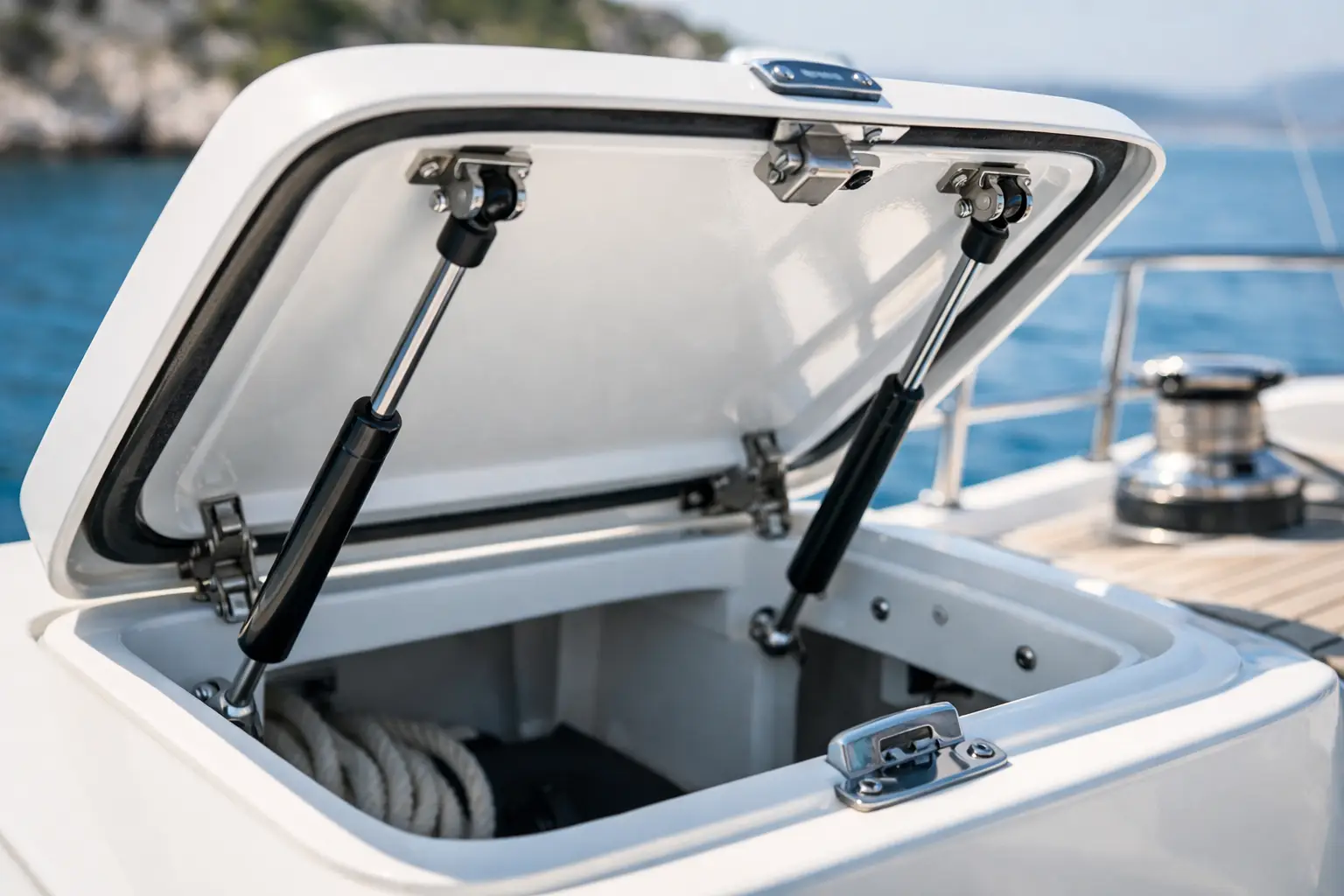
A hatch that will not stay open is more than an annoyance on a boat. It is a safety issue, a maintenance problem and, in rough conditions, a good way to end up with damaged hardware or injured hands. Marine hatch petrol struts need to do a simple job reliably – lift the hatch, hold it steady and close without fighting you – but getting that result depends on more than matching a part by eye.
Salt, spray, UV exposure and constant vibration make marine applications less forgiving than many land-based installs. A strut that works well on a toolbox or canopy may not last on a bait board locker, engine hatch or under-seat compartment if the materials, force rating and mounting geometry are wrong. That is why marine hatch selection should be treated as a technical fitment, not a generic replacement.
What marine hatch petrol struts actually need to handle
On a boat, the strut is working against more than hatch weight. The hinge position, opening angle, sea movement and hardware placement all change how the strut behaves. A relatively light hatch can still need a surprisingly firm strut if the mounting points give it poor leverage. The reverse is also true – a heavy hatch can sometimes be controlled with less force if the geometry is efficient.
Material choice matters as well. In marine conditions, corrosion resistance is not optional. Stainless steel components are generally preferred where they are exposed to salt air or direct spray, especially on external hatches and frequently opened compartments. If a hatch is in a more protected area, material options can be broader, but the environment still needs to be considered properly.
There is also the issue of controlled movement. A hatch should open smoothly and stay in position without launching upward or slamming down. That balance comes from correct force selection and proper bracket placement. Too much force can stress hinges, distort mounting points and make the hatch difficult to close. Too little force leaves the hatch unstable and unsafe.
How to choose the right marine hatch petrol struts
The fastest way to get the right result is to start with the existing strut, if one is fitted. In many cases, the old unit provides the key specifications: extended length, compressed length, end fittings and force rating in Newtons. If the original strut has failed, these details are still useful as a reference, though they should not be copied blindly if the hatch has always been hard to operate.
Measure the strut correctly
Extended length is measured centre-to-centre between the mounting points when the strut is fully open. Compressed length is the same measurement when the strut is closed. Stroke is the difference between the two. These dimensions affect whether the hatch opens far enough and whether the strut bottoms out before the hatch is fully shut.
A few millimetres can make a real difference. If a replacement is too long, it may stop the hatch closing properly or put the body under load at full shut. If it is too short, you can lose opening height or create poor operating angles.
Check the force rating
The force rating, usually marked on the strut body in Newtons, tells you how much assistance the strut provides. This is one of the most common points of error. People often assume a hatch simply needs more force when it starts dropping, but that can be the wrong fix if the mounting points are worn, the hinges are binding or the original strut was over-spec’d in the first place.
If there is no readable force marking, the hatch weight and bracket geometry need to be assessed. This is where application advice can save time. A strut is not selected by weight alone because the lever effect changes across the opening arc.
Match the end fittings and brackets
Ball joints, eyelets, fork ends and specific marine brackets all affect installation and movement. The fittings need to match both the strut and the hatch mounting hardware. Adapters are sometimes possible, but not always ideal in a space-constrained compartment.
Bracket position also affects performance. Even with the correct strut, a poor bracket location can cause over-extension, weak lift or uneven loading. If you are designing a new hatch setup rather than replacing an existing unit, bracket geometry should be part of the selection process from the start.
Common marine applications and what changes between them
Not all boat hatches behave the same way. An anchor well hatch, an engine cover and a side locker lid can all use petrol struts, but the conditions and movement are different.
External deck and locker hatches
These are usually exposed to water, sunlight and regular washdown. Corrosion resistance is a priority, and drainage around the mounting area should be checked. If water sits around the brackets or the rod is constantly exposed, service life can drop quickly with the wrong material choice.
Engine hatches and service covers
Engine access hatches tend to be heavier and often need higher force ratings or twin strut setups. Heat can also affect performance over time, particularly in enclosed compartments. For larger lids, balanced lift on both sides is important to avoid twisting the hatch or overloading hinges.
Seating and storage compartments
Under-seat hatches and storage lids often need a smoother, lighter action because they are opened frequently and used in tighter spaces. In these cases, the strongest strut is rarely the best one. Ease of closing and controlled opening matter just as much as hold-open force.
When replacing one strut is not enough
If a boat hatch uses two struts, replacing only the failed side is usually a false economy. Petrol struts lose performance over time, and a new unit paired with a tired one creates uneven lift. That can rack the hatch, overload one bracket and make the lid sit awkwardly when open or shut.
The same logic applies when hinges, brackets or mounting screws are worn. A new strut cannot compensate for loose fixings, cracked substrate or a hinge that has started to bind. Before fitting replacements, inspect the mounting area properly. On marine installations, moisture ingress around fasteners can create hidden weakness in timber cores or composite panels.
Signs the original setup may have been wrong
Not every failed hatch strut is simply worn out. Sometimes the strut was marginal from day one. If the hatch has always needed two hands to shut, never opened to a practical angle or dropped halfway through its travel, the original specification may have been off.
Another common issue is over-force. This shows up when a hatch springs open aggressively, sits under obvious strain when closed or starts pulling on hinges and brackets. It may feel secure at first, but over time that excess load can cause more expensive damage than the strut itself.
This is where a proper review of dimensions, force and mounting points is worthwhile. A better-spec’d replacement can improve usability and reduce wear across the whole hatch system.
Why marine-specific advice saves time
Marine hatch fitment is one of those jobs that looks straightforward until the measurements start conflicting with the way the hatch actually moves. That is why technical support matters. If you can provide the strut length, force if known, end fitting type, mounting orientation and a few basic hatch details, the selection process becomes much more accurate.
For non-standard setups, custom solutions are often the better path. That might mean a different force rating, alternate end fittings or guidance on revised bracket placement. For trade customers, boat builders and maintenance teams, getting that right early avoids repeat labour and unnecessary part swaps.
Specialist suppliers such as Petrol Struts can help assess both replacement and new marine hatch applications, particularly where the original part number is missing or the existing setup has never worked as it should. The key is giving enough detail to match the strut to the hatch, not just to the old part.
A reliable hatch should open with control, stay where you put it and close without a fight. If yours does anything else, the fix is usually not complicated – but it does need to be the right one.