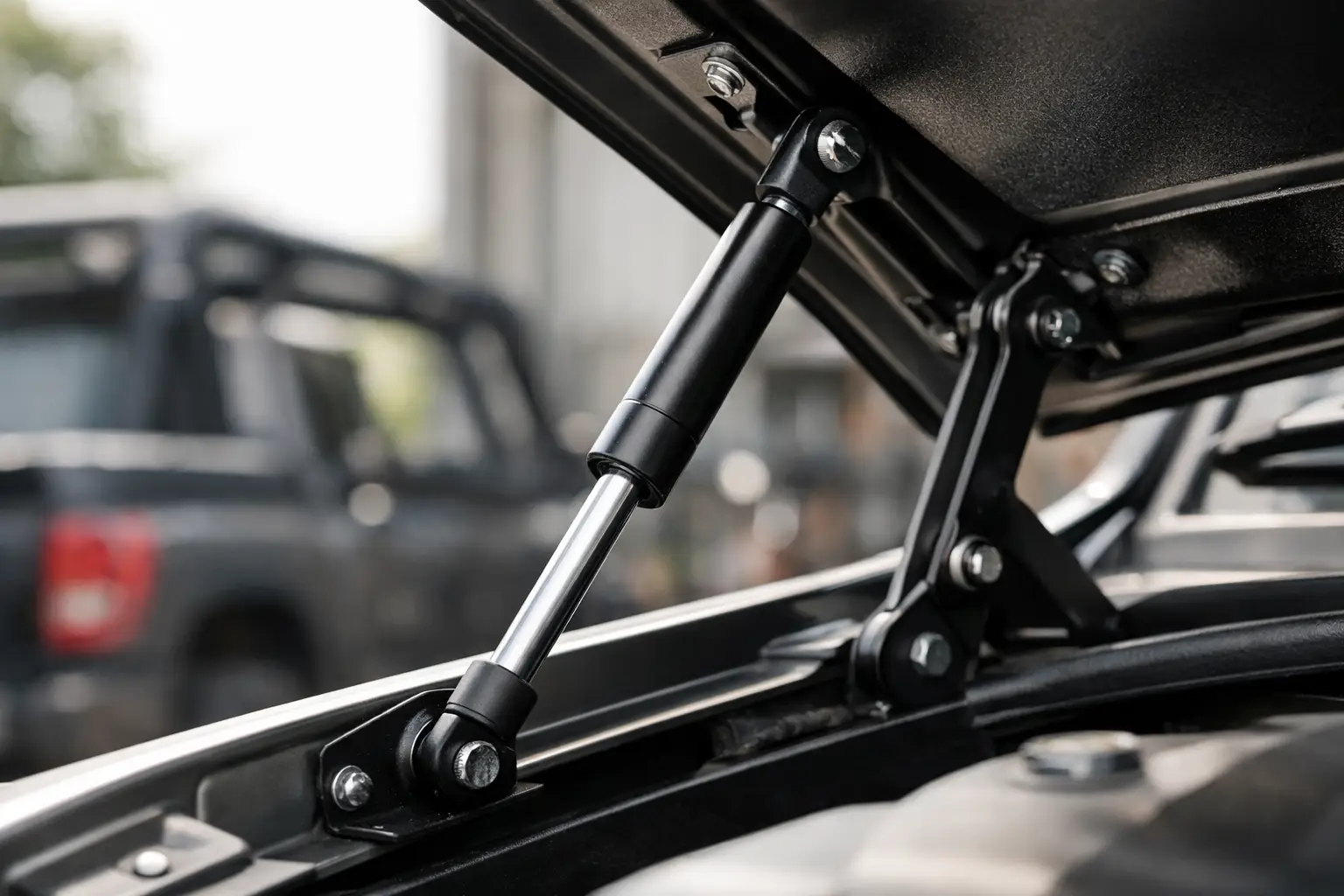
A failed strut usually gets attention when a canopy lid drops, a toolbox refuses to stay open, or a machine guard becomes a safety risk. That is where a proper heavy duty petrol strut review matters. For trade vehicles, industrial equipment, trailers, marine hatches and agricultural gear, the difference between a strut that merely fits and one that performs properly shows up fast in daily use.
This is not a product category where the cheapest option wins for long. Heavy duty petrol struts are load-bearing components, and once forces increase, small mistakes in sizing, end fittings, mounting geometry or seal quality become expensive. If you are replacing a failed strut or specifying one for a new build, the review criteria need to go beyond simple length and pressure.
Heavy duty petrol strut review – the real buying criteria
A good heavy duty petrol strut should do three things consistently. It should lift or support the load safely, operate smoothly through the full stroke, and maintain force over time in the environment it is actually used in. If one of those drops out, the strut is not doing the job, even if the catalogue dimensions look right.
Force rating is usually the first number buyers look at, but it should not be the only one. A strut with the wrong force can be just as problematic as a worn-out unit. Too little force and the hatch or lid falls away. Too much and the panel becomes difficult to close, hinges take extra stress, and mounting points can distort or fail.
Extended length, compressed length and stroke also matter, but they only tell part of the story. Mounting position changes leverage, and leverage changes effective force. That is why two struts with the same nominal force can behave very differently on different applications. A ute canopy side window, a caravan front boot, and a heavy machinery access panel all ask for different geometry.
Build quality is the next separator. On heavy-use applications, the rod finish, sealing system, cylinder strength and end fitting quality all affect service life. In cleaner, lower-cycle environments, lower-grade struts can sometimes hold up for a while. In mining, marine, agriculture or road-exposed vehicle use, they tend to show their limits quickly.
Where heavy duty struts perform well – and where they don’t
Heavy duty petrol struts are well suited to repetitive lifting tasks where controlled assistance is needed. They are commonly used on toolboxes, service bodies, trailers, canopies, machinery covers, marine lockers, cabinetry, seating assemblies and industrial access doors. In these cases, a correctly specified strut reduces strain on the user and supports safer opening and closing.
They are less forgiving when buyers treat them as universal parts. A strut chosen only by eye, or matched by approximate length without checking force and end fitting detail, often creates more problems than it solves. The panel may open too aggressively, stop short, twist during movement, or place uneven load on hinges. On heavier lids, this is not just inconvenient – it can become a maintenance and safety issue.
Temperature is another factor that gets missed. Petrol strut force varies with temperature, so a unit that behaves acceptably in a mild workshop may feel different on a hot day in the Pilbara or a cold early start in the southern states. For demanding applications, that variation should be considered before finalising force selection.
What separates a quality heavy duty strut from a cheap one
The biggest difference is usually not visible in a photo. It is in consistency. Better-quality struts deliver more reliable force, smoother operation and slower degradation over time. That matters when the application cycles frequently or carries real weight.
A quality strut will usually have better corrosion resistance, stronger end attachments and better sealing. That becomes especially important on marine gear, trailers, farm equipment and trade vehicles that live outdoors. Surface rust on the rod, contamination around seals, or play in the ball joints are early warning signs that service life may be short.
Certification and manufacturing standards also matter more than many buyers realise. If a supplier can back its product quality with recognised production standards and application support, that is usually worth more than a low upfront price. For buyers managing fleets, workshops or industrial assets, fewer failures and fewer incorrect replacements generally save more than bargain purchasing ever does.
Fitment is where most problems start
A large share of petrol strut failures are not really product failures. They are fitment errors. The old strut may have been wrong from the beginning, and replacing it with the same part only repeats the issue.
The key checks are straightforward. Confirm the extended length from centre to centre, the compressed length, the stroke, the end fitting type and thread size, and the force in Newtons if it is marked. Then check how the strut is mounted. Orientation, bracket position and open angle all affect performance.
If the original markings are worn off, measuring the part is only half the job. You also need to know what the strut is supporting, where the hinge point sits, and whether one or two struts are used. Lid weight, weight distribution and available mounting space all influence the correct specification.
For custom or modified setups, relying on a direct measurement alone can lead to poor results. This is where technical advice matters. A specialist supplier can work from dimensions, load details and photos to narrow down the right force and mounting arrangement, which is often faster than trial and error.
Heavy duty petrol strut review for common applications
On vehicles, the priority is usually dependable support with compact fitment. Bonnets, canopies, service bodies and toolboxes need struts that open cleanly and cope with vibration, dust and weather exposure. Here, durability and bracket strength are just as important as lift force.
On caravans and trailers, smooth movement matters because many access doors are relatively light but awkwardly hinged. Overpowered struts can twist frames or make closures difficult. Underpowered ones leave doors unsafe in windy conditions. Balance is more important than headline force.
In industrial and machinery use, the stakes are higher. Guards, covers and inspection panels are often heavier, used more frequently and expected to stay secure during maintenance. This is where heavy duty really has to mean something. Material quality, repeatability and proper specification are not optional.
Marine and agricultural applications place extra pressure on corrosion resistance and sealing. Salt, moisture, mud and fertiliser exposure can shorten the life of poor-quality struts quickly. Buyers in these sectors should be cautious about generic replacements that do not match the operating environment.
Is custom sizing worth it?
Sometimes yes, and sometimes it is unnecessary. If you have a straightforward replacement and the original unit performed correctly, a matching stocked strut is usually the practical choice. It is faster, simpler and often the most economical path.
If the old strut failed repeatedly, the lid has been modified, the brackets are not standard, or the application has unusual weight or travel, custom supply often makes more sense. The same applies when the load has to open to a precise angle or clear surrounding hardware. In those cases, a custom-spec unit can prevent ongoing issues with fitment and premature failure.
For trade and industrial buyers, custom is often less about special treatment and more about reducing downtime. Getting the correct strut the first time matters when equipment availability is tied to labour, site access or vehicle use.
What a buyer should ask before ordering
The useful questions are practical. What is the exact application? What length and stroke are required? What force is needed? What end fittings are used? Is the environment dusty, wet, corrosive or high-cycle? Is the current strut lifting correctly, or has it always been marginal?
If a supplier can answer those questions clearly and help work through missing details, that is a good sign. A broad range also helps, because it increases the chance of finding the correct specification rather than forcing a near match. For buyers who need support across different vehicles, trailers, cabinets or industrial assets, dealing with a specialist supplier such as Petrol Struts can shorten the process significantly.
Final verdict
A proper heavy duty petrol strut review comes down to one principle – the right strut is the one that matches the real load, the real geometry and the real operating conditions. Price matters, but not more than safe support, service life and fitment accuracy. If you are replacing a failed unit, take the extra few minutes to check dimensions, force and mounting detail properly. That is usually the difference between a quick fix and a part that keeps doing its job long after the first install.