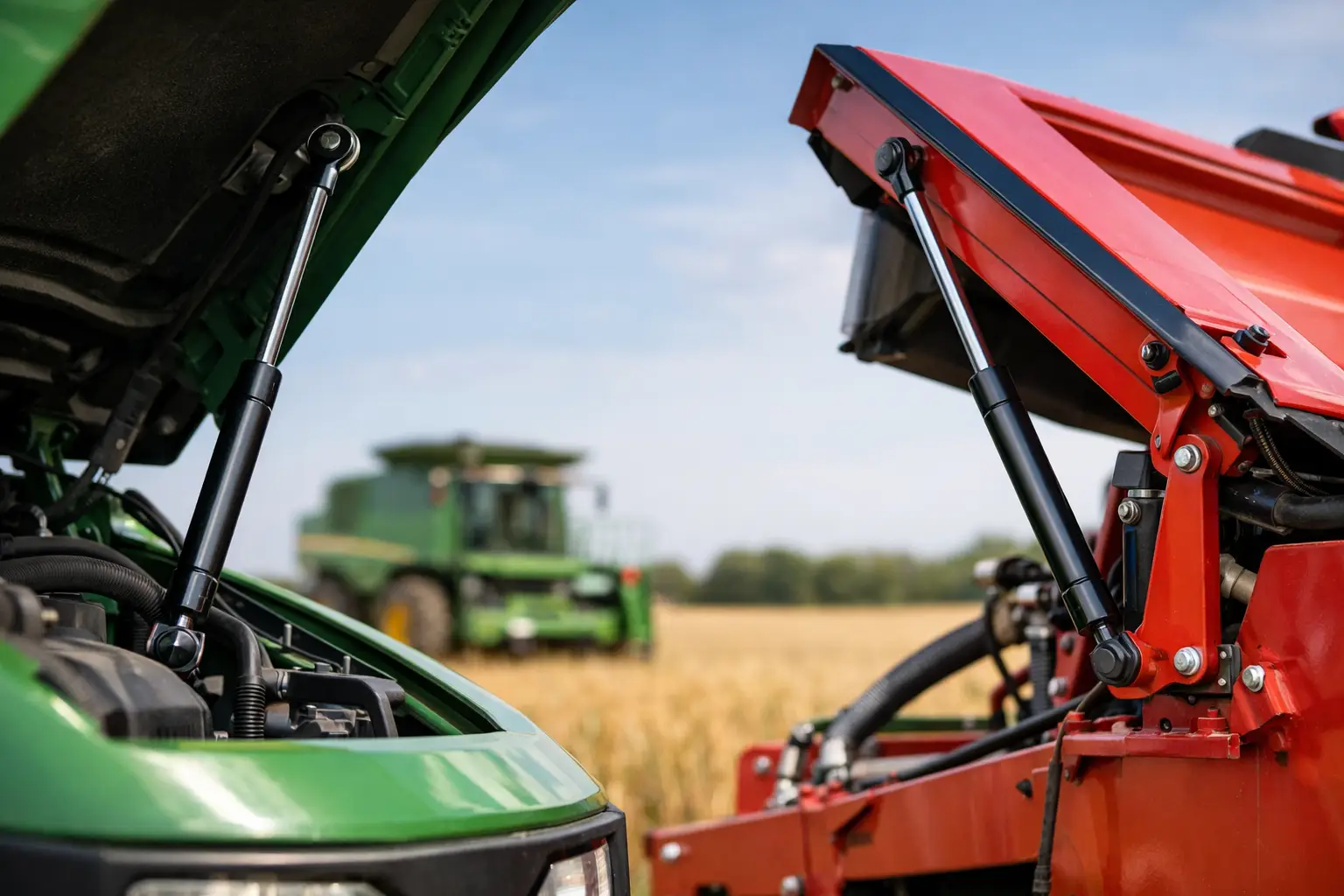
A bonnet that will not stay up, a grain box lid that drops without warning, or a service hatch that needs a shoulder to hold it open – these are not small annoyances on a farm. They slow maintenance, create safety risks and put extra strain on equipment. Choosing the right gas struts for farm equipment is about more than replacing a failed part. It is about getting the force, length and mounting right so the machine works properly in real conditions.
Where gas struts matter on farm equipment
Farm equipment uses gas struts in more places than many operators realise. Tractor bonnets, side access panels, cab windows, seed drill covers, sprayer lids, machinery guards, storage compartments and toolboxes all rely on controlled lift and support. On some machines, the strut mainly assists opening. On others, it does most of the holding work once the panel is raised.
That difference matters. A light inspection hatch and a heavy steel engine cover may look similar when closed, but they demand very different strut behaviour. One may need a soft assist through a short arc. The other may need higher force and more control at full extension. If the strut is not matched to the application, the lid can open too aggressively, sit too low, or refuse to stay up when the machine is on uneven ground.
Why farm conditions are harder on struts
Agricultural equipment does not live a gentle life. Dust, vibration, mud, washdowns, sun exposure and temperature swings all affect how a gas strut performs over time. A strut that works well in a sheltered cabinet may not last on a field machine that sees constant corrugations and exposure.
Mounting angle also plays a part. Many farm applications place the strut in a tight space with unusual geometry. The force needed is not only about lid weight. It also depends on where the strut mounts, how far from the hinge it sits, and the angle through the opening cycle. A strut that is technically the right length can still perform badly if its end fittings or installed position are wrong.
This is why direct substitution based on appearance alone often fails. Two struts can look almost identical and still have different force ratings, stroke lengths or fitting types.
How to choose gas struts for farm equipment
The quickest way to get the right result is to work from the existing strut if one is fitted. In many cases, the old unit will have a force rating marked in Newtons, along with a part number or extended length. That gives you a starting point, but it is still worth checking dimensions and mounting details before ordering.
If the original strut is missing, unreadable or clearly not performing properly, you need to confirm a few basics. Measure the extended length from the centre of one mounting point to the centre of the other. Measure the stroke, which is the distance the rod travels between closed and open positions. Then identify the end fittings, such as ball sockets, eyelets or forks, and note the thread size if the fittings are removable.
Force is the part that causes most mistakes. Too little force and the panel drops or feels heavy throughout the lift. Too much force and it can be difficult to close, may twist hinges, or may kick open harder than intended. On a wide bonnet or offset hatch, even a small force error can create uneven loading. In some cases, replacing both struts as a matched pair is the safer option, even if only one has failed.
What details to have ready
When asking for help with farm machinery struts, the more accurate the information, the faster the fitment process. Useful details include the machine make and model, where the strut is fitted, whether one or two struts are used, the old strut markings, and clear measurements in millimetres. Photos of the open and closed positions can also help when the application is unusual.
For custom applications, lid weight and hinge position become more important. If the equipment has been modified, such as with added guards or heavier panels, the original strut force may no longer be right.
Replacement or custom strut?
Standard replacement struts suit many common agricultural applications, especially where the original dimensions and force are known. This is usually the most efficient option for routine maintenance. If the machine is older, imported, modified or fitted with non-standard covers, a custom solution may be the better path.
Custom gas struts for farm equipment are often needed when a panel has been fabricated locally, when the original part is obsolete, or when repeated failures suggest the existing setup is not ideal. A custom strut can be matched to the actual opening angle, weight and mount position rather than forcing a near-enough substitute into service.
There is a trade-off here. Standard stocked struts can be faster and simpler when the application matches. Custom struts take more upfront checking, but they can solve ongoing issues with unsafe opening, poor hold-open position or premature wear.
Common signs a strut needs replacement
A failed gas strut is not always completely dead. Often it degrades slowly and operators work around it until the problem becomes a hazard. If a hatch starts dropping in cooler weather, if a bonnet no longer lifts smoothly, or if one side of a two-strut setup is doing all the work, replacement should be considered before hinges, brackets or the panel itself are damaged.
Other signs include visible oil on the rod, bent shafts, cracked fittings, corrosion around the body, or a lid that sits unevenly when open. On dusty machinery, seal wear can be harder to spot, so performance changes are often the first clue.
Why replacing one strut can be a problem
It depends on the application, but on paired setups it is common for the second strut to be close behind the first in wear. Fitting one new high-force strut beside one tired unit can create uneven lift and extra load on the mounting points. For heavy engine covers, tool compartments and large access doors, replacing both together is often the more reliable choice.
Installation points that affect performance
Even the correct strut can underperform if it is installed poorly. The rod should generally face downward when the hatch is closed so the internal seal stays lubricated. End fittings need to align properly without forcing the strut to twist through its travel. If the brackets have shifted or cracked, fitting a new strut alone may not solve the issue.
Cycle the panel carefully after installation. Check that the strut does not bottom out before the lid reaches full close or full open. Either condition can damage the strut or the mountings. Also make sure hoses, wiring and surrounding guards do not foul the strut through its movement.
For operators working across multiple machines, consistency matters. Keeping records of sizes, force ratings and fitment types can save time on future replacements and reduce downtime during busy periods.
Getting the right support the first time
Farm equipment is not always well served by generic parts matching. The practical route is to deal with a supplier that understands application loads, mounting geometry and the difference between a close match and a correct one. That matters even more when equipment is older, heavily used or not built to a common local spec.
A specialist supplier can help confirm measurements, identify suitable end fittings and advise whether a standard or custom strut is the better choice. For trade buyers and maintenance teams, that support reduces repeat ordering and helps avoid the cost of fitting the wrong component. Quality also counts. A strut built for heavy-use applications should be chosen with durability in mind, not just price on the day.
For Australian operators, quick access to stock and practical technical advice can make a real difference when a machine is down and the job cannot wait.
The best result is usually simple: match the strut to the machine, not the other way around. If you can provide accurate measurements and application details, the right gas strut will do its job quietly for years – holding safely, lifting cleanly and getting out of your way so the equipment can get back to work.