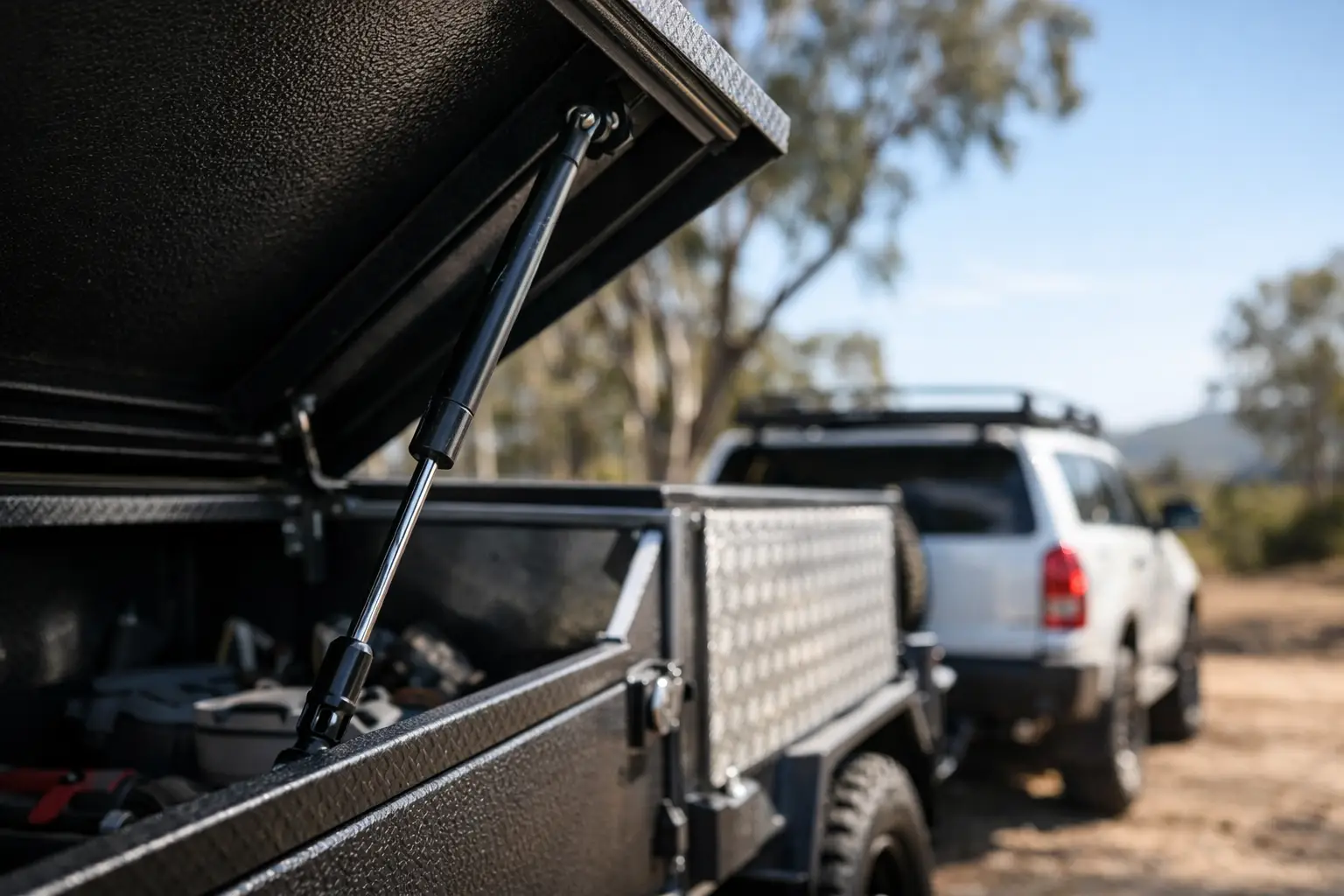
A trailer lid that drops without warning is more than an annoyance. On a work trailer, horse float, camper or toolbox setup, failed support can damage gear, slow the job down and create a genuine safety risk. That is why choosing the right petrol struts for trailers Australia buyers rely on is not just a matter of matching something that looks close. The force, length, mounting position and operating conditions all need to suit the job.
Trailer applications are rarely identical. Even two similar box trailers can need different struts if the lid weight changes, the hinge position shifts, or extra accessories are added. A strut that is too weak will not hold the lid open properly. One that is too strong can twist the frame, overload the mounts or make closing difficult. Good fitment starts with the actual application, not guesswork.
How petrol struts for trailers Australia buyers use actually differ
Trailer petrol struts are used across a wide range of setups. Front-opening toolboxes, side-opening canopies, enclosed trailer doors, generator compartments, dog boxes, service bodies and camper trailer storage hatches all place different demands on the strut. Some need controlled assistance over a short opening arc. Others need higher force to lift a long, heavy lid and keep it stable in wind or uneven conditions.
Australian conditions also matter. Heat can affect petrol pressure. Dust, vibration, corrugations and exposure to moisture or salt can shorten service life if the wrong strut or fittings are used. A trailer used in metro delivery work does not face the same conditions as one heading to a mine site, farm or boat ramp. That is why material quality, seal design and hardware choice should be part of the buying decision.
If the trailer is used daily, it also pays to think beyond simple replacement. Frequent cycling, heavy lids and rough handling can expose weaknesses in lower-grade struts quickly. A quality strut backed by proper specification is generally the cheaper option over time because it reduces repeat replacement and mount damage.
What to measure before ordering trailer petrol struts
The fastest way to get the right part is to start with clear measurements and application details. If the existing strut is still fitted, check the extended length from centre of socket to centre of socket, along with the compressed length if available. The stroke length is also important, as it determines how far the strut can travel during opening and closing.
Force rating matters just as much as length. This is usually marked in Newtons on the body of the strut. If the label is worn off or the strut has already failed, the better approach is to work from the lid weight, hinge layout and mounting geometry rather than trying to estimate by feel. A lid that weighs 25 kg can still require very different force depending on where the brackets are mounted and how far the lid needs to open.
Mounting end types should be checked at the same time. Ball studs, brackets, eyelets and angled fittings all affect compatibility. Even when the strut length is correct, the wrong end fitting can leave the unit misaligned or place side load on the shaft. That shortens life and can cause premature seal failure.
Photos help when the setup is non-standard. For custom or hard-to-identify trailer applications, a clear image of the lid open and closed, the hinge side, bracket locations and the old strut markings can save a lot of back and forth.
The details that usually get missed
Buyers often focus on strut length and forget the opening angle. That can be a problem on trailers where the lid needs to stay open high enough for safe access. A strut may physically fit but stop the panel too low, especially on front toolboxes and underbody compartments.
Bracket condition is another common issue. If the old strut failed after years of use, inspect the mounting points before fitting a new one. Bent brackets, loose fasteners and fatigue around the fixing points can make even a correctly sized strut perform poorly.
Choosing the right force for trailer lids and doors
Force selection is where trailer setups often go wrong. More force is not automatically better. If the strut is overpowered, the lid may spring upward too aggressively, strain hinges and brackets, or refuse to close cleanly. On lighter alloy lids, excessive force can distort the panel over time.
Too little force is the more obvious failure. The lid will sag, drop in wind, or need to be manually held open. But underpowered struts can also wear out faster because they are working close to their limit on every cycle.
The right force depends on the real load and the position of the strut relative to the hinge. A longer lever arm may reduce the force required. A compact installation with short mounting distances may need a stronger unit. Twin strut setups also need to be matched properly. Replacing one side only can create uneven lifting and twist through the lid.
Where the application is unusual, custom sizing is often the safest path. This is especially true for modified trailers, heavy checker plate lids, added racks, solar gear, spare wheel mounts or any setup where the original design has changed.
Replacement or custom solution?
If the trailer already has petrol struts and the original system worked well, direct replacement is usually straightforward provided the dimensions and force are verified. This suits many standard toolboxes, enclosed trailers and service compartments.
Custom supply makes more sense when the old strut never performed correctly, the original part is unavailable, or the trailer has been altered. A custom approach can also solve issues such as lids opening too low, excessive closing effort, poor stability in wind or repeated mount failures.
For trade buyers and fleet operators, getting the specification right from the start saves time later. Standardising struts across similar trailers can simplify maintenance, but only when the applications are genuinely the same. It is usually not worth forcing one part across different builds if lid weights or geometries vary.
When stainless or specialised hardware matters
Not every trailer needs stainless components, but some absolutely do. Boat trailers, coastal service vehicles and washdown environments call for better corrosion resistance than a general-purpose fitout. The same applies where the hardware is exposed underneath or near wheel spray.
Heavy-use applications may also need stronger brackets or upgraded end fittings. If a trailer sees constant vibration, rough tracks or daily commercial use, the hardware is just as important as the strut itself.
Installation points that affect performance
Correct installation is what turns a suitable strut into a reliable one. The rod should generally point downward in the closed position where the design allows it, helping lubrication reach the seal. Poor orientation can reduce service life.
Alignment matters too. Petrol struts are designed to work in line with their travel. If the mounting points force the strut to operate at an angle or introduce side loading, wear increases quickly. That is often why a replacement strut fails early even when the size looks right on paper.
It is also good practice to replace struts in pairs where two units share the load. Mixing an old weak strut with a new one creates uneven force and can put extra stress on the hinges and brackets. On trailers with wide lids, that imbalance is usually obvious within the first few cycles.
Before final fitment, check the full opening and closing path slowly. Make sure the strut does not bottom out before the lid is shut and does not hit its extension limit before the lid reaches the intended open position. Either mistake can damage the strut or the mounting points.
Why supplier support matters on trailer applications
Trailer petrol struts are one of those parts that look simple until the specification is wrong. For buyers who know the exact size and force, ordering is easy. For everyone else, access to technical support makes a real difference.
A specialist supplier can help work through the measurements, check whether the original force is suitable, and recommend hardware to match the application. That is particularly useful for older trailers, imported units, custom builds and trade repairs where no clear part number exists. Fast fulfilment also matters when a trailer is off the road or unsafe to use until the lid support is fixed.
For many Australian buyers, the best result is not just getting a replacement sent out quickly. It is getting a strut that fits properly, performs consistently and holds up under the conditions the trailer actually sees. That may be a stocked standard part, or it may be a custom specification backed by practical guidance.
If your trailer lid is hard to lift, will not stay open, or has never worked quite right, the fix usually starts with better measurements and a proper look at the mounting layout. Get those details right, and the strut stops being a consumable and starts doing the job it was meant to do.