A hatch that drops without warning usually does not fail all at once. It starts by lifting a bit slower, holding a little lower, or needing a hand where it never used to. That is usually the first real sign of why petrol struts fail – pressure loss, wear, incorrect specification, or operating conditions the strut was never sized for.
Petrol struts are simple in principle, but they work under load, in changing temperatures, and often in dirty or corrosive environments. On a toolbox, canopy, caravan bed, engine cover, cabinet or machine guard, they are expected to lift smoothly and hold consistently for years. When they stop doing that, the cause is often straightforward, but not always obvious.
Why petrol struts fail in real working conditions
Most failed struts come down to one of four issues: loss of petrol pressure, seal degradation, rod damage, or incorrect selection for the job. Sometimes it is only one of these. In many cases, it is a combination.
The petrol inside the strut provides the extension force. If pressure drops over time, the unit loses lift. That drop can happen slowly through normal ageing, or faster if seals are damaged or the strut has been exposed to contamination, side loading or excessive heat. A strut that still looks fine on the outside can already be well past its useful working force.
Seal wear is another common cause. The piston rod moves through the seal every cycle, and that seal has to retain pressure while keeping out dust, moisture and grime. In clean indoor applications, service life is usually longer. In agricultural, marine, mining and transport settings, the seal has a harder life. Dirt, salt, vibration and frequent cycling all speed up wear.
Then there is fitment. A good quality strut will still fail early if it is too weak, too strong, mounted on the wrong angle, or forced to work with poor bracket geometry. This is one reason replacement by appearance alone often goes wrong. Two struts can have the same length and end fittings but completely different force ratings and internal damping.
Pressure loss is the most common reason
When people ask why petrol struts fail, the first answer is usually pressure loss. Petrol struts are charged units. If the internal petrol pressure drops enough, the strut can no longer support the intended load.
That pressure loss is not always dramatic. Many struts lose performance gradually over years of use. A bonnet or lid may still open, but it will not stay fully raised. A heavy hatch may hold in mild weather but sag in the cold. A bed base may feel fine unloaded, then drop once weight shifts onto it. These are all practical signs that the force is no longer where it needs to be.
Temperature plays a part here. Petrol pressure changes with ambient conditions, so struts often feel stronger in hotter weather and weaker in colder weather. That does not mean the strut is defective. It does mean that a marginal strut, or one already losing pressure, tends to show its weakness first on a cold morning or in a shaded workshop.
Not every weak strut is worn out
Sometimes a strut seems to have failed when the application has changed. Added accessories, a heavier lid lining, extra storage on a hatch, or modified hinges can all shift the load beyond what the original strut was designed to handle. In that case, the strut is under-specced rather than simply worn out.
This matters because replacing like-for-like is not always the right fix. If the lid weight, centre of gravity or mounting points have changed, the correct replacement may need a different force rating or different dimensions.
Seal wear and contamination shorten service life
The seal is doing more work than most people realise. It holds pressure in and keeps contamination out, while the rod cycles under load. Once that sealing surface starts to wear, performance drops.
A scratched, nicked or corroded rod is especially hard on seals. Even minor surface damage can compromise sealing over time. That is why painted-over rods, tool marks, grit build-up and chemical exposure are all worth paying attention to. The rod needs to stay clean and smooth. If it does not, the seal tends to wear faster and pressure loss follows.
In marine and coastal applications, salt accelerates this problem. In farm and earthmoving environments, dust and grit do the same. On trailers, utes and service bodies, vibration adds another layer of stress. None of these conditions automatically ruin a strut, but they do narrow the margin for poor-quality units and poor maintenance.
Incorrect mounting causes premature failure
Petrol struts are designed to work in a specific orientation and through a specific arc. If that geometry is off, loads are transferred in ways the strut was not meant to handle.
Side loading is a common example. Petrol struts are intended to take force along their axis. If the brackets are misaligned, bent, or mounted so the strut twists during travel, extra stress goes into the rod, seal and end fittings. The strut may still operate for a while, but wear increases and failure comes earlier.
Mounting position also affects lubrication and damping. Many petrol struts are designed to be installed rod-down in the closed position so the internal oil helps lubricate the seal and support end-of-stroke damping. Mounting them the wrong way can reduce service life and change how the strut feels in operation.
End fittings and brackets matter too
A failed strut is not always a failed cylinder. Worn ball studs, loose brackets, cracked mounts or elongated fixing holes can make the whole assembly feel unreliable. In some cases the strut itself is still serviceable, but the hardware around it is not.
That is worth checking before ordering replacements, particularly on older caravans, trailers, toolboxes and machine covers where repeated movement can fatigue the mounting points.
Overextension, overcompression and misuse
Petrol struts are not designed to act as hard stops unless the system has been engineered that way. If a lid is regularly forced beyond its intended open angle, or slammed closed against the strut, internal damage can build up. The same applies when someone uses the strut body as a handle, lever point or tie-down point.
Misuse is not always obvious. A common example is fitting a stronger strut to make a heavy lid feel easier to open, without checking hinge strength or closing effort. The lid may open better, but the higher force can overload brackets, distort panels, or make closing unsafe. Stronger is not automatically better.
Corrosion and environment are major factors
Outdoor and heavy-use applications are harder on petrol struts than indoor cabinetry or light-duty access panels. Rain, washdown, fertiliser, salt spray, mud and chemical residue all affect lifespan. Even where the tube looks acceptable, corrosion on the rod or fittings can lead to rough movement, seal damage and eventual pressure loss.
For that reason, material grade and surface finish matter. So does choosing a strut built for the environment rather than just matching length and force. In harsh conditions, a cheaper unit can become a false economy very quickly.
How to tell when a petrol strut has actually failed
A failed petrol strut does not always mean total collapse. More often, it means the unit no longer performs its intended job safely or consistently.
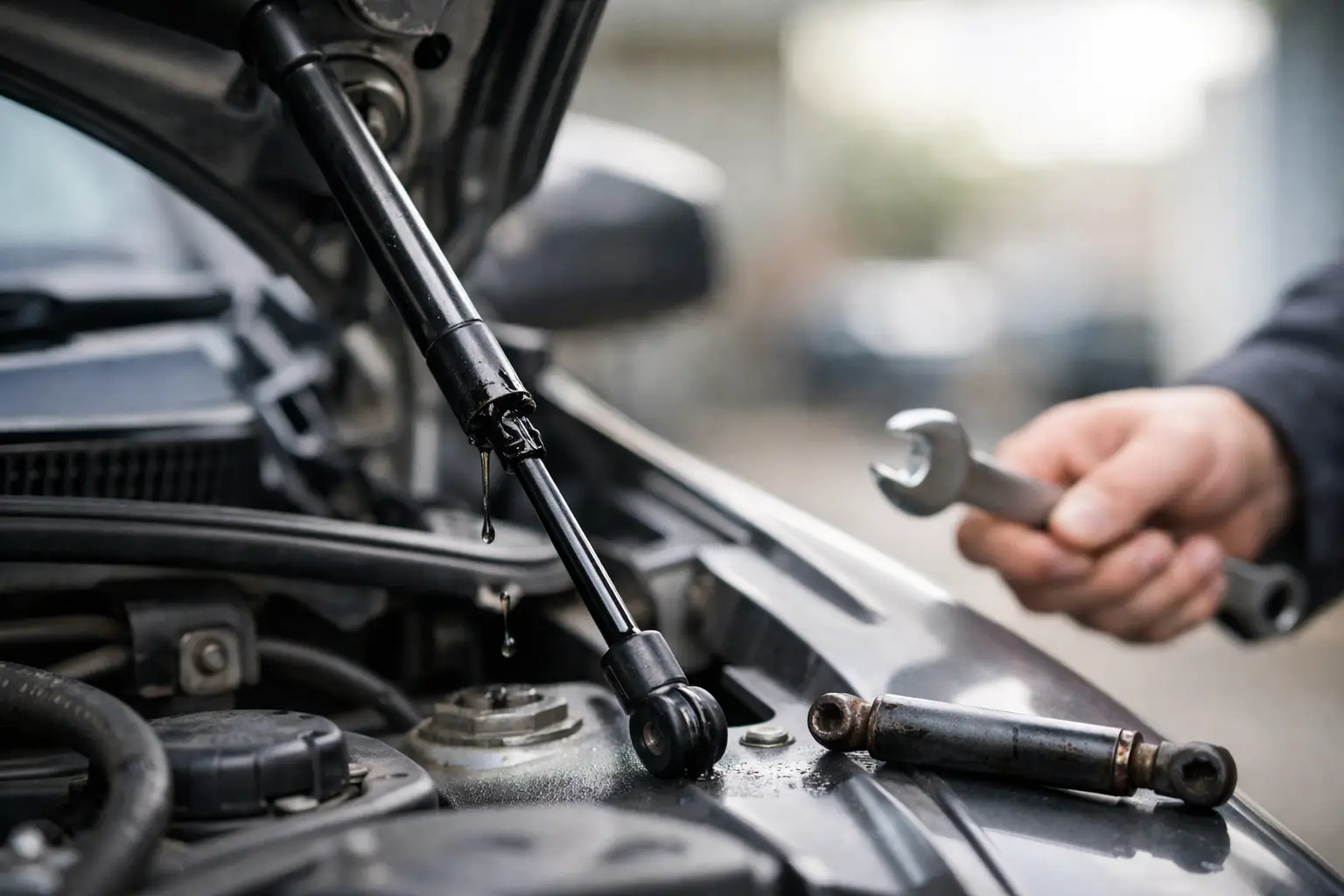
Typical signs include slow extension, inability to hold the load at full height, oil residue around the rod seal, visible rod damage, uneven lifting between paired struts, or a hatch that drops partway through travel. Noise, looseness at the ends, or jerky movement can also point to mounting or hardware issues rather than internal failure alone.
If a paired setup has one weak strut and one stronger strut, the stronger one often masks the problem for a while. That is why struts are generally best replaced as a pair on dual-strut applications.
Preventing repeat failures
The best way to avoid repeat issues is to match the replacement to the real application, not just the old part number if the setup has changed. Closed length, extended length, stroke, end fittings, mounting centres, force rating and intended orientation all matter. So does the weight of the panel and where that weight sits relative to the hinge.
Regular cleaning of the rod with a soft cloth helps in dirty environments, but avoid greases and heavy sprays on the rod unless the manufacturer specifically recommends them. They can attract grit or interfere with the seal. It also pays to inspect brackets and hinges at the same time. A new strut fitted to worn hardware can still give poor results.
Where the application is unusual, heavily loaded or exposed to hard conditions, getting the strut specified properly upfront usually saves time and rework. That is especially true for custom canopies, machinery guards, marine hatches, service bodies and modified caravan fit-outs where standard assumptions do not always apply.
A petrol strut usually fails for a practical reason, not a mysterious one. If you look at the load, the mounting geometry, the environment and the condition of the rod and hardware, the cause is usually there in plain sight. Get those details right, and the replacement is far more likely to do the job properly and keep doing it.