A petrol strut that is only slightly out of position can turn a simple lid, hatch or door into a nuisance – or a hazard. If you need to mount petrol struts safely, the job is not just about getting the brackets on and tightening the fasteners. The strut needs the right force, the right stroke, the right end fittings and the right geometry, otherwise the load may not lift properly, may twist the hinges, or may slam shut when you least expect it.
That matters whether you are fitting struts to a toolbox, canopy window, caravan bed base, machinery guard, boat hatch or heavy cabinet. In working applications, a poor install usually shows up fast. The lid binds, the mounting points flex, the strut bottoms out before the panel closes, or the opening angle never gets where it needs to be.
What safe petrol strut mounting actually means
Safe mounting starts with control. A correctly mounted petrol strut should support the load through its travel without overextending hinges, side-loading the rod or forcing the panel into an unnatural arc. It should also hold the load in the open position with enough reserve force to account for wear, vibration and real-world handling.
A lot of installation problems come from treating the strut like a universal support. It is not. Petrol struts are application-specific parts. The same lid weight can need a very different setup depending on hinge position, opening angle, centre of gravity and whether one strut or two are being used.
If the strut is too strong, the panel may be hard to close and can stress brackets or thin sheet metal. If it is too weak, it may lift partway and then drop. If the compressed and extended lengths are wrong, the strut may act as a hard stop, which is one of the quickest ways to damage the unit or the structure around it.
Before you mount petrol struts safely, confirm the correct strut
The cleanest install in the world will not fix the wrong specification. Before drilling holes or welding tabs, confirm four basics – extended length, compressed length, stroke, and force rating.
Extended length determines how far apart the mounting points can be when the panel is open. Compressed length tells you whether the strut can close without bottoming out. Stroke is the travel between those two lengths. Force rating, usually measured in Newtons, needs to suit the load and mounting geometry, not just the overall weight of the panel.
This is where many DIY replacements go wrong. Someone measures the old unit, orders the same length, and assumes the force is close enough. If the original setup was already poor, the replacement repeats the same problem. On custom jobs, copying a strut from another trailer, canopy or cabinet is even riskier because the hinge layout may be different.
If you are replacing an existing unit, the old strut label can help, but only if the current operation is correct. If you are designing a new setup, the useful dimensions are the panel size, panel weight, hinge location, desired open angle, and the space available for the body and rod through the full movement.
Bracket position matters more than most people expect
Where the brackets sit determines leverage. Move the body-end bracket a small distance and the opening effort can change noticeably. That is why two installs using the same strut can behave very differently.
Mounting closer to the hinge reduces leverage and usually requires more force. Mounting further away increases leverage but also changes how the strut behaves through the opening arc. In some layouts, the panel may feel light near closed and heavy near open. In others, it can push too aggressively at the start and then lose support before full extension.
The goal is balanced movement. On a top-hinged lid, the strut should assist lifting without trying to tear the lid sideways. On a side-opening compartment, paired struts should share the load evenly. On machinery covers and guards, the brackets need enough structural support to handle repeated cycle loads, not just static weight.
Thin aluminium, light sheet steel and composite panels often need reinforcement behind the bracket. If the panel skin flexes when opening or closing, the mount is not adequate even if the screws stay tight.
Use the structure, not just the surface
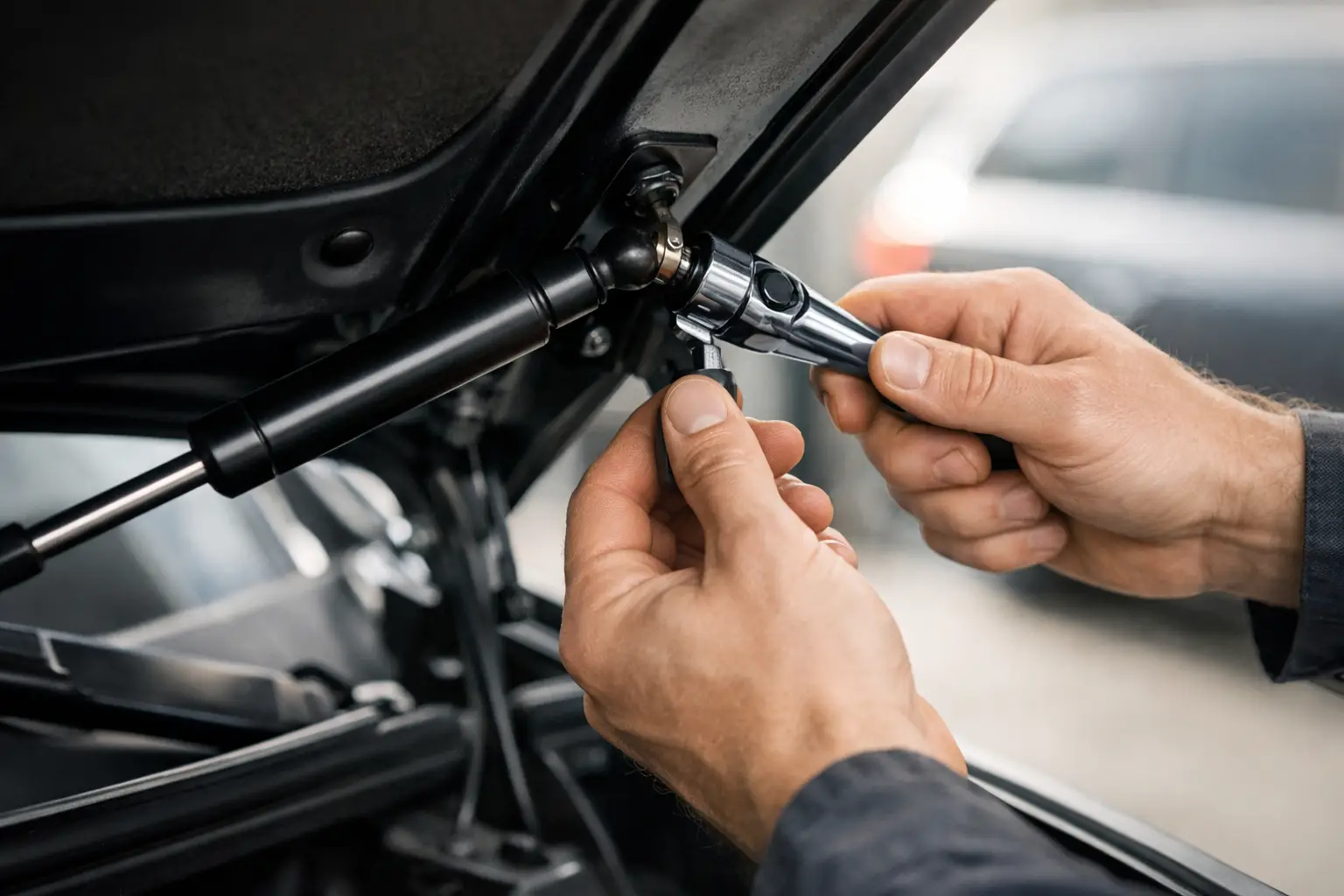
A bracket fixed into weak material is not a safe mount. Through-bolting with suitable backing plates is often a better option than relying on self-drilling screws into thin sections. In automotive and mobile equipment applications, vibration makes this even more important.
If the load is heavy or the opening cycle is frequent, weld-on or reinforced mounting points may be the better choice. The right method depends on the substrate, access behind the panel and whether the installation needs to be serviceable later.
Rod down is usually the correct orientation
For most standard petrol struts, install with the rod pointing downward when the panel is closed. This keeps the internal seal lubricated and helps extend service life. It is a simple detail, but it has a real effect on durability.
There are exceptions. Some specialised applications, travel paths or mounting constraints may require a different orientation, and some strut types are designed for specific positions. But as a general rule, rod down at rest is the safe default unless the application calls for something else.
Orientation also affects contamination exposure. In dusty agricultural, mining or workshop environments, protecting the rod and seal area from direct grime matters. A damaged rod surface shortens seal life and leads to premature failure.
Check travel at both ends, not just mid-stroke
A strut can look perfect halfway through the movement and still be wrong. The two points that matter most are fully closed and fully open.
At full close, the strut must not bottom out before the hatch, lid or door reaches its shut position. If it does, the structure absorbs the remaining force. That can bend brackets, crack welds or distort hinges. At full open, the strut should not be acting as the only stop unless it has been selected specifically for that duty and the system is designed around it.
A mechanical stop, hinge stop or defined opening limit is often the safer approach. That way the strut supports movement rather than taking impact loads every time the panel is opened firmly.
Test with the real load
Do not test an install with the panel empty if it will normally carry trim, liners, glazing, spare wheel mounts or tools. The final fitted weight can change the behaviour enough to matter.
This comes up regularly on canopies, service bodies and marine hatches where accessories are added after the first fitment. A setup that worked in the workshop can become under-supported once locks, seals, frames or racks are installed.
One strut or two depends on the application
Two struts are not automatically safer than one. For a narrow, rigid panel with good hinge support, one correctly specified strut can be fine. For a wider lid or anything prone to twist, two struts usually provide better stability and reduce uneven loading.
The trade-off is alignment. Dual-strut installs need bracket symmetry and consistent mounting geometry. If one side reaches its limit before the other, the panel can rack and the struts can wear unevenly. On larger doors and hatches, that can also put unnecessary load into the hinges.
If you are upgrading from one strut to two, the force per strut needs recalculating. Doubling the number without adjusting specification often gives an overpowered setup that is harder to close and rougher on the structure.
Common mistakes that make a safe install unsafe
The most common mistake is choosing force by guesswork. After that, it is poor bracket placement, weak mounting surfaces, and assuming the strut can function as a stop. Another frequent issue is fitting mismatched pairs, where one strut has a slightly different force or length from the other.
It is also worth avoiding reused brackets unless they genuinely match the new strut dimensions and articulation. End fittings need enough angular movement through the stroke. If the joint binds near open or closed, side load is being pushed into the strut rod, and that shortens service life quickly.
Over-tightening ball joints and end fittings can create its own problems too. The connection should be secure, but the strut must still articulate freely through the movement range.
When expert sizing is the better option
Some jobs are straightforward. A direct replacement on a standard toolbox or cabinet, where the original strut worked properly, is usually simple. Others need proper calculation. Heavy lids, unusual hinge positions, marine applications, industrial guarding and custom vehicle fit-outs are worth getting right before fabrication starts.
That is where specialist support saves time. A supplier focused on petrol struts can work from your dimensions, mounting constraints and target opening angle to narrow down the right specification. For Australian trades, workshops and equipment operators, that often means fewer fitment delays and less money wasted on trial-and-error parts.
If you are uncertain, gather the practical details first – panel weight, panel size, hinge position, open and closed mounting point distances, available space, and how many struts you plan to run. Good technical advice starts with good measurements.
A petrol strut should make the job easier every time the lid or hatch moves. If the setup feels forced, awkward or unpredictable, treat that as a sign to stop and recheck the geometry before the hardware tells you the same thing the hard way.