
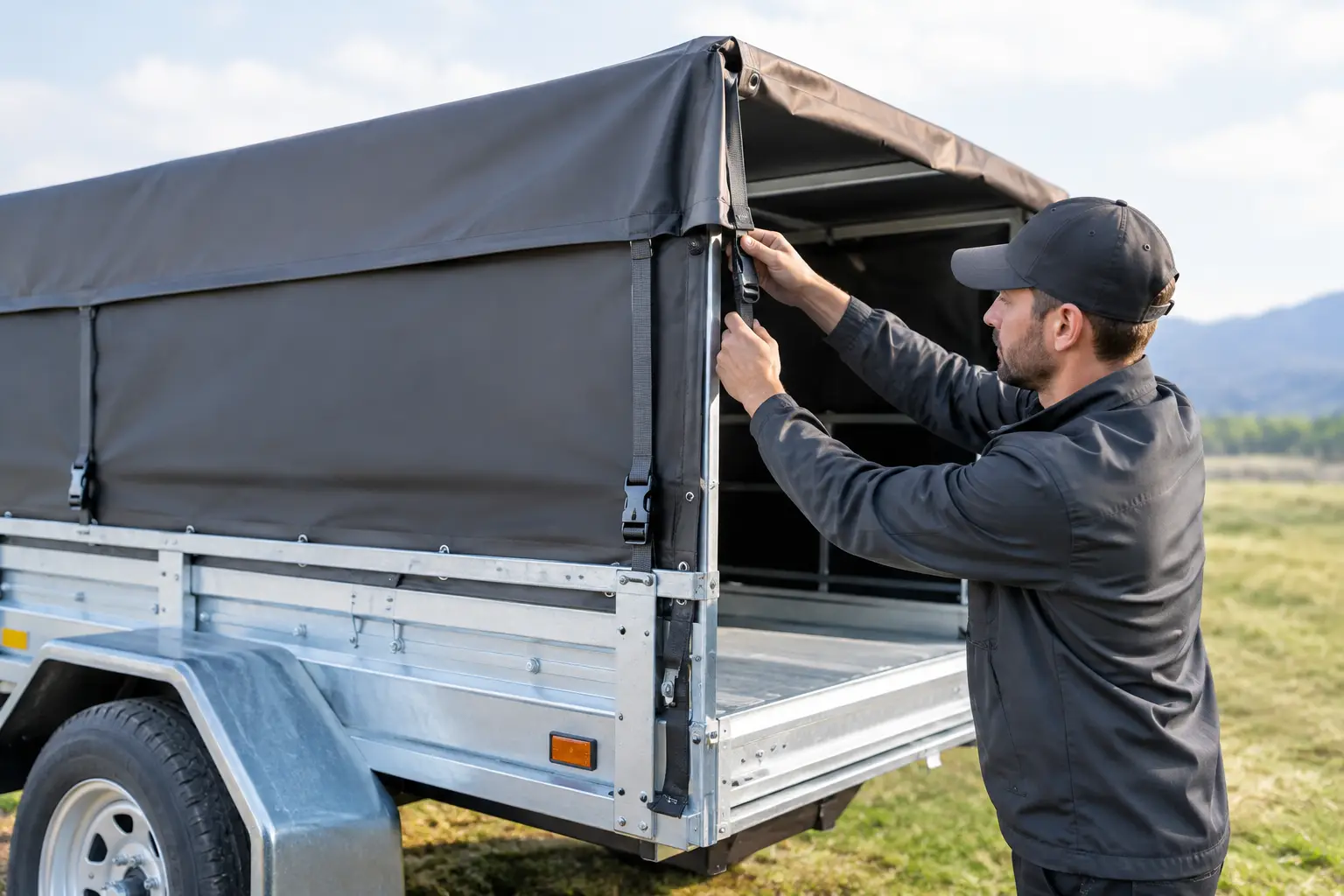
A trailer canopy door that will not stay open is more than an annoyance. On a work trailer, service unit or camper, it slows access, risks damaged hinges and can drop unexpectedly on the person loading tools. This trailer canopy support guide covers how to specify gas struts and mounting hardware that suit the door, the canopy and the way the trailer is actually used.
The right support is not simply the strongest strut that fits. Gas strut performance depends on force, extended and compressed length, mounting geometry, door weight and hinge condition. Get one of those wrong and even a quality strut can be difficult to close, fail to hold the door at full height, or put excessive load into the canopy structure.
Start with the canopy door and its operating position
Before selecting a replacement or planning a new installation, inspect the door itself. Check for cracked frames, loose rivets, worn hinges, water damage and added accessories such as spare-wheel carriers, jerry-can holders, shelving or lining. Any extra weight behind the door changes the force needed to lift and hold it.
Also consider the required open angle. A side-opening canopy door used constantly for tools may need to sit high enough for a tall operator to work beneath it. A rear door on a trailer parked close to a wall or another vehicle may need a more limited opening angle. The strut must reach its extension near the desired final position, rather than trying to force the door past it.
Canopy doors are often aluminium-skinned, but their internal structure varies significantly. A bracket fixed only through thin skin can pull out over time. Mounting points need to land on a frame, reinforcement plate or suitably designed backing plate that spreads the load across the panel.
Measure the existing gas struts correctly
If the existing supports were working properly before they lost pressure, they are usually the best reference. Remove one strut only after securely propping the door open. Never rely on a worn strut, a broom handle or another person to hold a heavy canopy door while you work.
Record the following details from the old unit:
- Extended length, measured centre-to-centre between the mounting points when the strut is fully extended.
- Compressed length, measured centre-to-centre with the rod fully closed.
- Stroke, which is the difference between extended and compressed length.
- Force rating, normally printed as a number followed by N, such as 400N or 700N.
- End fittings, including ball sockets, eyelets, clevises or threaded ends.
- Rod and tube diameter where the original part is unmarked or a custom replacement is required.
Do not estimate length from the tube alone. The mounting centres determine fitment. A strut that is slightly too long can bottom out before the door shuts, while one that is too short may limit opening or fail to provide useful leverage.
If the original struts are missing, take measurements with the door fully shut and at its intended open position. Measure the distance between proposed bracket centres in both positions. This identifies the required compressed and extended dimensions, but it does not by itself determine the correct force.
Choosing force: why mounting geometry matters
Gas strut force is measured in Newtons, not kilograms. The rating describes the push force at the strut, not the weight of the door it can support. A 500N strut does not automatically suit a 50kg canopy door.
The critical factor is leverage. A strut mounted close to the hinge has less leverage over the door and needs more force than one mounted further from the hinge. Its angle also changes throughout the opening movement. The strut may have good lifting effect halfway through travel but little holding effect when the door is near vertical if the geometry is poorly positioned.
For a pair of struts, the load is shared, but not always perfectly. A twisted door, uneven hinges or brackets mounted at different positions can place more load on one side. It is sensible to use matched struts from the same specification and replace both units as a pair.
Higher force is not automatically safer. Over-rated struts can make a canopy door hard to close, stress hinges, distort light alloy frames and create a sudden opening action. Under-rated struts may lift the door initially but let it creep down in wind, cold conditions or after tools have been added to the door.
Temperature also affects gas pressure. A strut that just holds a door in mild weather may feel weaker on a cold morning. For equipment used year-round, specify enough operating margin without creating excessive closing force.
New trailer canopy support guide: setting bracket locations
For a new installation, bracket placement should be planned before drilling. Start with the door in its closed position, then mark its intended fully open position. The aim is for the strut to compress fully enough to allow the door to close, without reaching hard bottom-out, and to extend near its full length as the door reaches the desired opening angle.
The body-side bracket is commonly positioned on a rigid vertical frame or sidewall reinforcement. The door-side bracket must be attached to a structural rail or reinforced area, not a flexible skin panel. Where access allows, use backing plates and corrosion-resistant fasteners suited to the canopy material.
A useful layout places the strut with the rod down when the door is closed or near closed. This helps keep the internal rod seal lubricated and can improve service life. It is not always possible with every canopy design, but it is the preferred orientation where geometry permits.
Avoid positioning the strut where it fouls shelving, ladder racks, wiring, locks or stored equipment. Cycle the door slowly by hand before final tightening. Look for binding, side loading at the ball joints and any point where the strut reaches full compression before the latch engages.
Fit the correct end fittings and hardware
Ball sockets are common on trailer canopies because they allow the strut to pivot through its arc. They must match the ball stud size and be fully clipped into place. A loose retaining clip or partly engaged socket can separate under load, allowing the door to fall.
Where vibration, dust and regular wash-down are part of the job, use hardware suited to the environment. Zinc-plated fittings may be appropriate for general enclosed use, while stainless steel hardware can be a better choice around saltwater, chemical exposure or persistently wet conditions. The material selection needs to consider the canopy and bracket materials as well, as dissimilar metals can contribute to corrosion.
For heavy doors, do not rely on light self-drilling screws. Through-bolts with washers or backing plates are generally a stronger option where the design permits. Check fasteners after the first weeks of use, particularly on trailers operating over corrugations or rough sites.
Test the support system before putting it to work
Once fitted, open and close the door several times with the trailer level. It should lift smoothly, remain open at the intended height and close without needing excessive force. Check that both struts extend evenly and that neither is rubbing against a bracket or panel edge.
Then test the conditions that matter in service. Load the door as it will normally be used, park the trailer on a slight slope and check whether wind can push the door beyond its intended travel. Gas struts support a door, but they are not a substitute for positive mechanical restraint where people will work under a raised canopy in strong wind or where the door carries an unusual load.
If a door falls, rises too aggressively or sits lower than expected, do not keep changing strut force at random. Recheck dimensions, mounting centres, hinge condition and bracket stiffness first. Geometry faults are often mistaken for failed struts.
When a standard strut is not enough
Standard replacement struts suit many toolbox and canopy applications, provided the measurements and force rating match. Custom support is often the better option for unusually wide doors, gullwing canopies, service bodies, enclosed plant trailers, marine-exposed units or doors fitted with heavy accessories.
For an accurate recommendation, have the extended and compressed lengths, mounting-centre positions, door dimensions, estimated door weight, desired opening angle and photos of the installation ready. Gas Struts can use those details to help identify a suitable replacement or specify a custom configuration with compatible fittings.
A canopy door should open with control and stay where you need it, without asking too much of the hinges, brackets or operator. Measure carefully, mount into structure and treat any change in door weight as a reason to reassess the support system before it becomes a safety problem.