A gas strut that is close enough can still create a problem. A lid may be difficult to start lifting, fly open near the top of its travel, fail to hold in cold weather or place damaging loads on hinges and brackets. Custom strut design resolves those issues by matching the strut to the actual weight, movement and mounting geometry of the job.
For a toolbox lid, caravan hatch or cabinet door, an off-the-shelf strut may be suitable when the dimensions and load are straightforward. For machinery guarding, agricultural equipment, marine hatches, heavy canopies and unusual fabricated assemblies, the correct result usually depends on more than the force printed on the cylinder. The strut length, stroke, end fittings and mounting positions all work together.
What custom strut design needs to achieve
A properly specified gas strut should make the moving component practical and safe to use throughout its travel. It needs enough force to support the load in the required open position, but not so much force that the operator has to fight the lid to close it or the hinges are overstressed.
This balance changes with the application. A rear canopy window may need a positive opening action and stable hold at full extension. A machine cover may need controlled assistance rather than a strong lift, particularly where the cover is opened frequently. A low-profile compartment lid can need a compact strut and carefully chosen brackets because there is little clearance when it closes.
The design also needs to account for how the load behaves. A lid does not have the same effective weight at every point in its swing. When it is nearly closed, its centre of gravity may sit close to the hinge and provide little lifting leverage. As it opens, the geometry changes. A strut force that looks correct on paper at full open can be inadequate where assistance is needed most.
The measurements that determine the right strut
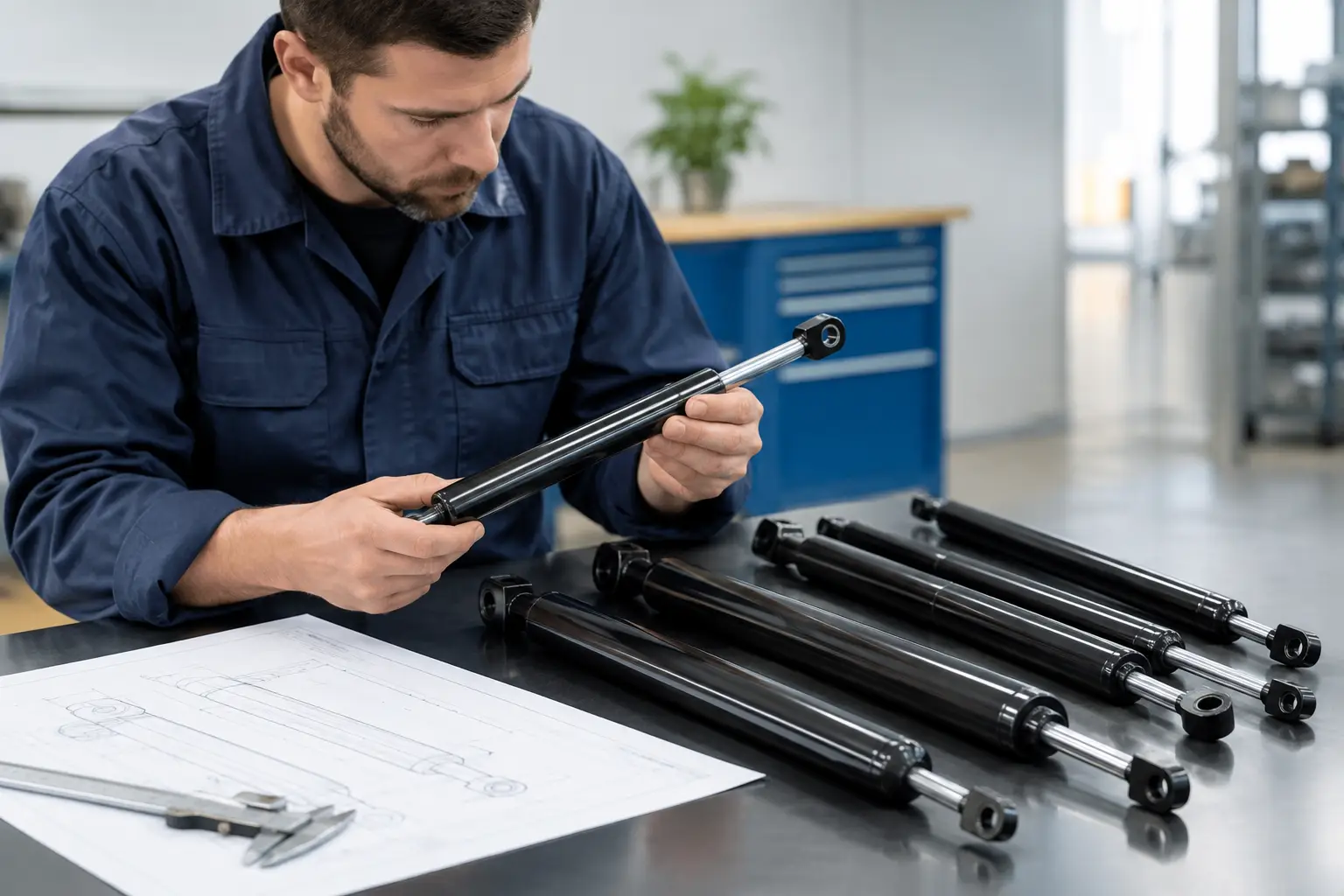
The most useful starting point is the existing strut, if one is fitted. Record the extended length from centre to centre of the mounting points, the compressed length, cylinder and rod diameter, end fitting type, and any force marking in Newtons. Photos of the strut and both mounting locations help confirm what is required.
Where there is no existing unit, the moving component must be measured in its fitted position. The key details are the panel weight, hinge location, fully closed and fully open angles, and the proposed locations of the fixed and moving mounting points. Measure from the centre of each ball stud, eye or pivot, not from the edge of the bracket.
The difference between the open and closed mounting-point measurements establishes the required stroke. The closed measurement also matters because the strut must not bottom out before the lid is fully shut. Allowance is needed for end fittings, brackets and clearance around the cylinder. A strut that is only a few millimetres too long when compressed can bend mounts or prevent proper closure.
Force selection is not simply a matter of dividing the lid weight between two struts. The distance from the hinge, the opening angle and the line of action of each strut determine its lifting leverage. This is why a 400N strut can be correct in one installation and completely wrong in another with the same panel weight.
Mounting geometry matters as much as force
Gas struts work best when their mounting points are planned around the full path of movement. At the closed position, the strut needs enough mechanical advantage to start the lift. Near full extension, it should support the component without forcing it past the desired opening angle.
Bracket placement can also alter the user experience. Moving a ball stud a small distance along a lid or frame can change opening effort considerably. It may improve the initial lift, reduce closing resistance or provide a more secure hold at the open position. On heavier covers, the wrong geometry can cause the cover to twist, especially if the struts are not positioned symmetrically.
Where possible, mount the cylinder higher than the rod when the strut is at rest. This orientation helps keep internal lubrication where it is needed and supports service life. The practical layout still takes priority. Some installations need a different orientation due to space restrictions, water exposure or the movement path of the component.
Clearance should be checked with the lid fully open and fully closed, then through the entire movement. Look for contact with frames, seals, wiring, racking, drawer slides and other hardware. A strut may clear in a simple side-on drawing but foul a surrounding structure once the offset of brackets and end fittings is included.
Choose fittings for the job, not just what is available
End fittings are part of the design, not an afterthought. Ball sockets suit many vehicle, canopy, cabinet and machinery applications because they accommodate movement through the arc. Eye ends, clevis fittings and threaded ends can be better suited to fixed pivot points or specialised fabricated brackets.
Material selection matters in exposed service. Marine, wash-down, agricultural and coastal applications may require corrosion-resistant components and appropriate brackets. A strut used on a trailer or ute canopy also needs fittings that stay secure under vibration. Retaining clips, correct ball stud sizes and sound bracket material all affect reliability.
For industrial equipment, consider access for future replacement. A strut may have the correct dimensions but be difficult to remove if its retaining clip faces an inaccessible side or a bracket is trapped behind a guard. Planning service access at the design stage saves downtime later.
Account for real operating conditions
Gas strut force varies with temperature. A strut fitted and tested on a mild day can feel weaker in a cold workshop and stronger in high summer heat. For applications that operate outdoors, in refrigerated areas or close to heat sources, that variation needs to be included in the force selection.
Frequency of use is another factor. A strut supporting a rarely opened storage hatch has different demands from one operating a machine guard several times per shift. Dust, moisture, chemical exposure, vibration and side loading also affect working life. If the application has a safety-critical requirement, the design should not rely on gas struts as the only means of securing the load. A mechanical stay, latch or lock may be required.
Avoid using a gas strut as a hard stop. The open position should be controlled by the lid, hinges or dedicated stops rather than repeated impact at the end of the strut stroke. Side loading should also be avoided, as gas struts are intended to work along their axis. Misalignment can wear seals, bend rods and shorten service life.
A practical process for a custom strut design
Start with the function: what needs to move, who will operate it and where it must stop. Then document the component weight, hinge position, available installation space, open angle and expected operating conditions. If the item is already built, photographs from both sides in open and closed positions provide useful context.
Next, establish the mounting geometry and calculate or test the force requirement. Prototyping is worthwhile for fabricated equipment, unusual lid shapes or heavy assemblies. A temporary mounting arrangement can show whether the lid has enough initial lift, whether it remains controlled near full open and whether the closing effort is acceptable.
Once the dimensions, force and fittings are confirmed, specify the strut and brackets as a matched system. This reduces the risk of receiving a suitable cylinder with unsuitable ends, or correct fittings with no clearance for installation. For Australian workshops and operators needing direct technical guidance, Gas Struts can help assess the application details and identify a custom arrangement suited to the load and movement required.
When standard struts are still the sensible option
Custom work is not always necessary. If an existing strut has clear markings, the mounting points are undamaged and the replacement matches length, force and fittings, a standard replacement is generally the fastest path. This is common for vehicle bonnets, boots, caravan doors, toolboxes and common cabinet systems.
Custom specification becomes worthwhile when the original design is unavailable, the load or hinge arrangement has changed, standard struts do not provide the required opening behaviour, or the installation has unusual space and environmental constraints. It is also the better approach when a failed strut is only a symptom of poor bracket position or an under-specified original layout.
Before ordering, check every measurement with the component supported safely and its full range of movement available. Accurate information at this point leads to a strut that feels right in use, protects the surrounding hardware and keeps the job working as intended.