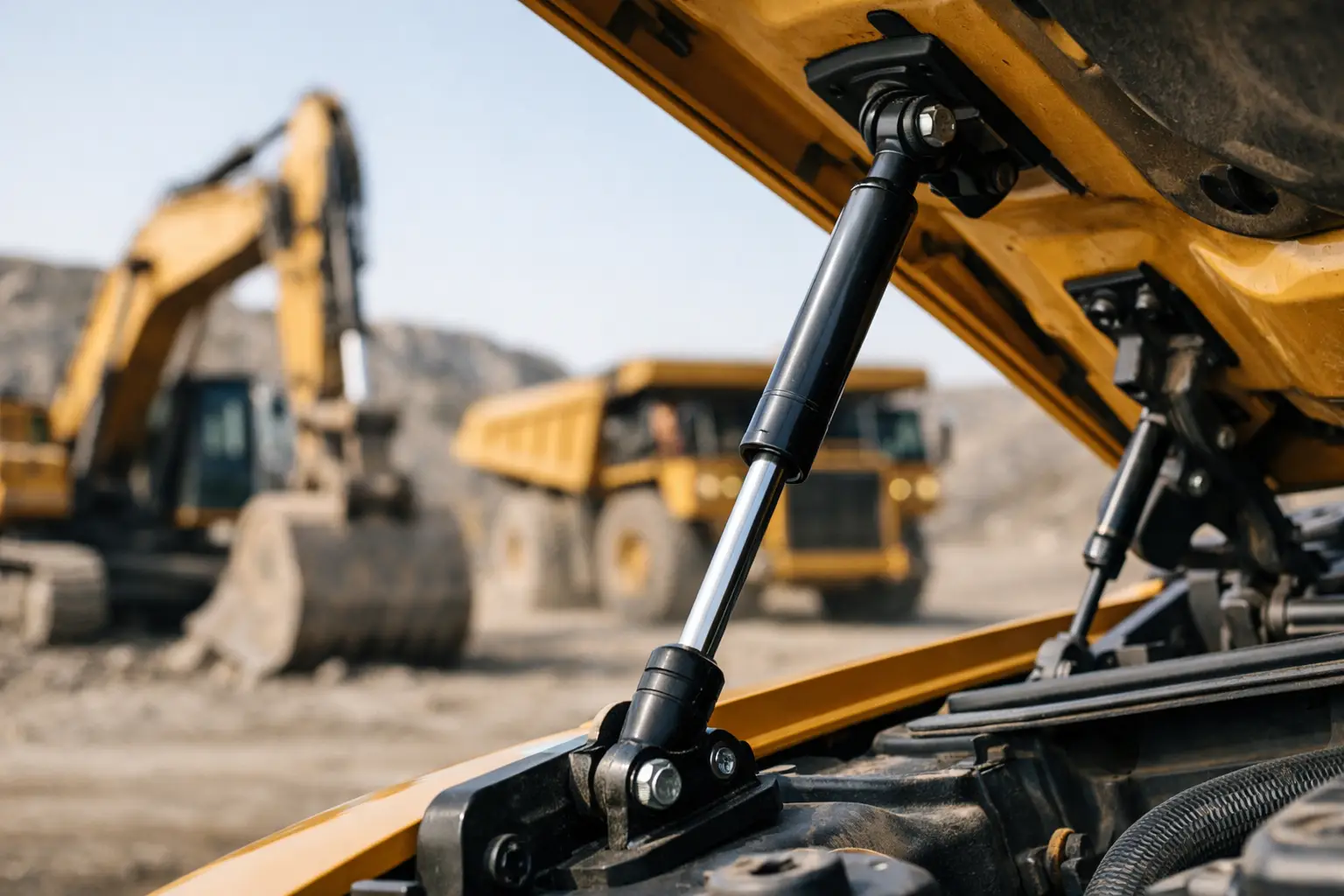
When a service hatch drops without warning or a heavy access panel stops holding at full extension, the problem is rarely minor. In mining operations, mining equipment petrol struts do more than make lids easier to lift. They help protect technicians, reduce strain during routine checks, and keep plant access points working as intended in hard conditions.
A failed strut on a light commercial vehicle is inconvenient. A failed strut on mining equipment can slow maintenance, create a safety risk, or leave critical compartments awkward to access in the middle of a shift. That is why replacement should never be based on guesswork alone.
Why mining equipment petrol struts matter
Mining gear works in an environment that exposes every moving part to punishment. Dust gets into seals, vibration works fasteners loose, and temperature swings can change how a strut behaves from morning startup to the hottest part of the day. Add in oversized doors, tool compartments, inspection covers and engine bay panels, and it becomes clear that the strut is a working component, not a convenience item.
A properly specified petrol strut supports controlled motion. It helps an operator lift a panel without excessive effort, holds that panel in a predictable open position, and assists with safe closing. On machines where access is frequent, that support adds up quickly. Maintenance crews notice the difference when they are not fighting dead weight every time they inspect filters, hydraulics or electrical systems.
The other side of the equation is wear. Mining equipment often carries more mass in each hatch or door than standard industrial equipment, and the mounting geometry is not always forgiving. If the force is wrong, the strut can overload brackets, twist mounting points or make the panel difficult to close. If the body material or seal quality is poor, service life can be short.
What makes a strut suitable for mining use
Not every petrol strut sold for industrial use is automatically suitable for mining equipment. The application usually demands closer attention to force, stroke, closed length, end fittings and corrosion resistance.
Force rating is the first point most buyers look at, and for good reason. Heavy access doors and covers need enough support to lift and hold safely. But higher force is not always better. If the strut is overpowered, the panel may spring open too aggressively or put extra stress on hinges and brackets. The right force depends on panel weight, centre of gravity, mounting position and the angle through the opening arc.
Material quality also matters. On-site conditions can include moisture, slurry, washdown procedures and abrasive dust. That combination is hard on rods, seals and mounting hardware. Better quality struts are built to resist contamination and maintain more consistent performance over time, especially where the machine is exposed continuously.
Then there is cycle demand. Some struts are opened occasionally during scheduled servicing. Others are used multiple times a day across fleets and fixed plant. The more frequently an access point is used, the less room there is for a low-grade part.
Common mining applications for petrol struts
Petrol struts turn up across a wider range of mining assets than many people expect. They are commonly fitted to engine covers, battery box lids, side access doors, generator housings, compressor enclosures, pump cabinets and control compartments. On support vehicles and field service units, they are also used on canopy doors, toolbox lids and storage systems.
Each application creates its own set of requirements. A battery box lid may need compact closed length and moderate force in a tight mounting area. An engine cover may need significantly higher force and stronger end fittings because of size, weight and vibration. A service body canopy might require smooth opening behaviour and reliable holding force for technician safety when parked on uneven ground.
This is where a generic replacement often falls short. Two struts can look similar on the bench and still behave very differently once installed.
Replacing mining equipment petrol struts without guesswork
The safest way to replace a mining strut is to match the original specification as closely as possible, then check whether the original design itself caused repeated failures. If a strut has been changed before, painted over, or fitted with non-standard ends, that assessment becomes even more important.
Start with the core measurements. You need the extended length from centre to centre, the closed length, and the stroke. Then identify the force, usually marked in Newtons on the strut body. End fitting type matters as well, whether that is a ball socket, eyelet, fork or another configuration.
Mounting orientation should also be checked. Petrol struts are typically designed to work with the rod facing down in the closed position where possible, which helps lubrication and seal life. If the machine layout forces a different arrangement, that does not rule the part out, but it may affect longevity and performance.
If no markings remain, the job becomes more technical. In that case, the panel weight, hinge position, opening angle and mounting point locations all help determine the correct replacement. This is often where specialist advice saves time. Instead of trialling multiple parts, you can work from actual application data and get a strut that behaves properly from the start.
Why custom fitment is often the better option
Mining fleets are rarely made up of textbook applications. Equipment gets modified, guards are reworked, replacement panels differ from OEM dimensions, and site-specific service bodies introduce extra access points. In these cases, an off-the-shelf strut may be close, but close is not always good enough.
A custom solution can address force changes, altered mounting geometry, unusual stroke requirements or higher durability needs. That matters when an access panel has to stay open reliably in the field, not just in a workshop test fit.
For trade buyers and maintenance managers, custom fitment also helps standardise across equipment where practical. That can reduce downtime spent chasing mismatched replacements and lower the risk of staff fitting whatever looks nearest on the shelf. If the strut is a known spec for a known application, replacement becomes much more straightforward.
Signs your current struts are not up to the job
The obvious sign is loss of holding force. If a hatch drifts down, will not stay fully open, or needs a prop to remain safe, the strut should be replaced. But there are less obvious warning signs as well.
Jerky movement can indicate internal wear or contamination. Visible rod damage can shorten seal life quickly. Bent shafts, loose end fittings and bracket fatigue often suggest the force or geometry is wrong, even if the strut still works for now. Difficulty closing a panel can also point to over-specification, not strength.
Where a strut fails repeatedly in the same position, it is worth looking beyond the part itself. Vibration, heat exposure, poor bracket alignment and side loading can all reduce service life. Replacing the strut without addressing the cause usually leads to the same result.
What to have ready before you order
A quicker quote usually comes down to the details provided upfront. The most useful information includes the extended and closed lengths, Newton rating, end fitting style, rod and tube diameter if known, and clear photos of the mounted strut and brackets. If the original part number is legible, that helps as well.
For an unmarked or non-standard unit, photos of the full hatch or panel in both open and closed positions are valuable. So are basic details about the machine type and what the strut supports. The more complete the picture, the easier it is to recommend a correct replacement rather than a rough substitute.
For buyers managing multiple assets, it can be worth recording these details as part of maintenance history. That turns the next replacement into a planned task instead of a rushed measure after a breakdown.
Choosing a supplier that understands hard-use applications
Mining applications leave little room for vague product matching. A supplier should be able to help with more than just a catalogue lookup. They should understand force selection, mounting variables, end fitting options and the difference between a standard replacement and a strut intended for ongoing heavy use.
That support is especially useful when the equipment is older, modified or fitted with struts that are no longer readily identified. Access to stocked sizes helps for common replacements, but technical guidance matters just as much when the application is specific. That is why many trade and industrial buyers deal with Petrol Struts at https://gasstruts.net.au/ when fit, force and reliability need to be right the first time.
The best result is not simply getting a hatch to open again. It is getting a strut that suits the equipment, protects the operator and stands up to the actual work being done. On mining gear, that difference shows up quickly in safety, maintenance efficiency and how often the same part needs replacing.
If a strut on site is failing early, hard to identify or no longer matched to the job, it is worth stopping to measure it properly before ordering the next one. A few extra details at that stage usually save far more time than another short-lived replacement.