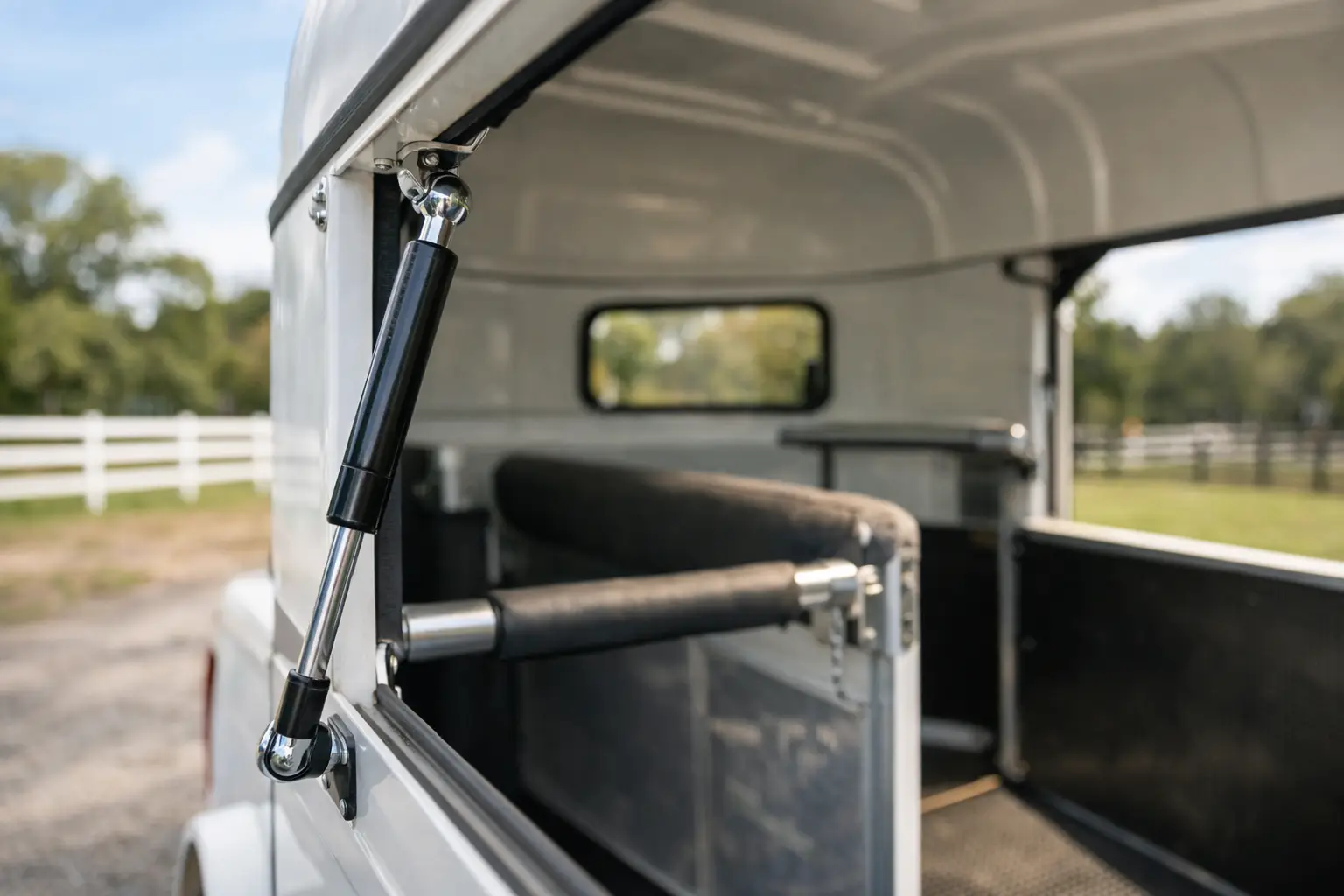
A horse float ramp that drops too hard or a front window that will not stay up is more than an annoyance. It is a safety problem, and in many cases the cause is worn or incorrectly matched horse float gas struts. When the strut force, length or end fittings are wrong, the float becomes harder to use and less safe around horses, handlers and gear.
Horse floats work in demanding conditions. They sit outside, travel long distances, deal with dust, vibration, washdowns and uneven loading, and often see periods of storage between trips. Gas struts in that environment need to do more than simply lift a panel. They need to control movement properly and keep doing it over time.
Where horse float gas struts are used
On a horse float, gas struts are commonly fitted to rear ramps, front tack box lids, side access doors, service hatches, roof vents and front windows. Some custom setups also use them on storage compartments or feed lockers. Each of those jobs places different demands on the strut.
A tack box lid might only need moderate lift assistance and a compact body size. A rear ramp, on the other hand, may need a much higher force rating and careful positioning to control the opening arc. That is why there is no single universal strut for every horse float application.
The right replacement depends on how the panel is hinged, where the strut mounts, the panel weight and how far it needs to open. Two horse floats can look similar and still use completely different struts.
Why strut matching matters
The most common mistake is assuming that any strut with a similar overall length will do the job. In practice, small differences in force or stroke can create real problems.
If the force is too low, the lid or ramp may sag, fail to stay open or slam shut in wind. If the force is too high, the panel can become difficult to close, mountings can be put under excess load and the structure around the brackets may start to fatigue. A strut that is too long or too short can also change the opening angle and place side load on the rod, which shortens service life.
On horse floats, that matters because the equipment is being used around live animals. Sudden movement, poor control or unreliable support can create unnecessary risk in a tight working space.
How to identify the correct horse float gas struts
If the original struts are still fitted, the fastest path is to read the markings on the body. Many struts are marked with a force rating in Newtons, a part number and sometimes a manufacturing code. That gives a good starting point, but it should still be checked against the actual dimensions and fittings.
The key measurements are the extended length from centre to centre of the end fittings, the stroke length, the style of end fitting and the force rating. It also helps to note whether both struts are fitted as a pair and whether the panel is side-hinged or top-hinged.
If the old struts are missing or unreadable, the next step is to measure the application itself. In most cases, a supplier will want clear details on the open and closed positions, bracket style and how the float is used. A rear ramp on a straight-load float may need a different setup from a front tack compartment on an angle-load model, even if the dimensions are close.
Photos help as well, especially where bracket type or mounting angle is not obvious.
The measurements that matter most
When replacing horse float gas struts, force gets most of the attention, but fitment details are just as important.
Extended length tells you whether the strut can reach the correct open position. Compressed length confirms it can close without bottoming out. Stroke is the difference between those two points and affects how the panel travels. End fittings matter because a ball socket, eyelet or fork end cannot simply be swapped without checking bracket compatibility.
Mounting orientation also matters. In many applications, the rod should point down when the panel is closed. That helps keep the internal seal lubricated and can improve service life. There are exceptions, but it is one of the details worth checking before ordering.
Signs your current struts need replacement
Gas struts do not always fail all at once. Often the change is gradual, which makes it easy to put off replacement until the unit becomes unreliable.
Common signs include a ramp or lid that no longer holds open, panels that drop faster than they used to, oil visible on the rod or body, bent shafts, corroded end fittings and movement that feels jerky instead of controlled. If one strut has failed on a paired setup, the other is usually not far behind. Replacing both at the same time is generally the better call.
That is especially true on horse floats, where uneven support can twist the panel and strain the hinges.
Standard replacement or custom strut
Some horse float gas struts can be replaced with a stocked standard size. That is often the quickest and most cost-effective option when the dimensions, force and fittings line up properly.
Other applications need a custom solution. That tends to happen on older floats, imported models, modified tack compartments or applications where original bracket geometry is unusual. A custom strut may also be the right answer if the original setup never worked particularly well and the goal is to improve how the panel opens and closes.
There is a trade-off here. A standard strut can reduce lead time and simplify ordering, while a custom strut can solve recurring fitment or performance issues. The right option depends on whether the application is straightforward or whether it needs proper re-matching.
Material quality and durability matter on floats
Horse floats are exposed to a mix of road grime, moisture and repeated movement, so cheap struts usually do not stay cheap for long. Better-quality units are built for pressure retention, seal performance and resistance to corrosion in real operating conditions.
That is where product standard matters. For buyers who need dependable replacements rather than guesswork, it makes sense to source from a specialist supplier with broad stock coverage and application support. At Gas Struts, that includes replacement and custom-fit options backed by technical guidance, a two-year warranty and fast fulfilment across Australia.
For high-use floats, bracket condition should also be checked during replacement. A new strut fitted to a loose or cracked bracket will not fix the underlying problem.
When force should be changed
Not every replacement should copy the original force exactly. If the float has had structural changes, added lining, altered doors or heavier hardware fitted over time, the original Newton rating may no longer be ideal.
Likewise, if the panel has always been hard to close or has never opened to a useful angle, there may be a better force and mounting combination available. This is where application advice matters. Changing force without checking geometry can create a new problem, but in the right situation it can improve safety and ease of use.
That is particularly relevant for horse owners and workshop operators dealing with older floats that have been repaired or modified more than once.
What to have ready before you enquire
If you need help sourcing horse float gas struts, having the right information speeds things up. The useful basics are the strut length, stroke, force if known, end fitting type, number of struts used and clear photos of the mounting points. It also helps to mention what the strut supports, such as a rear ramp, window or tack box lid, and whether the current setup is too weak, too strong or simply worn out.
That information gives a supplier a far better chance of matching the part correctly the first time.
A horse float is not the place for trial-and-error hardware. If the strut is doing a job that affects safety, animal handling or daily access, it is worth getting the specification right and fitting a unit built to last.