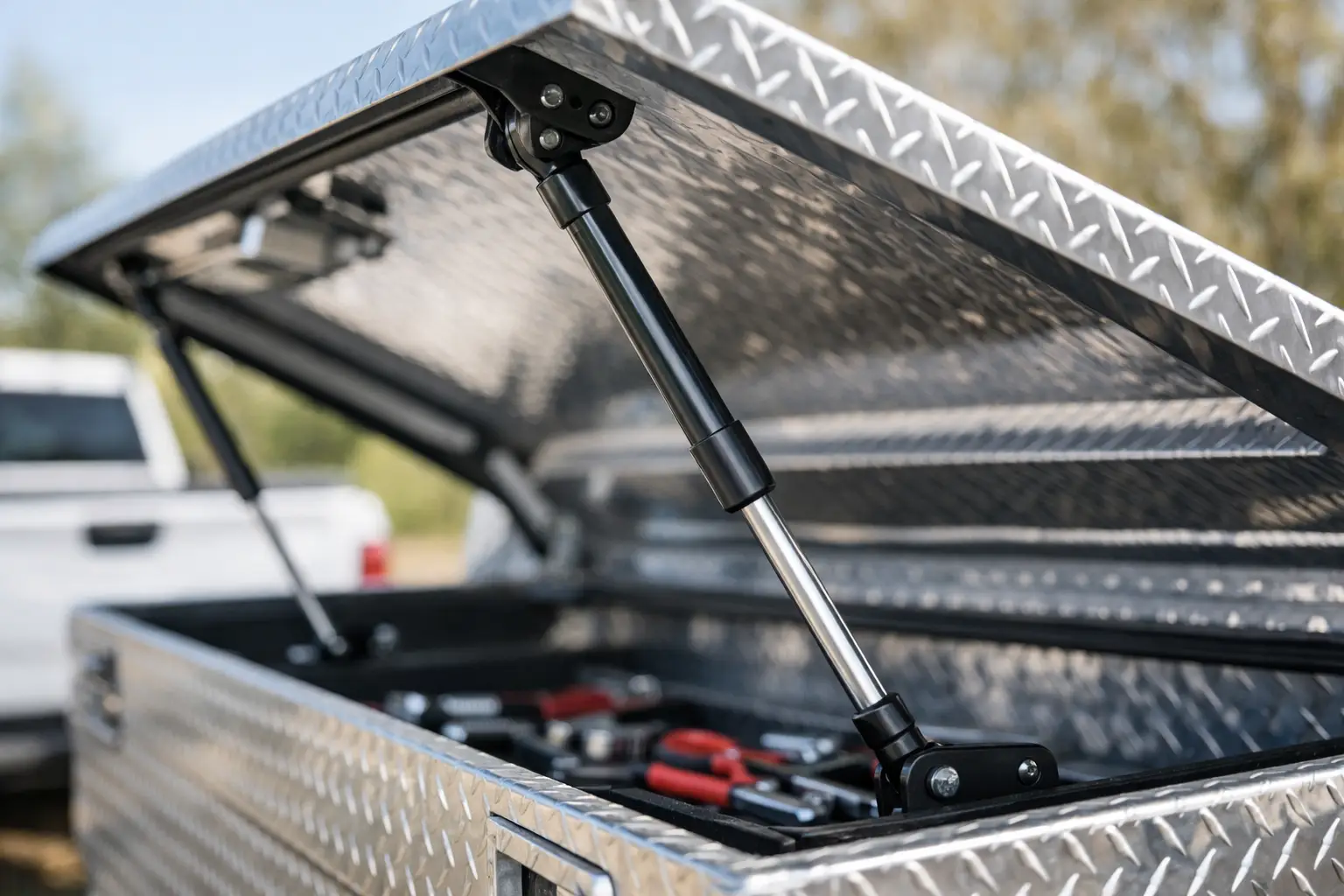
A toolbox lid that drops without warning is more than annoying. On a ute, trailer or site box, it slows the job down, damages hinges and creates a genuine safety risk. That is why getting the right toolbox lid gas struts matters – not just any strut that looks close enough, but one matched to the lid weight, mounting geometry and the way the box is actually used.
Why toolbox lid gas struts need to be matched properly
Toolboxes cop a harder life than most lid applications. They are opened and shut repeatedly, exposed to dust, vibration, weather and uneven loading, and often mounted on vehicles or equipment that do not stay still for long. A gas strut that works fine on a light cabinet door may fail quickly or lift poorly on a heavy checker plate toolbox.
The usual problems come from incorrect force, incorrect extended or compressed length, or poor bracket positioning. Too much force and the lid can be difficult to close, place excess load on the hinge or twist the mounting points. Too little force and the lid will not stay up reliably, especially when the toolbox is parked on a slope or the lid has extra weight from seals, racks or internal lining.
This is where a lot of buyers get caught. They assume the old strut rating is all they need, but replacement is not always that simple. If the original setup was marginal from day one, fitting the same thing again may only repeat the problem.
What to check before ordering toolbox lid gas struts
Start with the basics. If the existing strut still has a part number, that can help, but you should still confirm the measurements. Gas struts are selected by specification, not by appearance alone.
The key measurements are the extended length from centre of fitting to centre of fitting, the compressed length, and the stroke. You also need the end fitting type and size, such as ball sockets, eyelets or forks. On a toolbox, the mounting style matters because clearance can be tight around the lid frame, internal tray space or weather seals.
Force rating is the next critical detail. This is usually shown in Newtons. If the existing strut has worn out, the printed number may not reflect what it is currently doing, but it still gives you a starting point. If there is no marking or the setup is custom, you will need to work from lid dimensions, lid weight, hinge position and bracket locations.
Lid construction also affects the answer. A plain aluminium lid behaves differently from a steel lid with internal bracing, central locking, rubber sealing and mounted accessories. Even the opening angle changes the force requirement. A lid that only opens to 70 degrees may need a different setup from one designed to lift wider for access.
The main sizing mistakes and what they cause
Incorrect length is often the first problem. If the strut is too long when extended, the lid may over-travel or the strut may bottom out before the lid reaches its natural stop. If it is too short, the lid may not open high enough to be practical, or the geometry may reduce the lifting assistance too early.
Compressed length matters just as much. A strut that does not compress far enough will fight the lid in the closed position and can place constant stress on the hinge, latch or mounting brackets. Over time that can crack welds, pull fasteners loose or distort thin sheet material.
Then there is force. Many people try to solve a weak or sagging lid by fitting a much stronger strut. Sometimes that works, but often it just creates a new issue. The lid may spring up too aggressively, become hard to close or put uneven load through the structure if the pair is not balanced. On vehicle-mounted boxes, that extra stress shows up quickly because vibration is already working against the hardware.
One strut or two?
It depends on the width and weight of the lid, along with how the lid is hinged and supported. Smaller side-opening or narrow top-opening lids may work well with a single gas strut. Wider lids generally benefit from a pair because the load is shared more evenly and the lid is less likely to rack under repeated use.
A pair is not automatically better if the toolbox body is light or the mounting points are weak. In that case, two higher-load struts can transfer more force into the structure than it was designed to handle. The right answer comes from the full setup, not a rule of thumb.
If one strut in a pair has failed, replace both. An old and new strut working together rarely gives balanced performance, and the stronger unit ends up carrying more of the job.
Material quality matters on working vehicles
Toolbox applications are not gentle. Struts on utes, service bodies, trailers, caravans and field equipment deal with grime, water, vibration and heat cycling. Cheap struts can look acceptable on day one but lose force early, corrode around the rod or develop rough operation that wears mounts and brackets.
For trade and industrial use, seal quality, rod finish and manufacturing consistency matter. So does the hardware around the strut. A good strut fitted to poor brackets is still a weak system. If the box is exposed to marine spray, washdown conditions or harsh site environments, material selection becomes even more important.
This is also where buying from a specialist supplier pays off. When the application is unusual, or the box has been modified, technical advice is often the difference between a quick fix and a repeat failure.
When standard struts are enough and when custom makes more sense
A straightforward replacement is usually possible when the toolbox is a common size, the original geometry is sound and you can confirm the measurements and force. Standard stocked sizes suit a lot of ute boxes, canopy compartments, trailer boxes and workshop storage units.
Custom gas struts are worth considering when the lid has changed, the original design was poor, or the application has unusual operating conditions. That might include extra-heavy lids, restricted mounting space, wide opening angles or boxes mounted on specialised equipment. In those cases, matching force and length alone may not solve the issue. The bracket positions may also need to change.
At that point, giving a supplier the right information becomes important. Clear photos, centre-to-centre measurements, end fitting details, lid dimensions and an estimate of lid weight all help. So does noting whether the lid opens horizontally, vertically or at an angle, and whether the toolbox is mounted on a vehicle, trailer or fixed installation.
Installation details that affect performance
Even the correct strut can perform poorly if it is installed badly. The rod should generally be mounted in the recommended orientation for the application so the internal seal stays lubricated and service life is protected. Brackets need to be aligned so the strut is not side-loaded through the stroke.
Fastener condition matters too. Worn ball studs, loose brackets and elongated mounting holes create movement that shortens strut life. If the lid has been slamming shut or twisting for a while, inspect the hinge line before fitting new parts. Replacing the struts without fixing the underlying wear can waste the job.
Take care with closing force after installation. The lid should shut securely without needing excessive effort. If it has to be forced down hard, the strut force or geometry may be wrong. If it lifts but will not stay open in normal working conditions, it is under-supported.
Getting the right advice the first time
For many buyers, the fastest path is not trial and error. It is sending the measurements and application details to a supplier that deals with these setups every day. That is particularly useful when the original strut markings are missing, the toolbox is imported, or the mounting arrangement is non-standard.
A specialist can help confirm whether you need a direct replacement or a revised setup. That matters for fleet operators, workshops and tradespeople who cannot afford repeat downtime, and for individual owners who simply want the lid to open safely and stay open. If you need support with standard or custom-fit options, Gas Struts can help match the application through practical sizing advice and Australia-wide supply.
A good toolbox should work one-handed, hold safely and close without a fight. If the lid is doing anything else, the struts are telling you something.