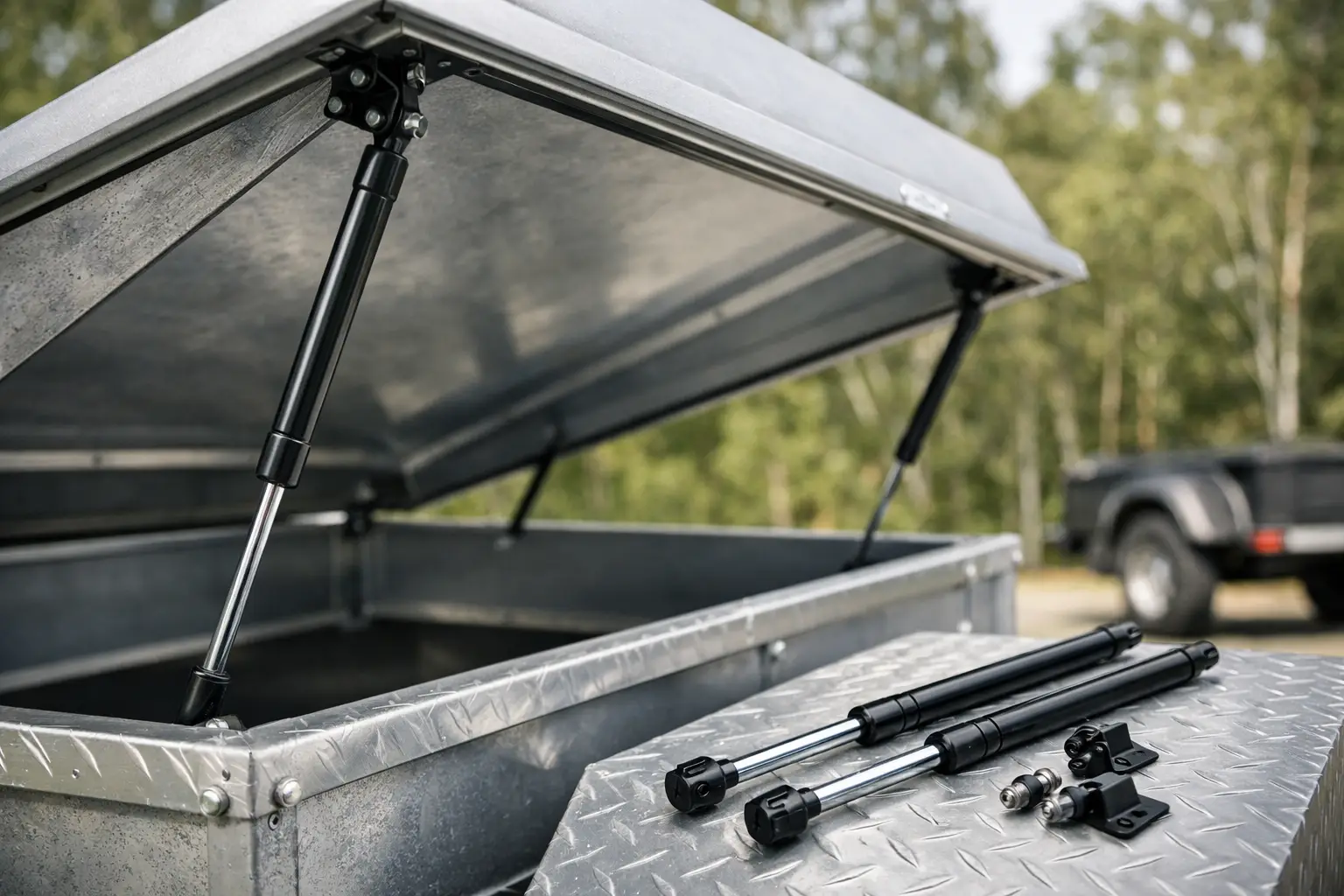
A trailer lid that drops without warning is more than an annoyance. It slows the job down, puts hands and shoulders at risk, and usually means the existing trailer lid petrol struts are worn out, under-specced or simply the wrong fit for the lid weight and mounting geometry.
Getting the right strut is not just a matter of matching length. Trailer lids vary widely in size, material, opening angle and hinge position, and those details change how much force is needed and how the lid behaves through the lift. A strut that looks close on paper can still be awkward to open, fail to hold the lid at full extension, or wear out early because it is working outside the right range.
Why trailer lid petrol struts fail early
In most cases, the strut itself is not the only issue. Trailer applications are hard on moving parts. Dust, water, corrugations, vibration and frequent opening all add load to the seals, rod surface and brackets. If the lid has been modified with extra sheet, racks, lining or tools mounted underneath, the original struts may no longer have enough force.
Mounting position also matters. Two struts with the same force rating can behave very differently depending on where they are fixed to the lid and body. If the lower bracket sits too far inboard, the lid may feel heavy at the start of the lift. If the upper mount is poorly placed, the lid may over-centre, bind, or stop short of the desired opening angle. That is why replacement based only on visual similarity often leads to a second round of troubleshooting.
Temperature is another factor. Petrol struts naturally produce less force in colder conditions and more in hotter ones. For a trailer used across varied Australian conditions, that can be enough to expose a marginal force selection. A lid that stays up in summer may sag in winter mornings, especially if the struts were only just coping to begin with.
How to choose trailer lid petrol struts properly
The right approach starts with the basic measurements, but it should not stop there. Closed length, extended length and end fitting type are essential, yet force rating and bracket geometry are what determine how the lid actually works in service.
Measure the strut, then check the application
If you are replacing an existing unit, record the extended length from centre to centre, the closed length, and the stroke. Also check the end fittings – common options include ball sockets, forks and eyelets. Then confirm whether the current struts were performing correctly before they failed. If the lid was always too heavy, opened too fast, or never reached the right angle, matching the old part exactly may repeat the same problem.
It also helps to note any markings on the old strut. Force is often shown in Newtons, such as 250N, 400N or 600N. If the marking has worn off, the lid weight and mounting points become more important for selecting a suitable replacement.
Force rating is where most errors happen
Too little force and the lid will not stay open safely. Too much force and the lid can become difficult to close, place excess stress on hinges and brackets, or twist a lighter lid over time. On twin-strut setups, the load should be balanced across both sides. If one strut has failed and the other is still operating, replacing only one can create uneven lift and shorten the life of the remaining unit.
The required force depends on more than lid weight. A long but relatively light aluminium lid may need a different force setup than a shorter steel lid because leverage changes across the opening arc. The centre of gravity matters, as does any gear fitted to the underside of the lid.
Bracket position changes the result
This is the part many buyers overlook. The same strut can feel strong or weak depending on where it is mounted. Good geometry gives controlled lift through the full range, supports the lid at the desired open angle, and avoids side loading on the rod.
If you are building a new lid system or changing bracket positions, it is worth getting application advice rather than guessing. A technically correct strut with poor geometry is still the wrong solution.
When a standard replacement works – and when it does not
For many trailers, a like-for-like replacement is fine. If the lid opened smoothly, held properly and the brackets are sound, the job may simply be to match the original dimensions, fittings and force. That is the fastest path for a straightforward repair.
But there are plenty of cases where standard replacement is not enough. Custom tool trailers, canopies, enclosed trade trailers, horse float tack compartments and camper conversions often carry extra hardware or use non-standard hinge and lid layouts. In those jobs, the strut has to suit the actual application rather than a generic category.
That is where custom trailer lid petrol struts or revised mounting advice can save time. Instead of trying two or three near matches, it is often more efficient to supply the measurements, lid weight, bracket positions and photos, then select a strut that suits the geometry from the start.
Signs your trailer lid struts need attention
Most failures do not happen all at once. The warning signs usually show up first in day-to-day use. The lid starts dropping in the last part of the stroke, needs a shoulder to hold it open, or becomes noticeably heavier to lift. In some cases, oil residue appears near the rod seal, or the rod shows pitting and corrosion.
Brackets should be checked at the same time. A sound strut fitted to a cracked bracket or worn ball stud will not perform properly for long. If the lid is twisting during operation, inspect hinge alignment as well. A strut problem can sometimes be a symptom of a broader fitment issue.
Installation details that affect service life
Correct orientation matters. In many applications, petrol struts should be installed with the rod pointing downward when the lid is closed. That helps keep the internal seal lubricated and can improve service life. There are exceptions depending on the setup, so the actual mounting design still needs to be considered.
Avoid forcing a strut into place by levering the lid excessively or pulling mounts out of alignment. The brackets and hinge line should allow the strut to move freely through its arc. Side loading is one of the quickest ways to shorten strut life.
It is also worth replacing worn hardware when fitting new struts. Ball studs, brackets and nyloc nuts are inexpensive compared with the cost of a lid failure on site. For trailers used in trade, rural or marine-adjacent conditions, corrosion resistance should be part of the decision, not an afterthought.
What to have ready before ordering
If you need the right part quickly, a few details make the process far more accurate. The most useful information is the extended and closed length, end fitting style, force rating if known, and clear photos of both mounting points. For trailer lids, it also helps to know the lid dimensions, approximate weight, how far it opens, and whether one or two struts are fitted.
If the old strut is missing or has no markings, say so. It is better to start from the application details than to estimate from memory and end up with the wrong part. For unusual trailers or modified lids, custom advice is often the most reliable path. Petrol Struts can help with both stocked replacements and application-based solutions through https://gasstruts.net.au/.
Quality matters more on working trailers
Cheap struts can be tempting when the job looks simple, but trailers are not light-duty cabinet applications. Repeated vibration, outdoor exposure and uneven ground all place extra demand on seals, rod finish and internal pressure consistency. A poor-quality strut might fit, but that does not mean it will hold up.
For workshop operators, fleet managers and trade users, downtime is usually more expensive than the part itself. A properly selected strut backed by technical support, dependable stock and warranty coverage is the safer buy, especially where the trailer is opened multiple times a day.
If your lid is hard to manage now, do not wait for a full failure. A strut that is only just hanging on has already stopped doing its job properly, and trailer lids rarely pick a convenient moment to let go.