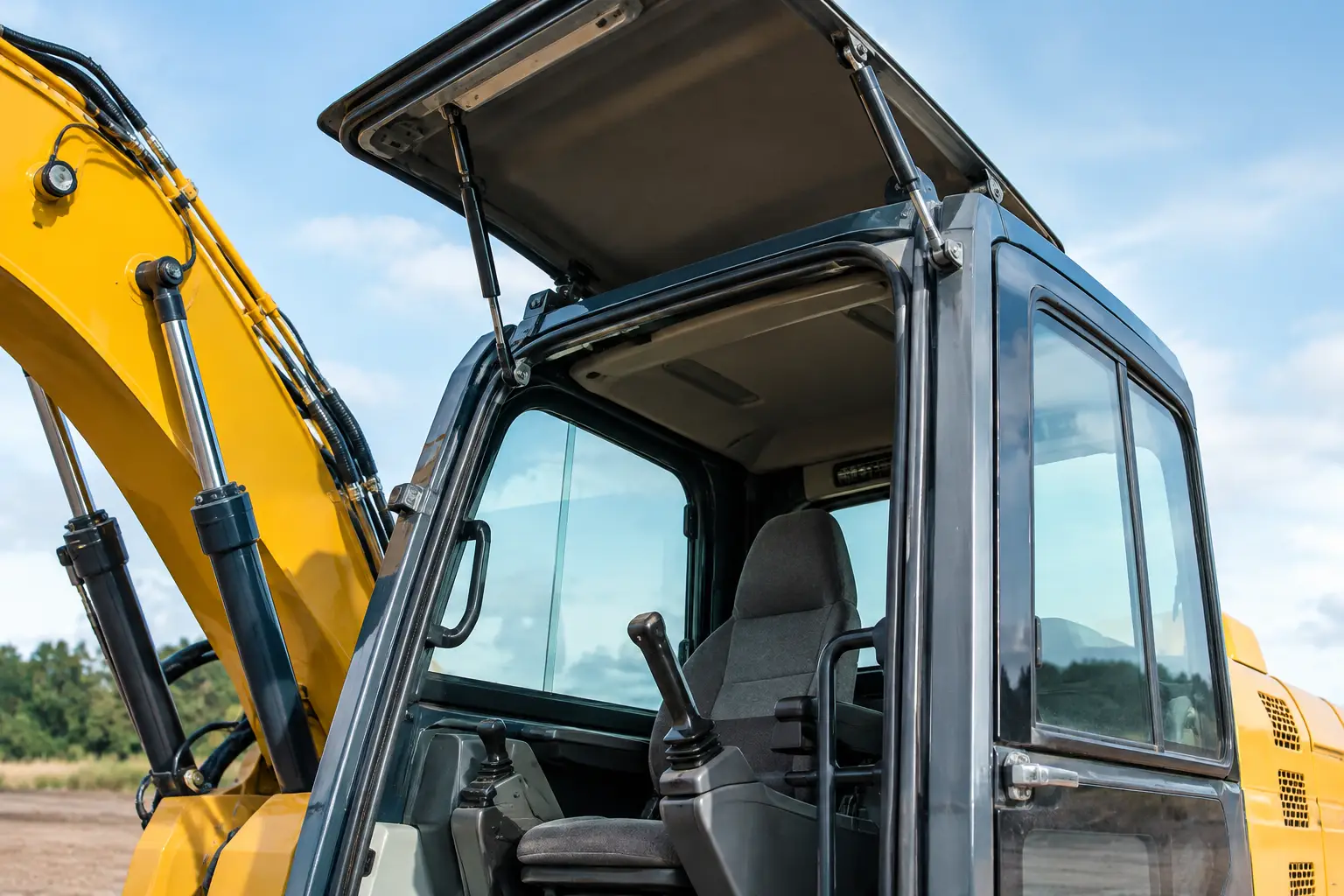
A raised excavator cab is not a light toolbox lid. When it is opened for servicing, the support system must handle substantial weight, awkward geometry, vibration and repeated workshop use. This excavator cab support example shows how to assess a gas strut setup properly, using figures that make the selection process clear without treating a critical machine safety system as guesswork.
The first rule is simple: gas struts may assist or hold a service-position cab only where the machine design permits it. They must not be used to alter the structural integrity of a certified cab, ROPS or FOPS system. Always retain the manufacturer’s specified mechanical safety prop, locking device or service stand. A gas strut is a motion-control component, not a substitute for a positive mechanical lock while anyone works beneath or around a raised cab.
What an Excavator Cab Support Must Do
A cab-tilt support arrangement commonly needs to do three jobs. It needs to reduce the effort required to raise the cab, keep it controlled through its travel and provide useful holding force at the service position. In practice, the hardest part is not finding a strut with a high enough force rating. It is matching that force to the pivot position, centre of gravity, mounting locations and operating angle.
An oversized strut can be just as troublesome as an undersized one. It may make the cab hard to pull down, load hinges and brackets excessively, or cause rapid opening near the top of the stroke. An undersized strut may allow the cab to drop, leave it difficult to lift or lose control as the strut ages.
For plant equipment, the best result normally comes from measuring the actual machine or working from verified OEM dimensions. A part number from a similar excavator is useful only if the cab weight, hinge layout and mounting geometry are the same.
Excavator Cab Support Example: Estimating Strut Force
Consider a service cab that pivots at its rear mounting points. The cab assembly weighs 220 kg, giving an approximate gravitational load of 2,158 N. At a particular point in the lifting travel, the cab’s centre of gravity sits 520 mm from the pivot centreline. This creates a turning moment of roughly 1,122 Nm:
`2,158 N × 0.52 m = 1,122 Nm`
The installation uses two gas struts. At that same point, each strut attaches 650 mm from the pivot and its line of force works at an angle of 38 degrees to the mounting radius. The force contribution is affected by the sine of that angle. The estimated force per strut is therefore:
`1,122 ÷ (2 × 0.65 × sin 38°) = approximately 1,400 N`
On paper, two 1,400 N gas struts would balance the cab at that one position. That is not yet a final specification. The geometry changes continuously as the cab lifts, and the lowest mechanical advantage often occurs close to the closed position. If the strut is nearly in line with the pivot radius at the start of travel, even a high-force strut may provide little lifting effect.
The calculation must be checked at several points: cab closed, early lift, mid-travel and fully raised. The most demanding point determines the required force, but the full travel determines whether that force will remain manageable. For a 220 kg cab, a strut force requirement in this range is plausible, but the correct rating can move significantly with only a small change in bracket position.
Measure the Hardware Before Ordering
A replacement strut should be identified from the existing unit where possible. Read the force marking on the cylinder, usually shown in newtons, and record the extended length, compressed length and end fitting style. Measure centre to centre from one ball stud or pin centre to the other, rather than measuring the body alone.
For a new or modified installation, record the mounting-centre distance with the cab fully closed and fully open. The selected strut must compress slightly more than the closed dimension and extend beyond the open dimension without reaching either end of its stroke. Allowing a sensible margin prevents the strut from bottoming out before the cab reaches its stops or being pulled to full extension under load.
Also note the bracket locations in relation to the pivot, the angle of each strut through travel, available clearance and the connection type. Common fittings include ball sockets, eye ends, clevises and threaded mounts. On heavy machinery, brackets, pins, ball studs and welds must be rated for the imposed load. A correctly specified strut cannot compensate for a weak or poorly aligned mounting point.
Details that change the result
Cab support is sensitive to details that are easy to overlook. Added sound insulation, an air-conditioning unit, tools stored in the cab or aftermarket guarding can change the weight and centre of gravity. A cab that is meant to be lifted only for periodic servicing may need a different balance than one opened frequently in a workshop.
Temperature matters as well. Gas strut output falls in cold conditions and rises in heat. Equipment working across Australian mine sites, farms or civil projects may see a wide temperature range, so a strut that feels acceptable in a warm shed should not be approved without considering its cold-weather performance. Friction in hinges and seals also affects the real force required.
Choosing a Suitable Gas Strut Configuration
Once the geometry has been checked, select a strut with the required extended and compressed dimensions, mounting ends and force rating. For a twin-strut arrangement, use matched struts from the same specification. Mixing old and new units, or units with different force ratings, can make the cab lift unevenly and concentrate load on one side.
As a general design approach, allow enough reserve to overcome hinge friction, seal friction and normal variation, but do not simply add a large force margin. The right allowance depends on the application. A manually raised cab may need modest assistance so an operator can control it. A cab that must hold itself open before a mechanical prop is engaged may need more holding support, but it still requires a separate positive lock for safe servicing.
Orientation should follow the strut manufacturer’s recommendation. In many applications, installing the rod downward when the cab is closed helps keep the rod seal lubricated and can improve service life. Clearance must be checked through the entire movement, including hoses, wiring, filters and access covers. A strut that contacts a component only near full travel will soon damage itself or the machine.
Fitment and Safety Checks
Before placing the machine back into service, test the system with the cab unloaded and with the normal installed equipment in place. Raise and lower it slowly several times. Check for binding, uneven movement, interference and any point where the cab accelerates suddenly. Confirm that the mechanical support engages securely and that it takes the cab load independently of the gas struts.
Never drill, weld or modify structural cab members without engineering approval from the equipment manufacturer or a qualified engineer. If replacement brackets are required, use suitable materials, fasteners and corrosion protection for the machine environment. Mining, quarry and coastal applications place far greater demands on hardware than a clean indoor workshop.
A worn strut often shows up as a cab that will not remain open, needs manual lifting or drops through part of its travel. Those symptoms can also indicate seized hinges, damaged brackets or changed cab weight, so inspect the entire assembly before ordering by force rating alone.
For a dependable quote, provide the machine make and model, photos of both mounting ends, extended and compressed centre-to-centre measurements, the marked force if available, and details of any modified cab equipment. Gas Struts can then help match a replacement or assess a custom configuration that suits the actual cab geometry. Getting those measurements right is the quickest way to turn a difficult, unsafe service lift into a controlled and repeatable one.