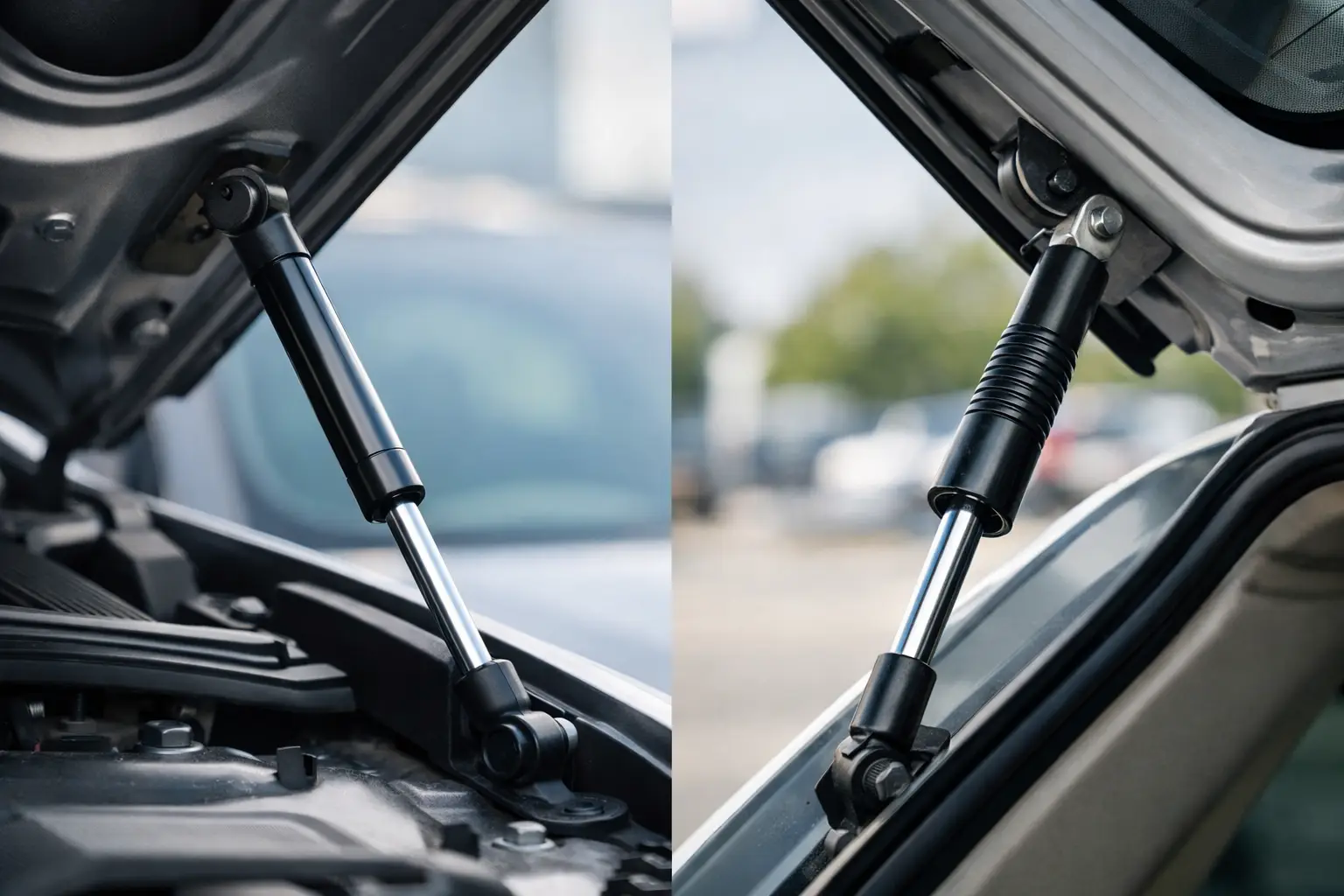
You usually notice the difference between terms like gas struts and lift supports when a canopy, toolbox lid or bonnet stops staying up. At that point, the question of gas struts vs lift supports stops being about wording and starts being about getting the right part, with the right force, fittings and stroke, so the job is safe and reliable.
For most practical applications, these two terms often refer to the same type of component. Both describe gas-charged supports designed to help lift, lower and hold a panel, lid, hatch or cover in position. The confusion comes from industry language. Some suppliers, manufacturers and end users say gas struts. Others say lift supports. In many cases, they are talking about the same thing.
That said, there are times when the wording matters because buyers are not always describing the same feature, size range or application standard. If you are replacing failed supports on a vehicle, machine, cabinet or marine hatch, it pays to understand where the overlap ends and where the specification begins.
Gas struts vs lift supports: are they the same?
In plain terms, yes, often they are. A gas strut is typically a sealed cylinder filled with compressed gas, with a rod that moves in and out to provide controlled lifting assistance and dampening. A lift support is often that exact same item, just described with more emphasis on what it does rather than how it works.
In automotive settings, lift support is a common term for bonnet, boot and tailgate applications. In industrial, agricultural, marine and trade environments, gas strut is often the preferred term. You will also hear related names like gas springs, gas shocks and gas stays. None of these terms are automatically wrong, but they can lead people to assume parts are interchangeable when they are not.
The key point is this: the name matters less than the specification. If the extended length, compressed length, stroke, end fittings and force rating are wrong, the part will not perform properly regardless of what label is on the box.
Where the terms are used differently
The biggest difference between gas struts vs lift supports is usually context, not construction. Vehicle owners replacing bonnet or boot supports often search for lift supports because that is the language used in many vehicle parts catalogues. Trade customers working on toolboxes, machinery guards, access doors or custom canopies are more likely to ask for gas struts.
There can also be a small difference in expectation. Lift support can sound like a finished replacement part matched to a specific vehicle or hatch. Gas strut can imply a broader product category that includes standard sizes, adjustable options and custom-built solutions. That distinction is useful when you are working outside a standard OEM replacement job.
If you are fitting out a caravan front box, a marine locker, an agricultural machine cover or a custom service body, you are usually not shopping by name alone. You are working from measurements, mounting geometry and required force. In those cases, gas strut is generally the more useful term because it covers the wider technical range.
What actually matters when choosing one
A support that looks close enough is often not close enough. This is where many replacements go wrong. Two parts can share a similar appearance and still behave very differently in use.
Force rating is one of the most critical specifications. This is usually measured in Newtons. Too little force and the lid will not stay open or will sag in wind, vibration or uneven loading. Too much force and the panel may be difficult to close, may spring open too aggressively or may place stress on hinges and mounting points.
Length matters just as much. Extended length affects how high the panel opens. Compressed length determines whether the unit can close fully without binding. Stroke controls the amount of travel between open and closed positions. If any of these are wrong, fitment and movement suffer.
End fittings also need to match. Ball sockets, eyelets, forks and other mounting styles are not interchangeable without the correct hardware. Even when you can physically attach the part, the wrong fitting angle can change how the strut loads through the opening cycle.
Then there is the application itself. A bonnet on a passenger vehicle behaves differently from a toolbox lid on a work ute. A marine hatch may deal with corrosion. A mining or agricultural application may see dust, vibration and repeated heavy-duty cycles. Temperature, mounting orientation and the weight distribution of the panel all affect performance.
Why one-size-fits-all replacements cause problems
A common mistake is choosing based only on length or using whatever was available at the local parts counter. That can work for basic, low-risk applications, but it is a poor approach for heavy lids, custom builds and equipment used every day.
Gas-charged supports are part of a lifting system. The hinge position, mounting bracket location, opening angle and centre of mass of the panel all interact. A support with the wrong force can make a hatch feel acceptable in the workshop but unsafe on site. It may hold on level ground and fail on an incline. It may work empty and struggle once a canopy door has racks or accessories fitted.
This is why experienced buyers focus on application data, not just generic descriptions. If you are replacing an existing part, the best starting point is the number printed on the old unit, followed by accurate measurements and photos of the fittings. If the original unit is missing or unreadable, dimensions and panel details become even more important.
When a standard lift support is enough
If you are replacing a common bonnet, boot or tailgate support on a standard vehicle, a direct-match replacement is often the simplest option. In that situation, whether the item is called a gas strut or a lift support makes little difference as long as it is correctly matched to the vehicle and installation point.
The same goes for many cabinets, storage boxes and light access doors where the original design is straightforward and the loading has not changed. A standard replacement can restore normal operation quickly and economically.
But standard replacement only works when the original setup was correct for the application and the new part truly matches it. If the vehicle has been modified, the hatch has gained weight, or the original supports were underperforming, copying the old spec may not solve the actual problem.
When you need a gas strut specified properly
Custom and heavy-use applications are where technical selection matters most. Canopies, trailers, marine lockers, machinery covers, caravan storage lids, plant equipment guards and industrial enclosures often need more than a simple replacement lookup.
In these jobs, the support needs to suit the opening geometry and working environment, not just the length of the old part. Stainless options may be required for marine exposure. Higher cycle life may matter for production equipment. Twin-mounted struts may need balanced force to prevent twist or uneven loading. In some cases, a small change in bracket position can improve operation more than simply increasing the force rating.
This is also where specialist advice saves time. A good supplier will ask for the closed and open dimensions, the hinge-to-mount distances, the approximate panel weight, the number of struts used and photos of the setup. That information is what gets you to a support that actually works.
How to choose the right replacement
If you are comparing gas struts vs lift supports for a real replacement job, start by ignoring the label and checking the details. Read any markings on the existing unit. Measure the extended length from centre to centre of the fittings. Measure the compressed length if possible. Confirm the fitting type at each end and note the mounting orientation.
Next, consider whether the application has changed. Added toolboxes, spare wheel carriers, lining, shelving or reinforced lids all affect the force required. So does environmental exposure. A strut used on a farm gate box or coastal boat hatch may need a different material or sealing standard than one fitted inside a dry workshop cabinet.
If the old unit failed early, do not assume it was the correct spec. Failure can be caused by overload, poor geometry, contamination, corrosion or side loading. Replacing like for like may repeat the same issue.
For buyers managing fleets, workshops or industrial equipment, consistency also matters. Standardising the right specification across assets simplifies maintenance and reduces downtime. That is often more valuable than chasing the lowest-cost replacement.
The better question to ask
In practice, the better question is not gas struts vs lift supports. It is whether the support is correctly specified for the load, mounting points and environment. Once that is clear, the terminology becomes far less important.
For most Australian buyers, especially in trade, transport, agriculture, marine and industrial work, dependable performance comes down to accurate sizing and proper support selection. A bonnet strut, canopy support or machinery hatch assistor only earns its keep when it opens smoothly, holds safely and lasts under real use.
If you are unsure what to order, bring the measurements, the fitting details and a clear photo of the setup. That gives you a far better chance of getting a part that works first time and keeps the job moving.