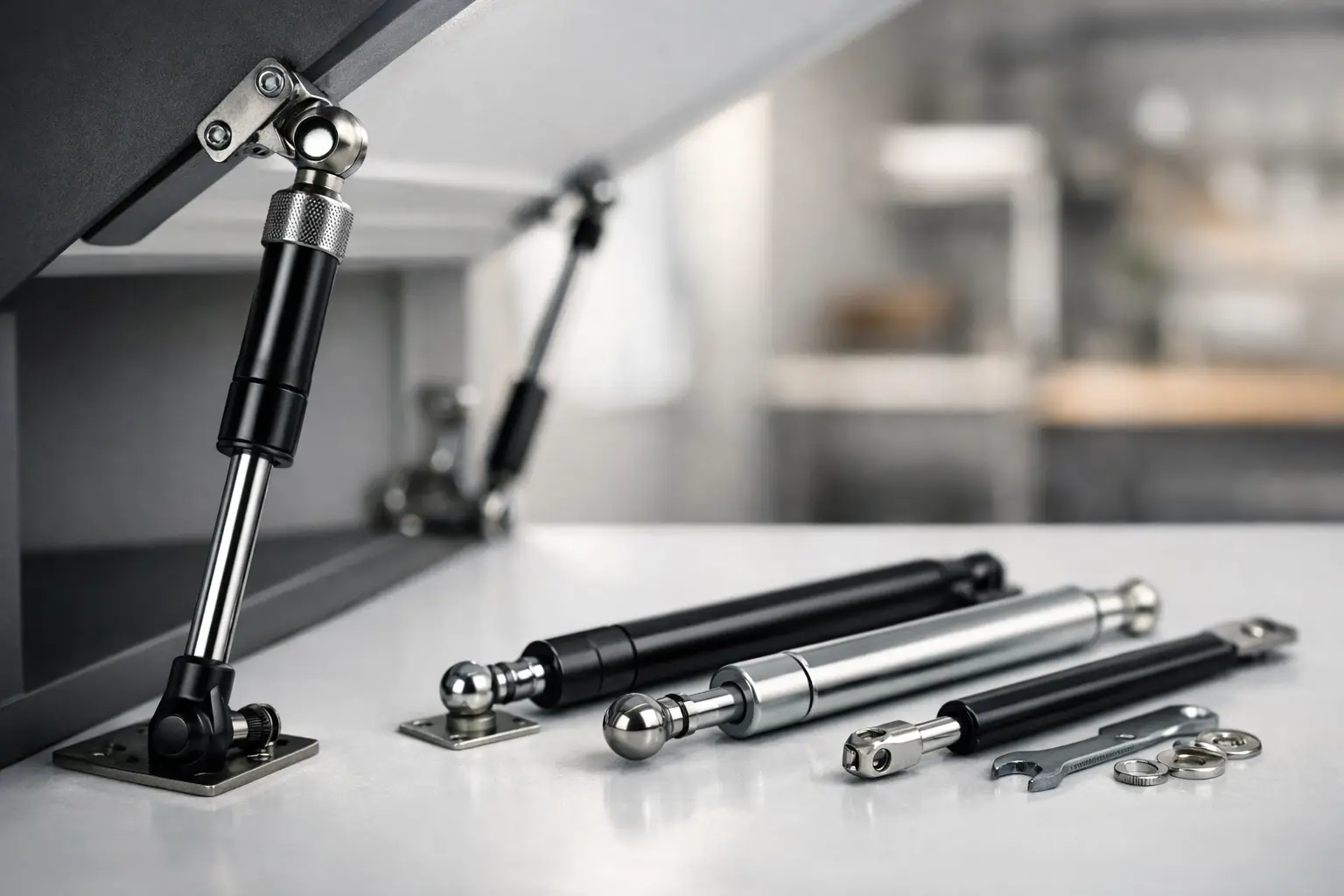
A rear canopy that springs open too hard, a toolbox lid that will not stay up, or a machinery guard that drops faster than it should – these are the jobs where adjustable petrol struts can make the difference between a workable setup and a constant nuisance. For many applications, a fixed-force strut is the right answer. But when load, mounting position or operating conditions vary, adjustability gives you more room to get the result right.
The key is knowing when that flexibility is useful and when it is not. Adjustable petrol struts are not a cure-all. They are a practical option for applications where precise lift assistance matters, and where a standard off-the-shelf force may be close but not quite correct.
What adjustable petrol struts actually do
Petrol struts are sealed motion-control components that use compressed petrol to support, lift or dampen movement. You will see them on bonnets, boots, caravan hatches, boat lockers, access panels, cabinets, seats and industrial covers. Their job is simple – reduce the effort needed to open a load and help hold it in a controlled position.
Adjustable petrol struts add another layer to that. Instead of being locked to one set force with no scope for change, they allow the force to be fine-tuned within a controlled range. That is useful where the final installed behaviour needs to be set more accurately than a standard part allows.
In practical terms, that means you can account for variations in lid weight, hinge geometry, centre of gravity and mounting angle. Two lids can weigh the same on paper but behave very differently once installed. That is often where adjustment earns its keep.
Where adjustable petrol struts make the most sense
The best applications for adjustable petrol struts are the ones where exact performance matters more than simple replacement. A toolbox on a work ute might carry different liners or hardware over time. A caravan compartment may have limited mounting space, which affects leverage and opening behaviour. An industrial enclosure might need enough support to hold safely open, but not so much force that operators struggle to close it.
This is also common in custom builds and retrofit jobs. If the original strut specification is unknown, or the mounting points have been changed, using an adjustable unit can help bridge the gap between estimate and final working setup.
Marine, agricultural and mining environments can also benefit, especially where accessories, covers or guarding have been modified from original factory design. Even then, the environment matters. Corrosion resistance, seal quality and end fitting strength still need to match the job. Adjustability is only one part of the specification.
When a fixed-force strut is the better option
Not every application needs adjustment. In many replacement jobs, a fixed-force strut is simpler, quicker and more cost-effective. If the original force is known and the application has not changed, matching the extended length, compressed length, stroke and end fittings is often all that is required.
A fixed-force strut also removes the risk of over-adjusting or under-adjusting during installation. For fleet maintenance, production runs or repeatable industrial setups, consistency usually matters more than flexibility. If every hatch or panel is identical, a properly specified standard strut can be the cleaner solution.
That is why the first question is not whether adjustable petrol struts are better. It is whether the application genuinely needs force tuning.
The measurements that still matter
Adjustment does not replace proper sizing. Even with adjustable petrol struts, the physical dimensions must suit the installation. The critical details are extended length, compressed length, stroke, end fitting type and mounting orientation.
If any of those are wrong, the strut may bottom out before the lid closes, over-extend the assembly, foul on surrounding hardware or apply force through the wrong part of the opening arc. That can cause poor operation and, in some cases, damage hinges, brackets or panels.
Force is only one part of the equation. Geometry is what determines how that force behaves across the opening cycle. A strut that seems correct on paper can still perform badly if the brackets are too close to the hinge, too far apart, or set at the wrong angle.
For that reason, good fitment starts with accurate measurements and clear application details. Photos, dimensions and load information save time and reduce guesswork, particularly for custom or hard-to-identify jobs.
How force adjustment affects real-world performance
With adjustable petrol struts, small changes can have a noticeable effect. Too little force and the lid feels heavy, drops through the top of the travel, or will not stay open reliably. Too much force and it can kick up aggressively, twist the panel, strain the mounting points or make closing difficult.
The aim is not maximum lift. It is controlled, predictable movement. On a vehicle canopy, that may mean smooth opening with enough holding force for wind or uneven parking angles. On a cabinet or machine cover, it may mean safe access without excessive closing effort. On a seat or platform, it may mean support that feels balanced rather than abrupt.
Temperature also plays a part. Petrol strut force can vary with ambient conditions, so a setup that feels ideal in mild weather may behave differently in high summer or colder inland mornings. In hard-use Australian conditions, that is worth allowing for when choosing both force range and product quality.
Common mistakes with adjustable petrol struts
One common mistake is treating force as the only specification that matters. Another is assuming a heavier lid always needs a stronger strut. In reality, hinge position, opening angle and mounting geometry often matter just as much as weight.
A second issue is replacing one failed strut without checking the pair. If one unit has lost force, the matching strut is often not far behind. Uneven support can twist the lid and shorten service life.
A third mistake is fitting an adjustable strut to compensate for poor bracket placement. Some adjustment range can help tune performance, but it cannot fully correct an installation with the wrong geometry. If the setup is fundamentally wrong, the right fix may be revised mounting points rather than more force.
Why quality matters more in adjustable applications
Because adjustable petrol struts are often chosen for more exacting jobs, build quality becomes even more important. Seal integrity, rod finish, cylinder quality and end fitting strength all affect service life. So does the consistency of the internal charge and damping behaviour.
In practical terms, poor-quality struts can lose force early, corrode in exposed environments or perform inconsistently from one unit to the next. That is a bigger problem when the application depends on precise movement rather than basic lift assistance.
For trade buyers and maintenance teams, the cost of rework is usually greater than the saving on a cheaper part. A failed strut on a toolbox is inconvenient. A failed strut on machinery guarding, a service hatch or marine access panel can create safety and downtime issues as well.
Getting the right adjustable petrol struts the first time
If you are sourcing adjustable petrol struts for a new or replacement job, the fastest path is to provide clear details upfront. The most useful information is the application type, the existing strut markings if available, extended and compressed lengths, end fitting style, approximate lid or panel weight, and photos showing the open and closed positions.
If the setup is custom, include the hinge location, desired opening angle and how the panel should behave. Should it lift by itself, assist partway, or simply hold safely once opened? That answer changes the strut specification.
This is where specialist support matters. A supplier focused on petrol struts can help sort out whether an adjustable model is the right option, whether a fixed-force replacement would do the job better, and whether custom sizing or fittings are needed. That saves trial-and-error, especially on unusual applications.
Petrol Struts works with both standard replacements and custom solutions across vehicle, industrial and equipment use, which is often the difference between getting a part that merely fits and one that actually performs properly.
Adjustable petrol struts are about control, not guesswork
The reason adjustable petrol struts appeal to so many tradespeople, workshop operators and equipment owners is straightforward. They give you a way to fine-tune movement where the margin for error is small. But they still need to be selected with the same care as any other strut – correct dimensions, suitable fittings, sound mounting geometry and build quality that will stand up to real use.
If your current setup is too heavy, too aggressive, unsafe or simply not behaving as it should, adjustment may be the missing piece. Start with accurate measurements, be realistic about the application, and get advice before forcing a near match to do a precise job. That approach usually saves time, money and a fair bit of frustration later.