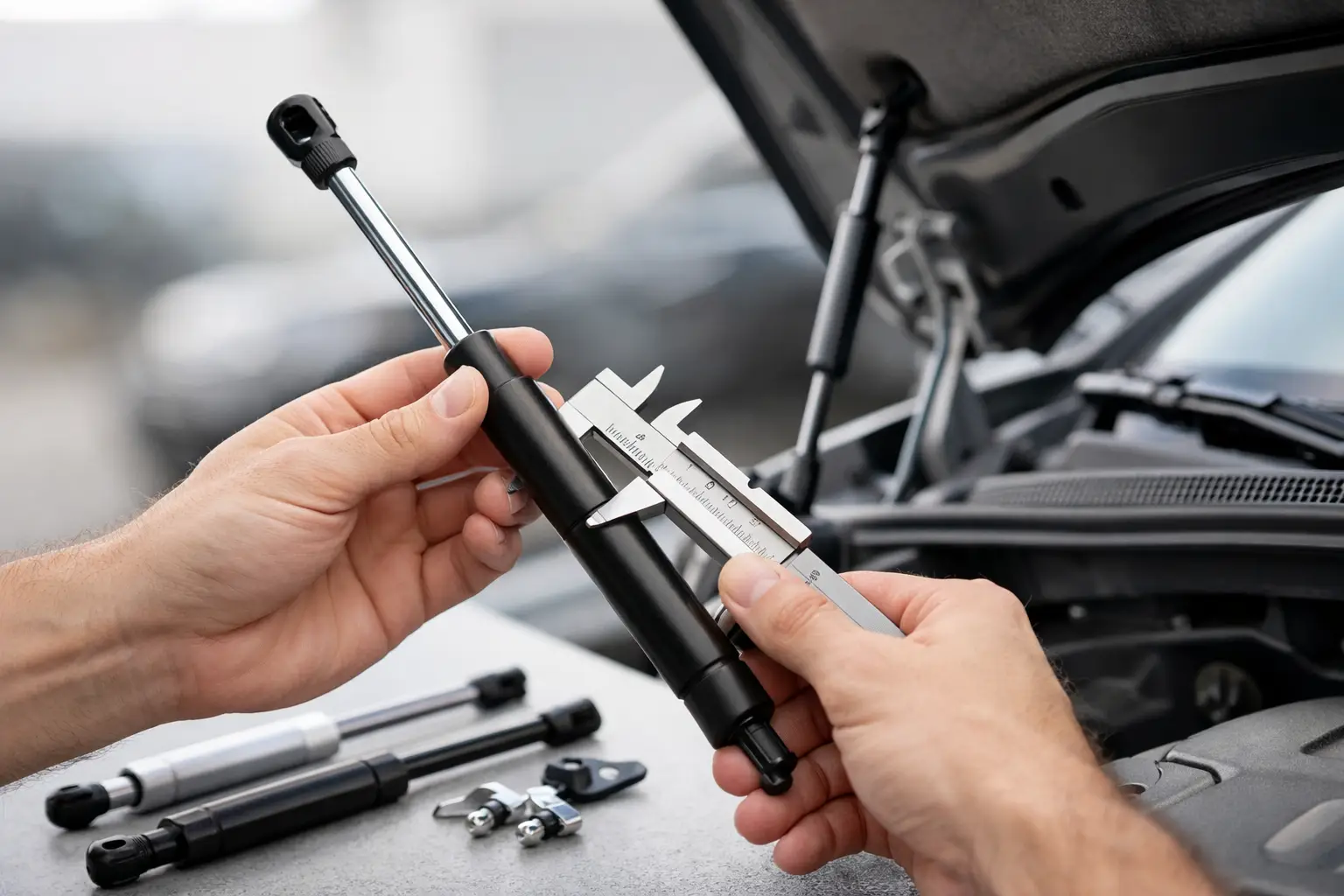
A petrol strut that is a few millimetres off in length or badly matched in force will usually tell you straight away. The lid won’t stay open, the panel slams shut, or the mounting points start wearing under load. If you’re working out how to choose petrol struts, the safest approach is to match the strut to the application, not just to the old part number or a rough visual guess.
That matters whether you are replacing failed struts on a bonnet, canopy, toolbox, caravan bed, engine cover or industrial access hatch. The right strut improves safety, reduces stress on hinges and hardware, and makes the lift feel controlled instead of awkward.
How to choose petrol struts without guessing
The quickest way to get into trouble is to choose by appearance alone. Two struts can look almost identical but have different extended lengths, compressed lengths, end fittings and force ratings. Any one of those differences can affect performance.
Start with the job the strut needs to do. Is it holding a light cabinet door open, lifting a heavy trailer lid, supporting a marine hatch in wind, or controlling access to machinery that gets opened dozens of times a day? Usage conditions matter because petrol struts are not just about lift. They also deal with leverage, mounting geometry, frequency of use and environmental exposure.
If the existing strut worked well before it failed, the old unit is often the best reference point. If it never worked properly, or you are designing a new application, you will need to work from measurements, weight and mounting position instead.
Start with the existing strut details
Most replacement jobs are easiest if you can read the information printed on the old strut. Common markings include a part number, force in Newtons, and sometimes a manufacturing code. The Newton rating is critical because it tells you how much push force the strut provides.
If the label is worn off, you can still identify the right replacement by measuring the strut and checking the fittings. Measure the extended length from the centre of one end fitting to the centre of the other while the strut is fully open. Then measure the body diameter, rod diameter and the type of end fitting, such as ball socket, eyelet, clevis or bracket connection.
It is worth checking both sides if the application uses a pair. Previous repairs are not always matched correctly, and one side may have been replaced with the wrong force or fitting.
Measure the right dimensions
When people ask how to choose petrol struts, length is usually the first thing they think about. It is important, but not on its own.
The extended length controls how far the lid, door or hatch can open. The compressed length matters just as much because it determines whether the strut can close fully without bottoming out. If the compressed length is too long, the panel may never shut properly. If the extended length is wrong, the opening angle can be limited or the strut can overextend the mounting geometry.
The stroke is the difference between compressed and extended length. That tells you how much travel the strut has available. For some applications, especially tight enclosures or compact lids, stroke and compressed length are what make or break the fit.
Mounting points also need checking. Even a correct strut can behave poorly if the brackets are in the wrong position, worn, bent or installed at the wrong angle.
Choose the correct force rating
Force is where most selection mistakes happen. Too little force and the application will not stay open safely. Too much force and it can be hard to close, place unnecessary stress on hinges, or twist lightweight lids and doors.
Petrol strut force is usually shown in Newtons, often marked as N on the body. The right rating depends on the weight of the panel, where the centre of gravity sits, the mounting angle and whether one or two struts are used. A long, wide hatch with weight concentrated away from the hinge will need a different force from a compact lid of the same mass.
This is why copying only the physical size is risky. You can fit a strut that looks right and still end up with poor operation. In new designs, the force needs to be calculated from the application geometry rather than guessed.
There is also a practical trade-off. Some operators prefer a firm lift that snaps up quickly and holds strongly in outdoor conditions. Others need smoother, lighter closing in confined workspaces or user-facing applications. The best choice depends on how the unit is used day to day.
Match the fittings and mounting style
End fittings are not a minor detail. They determine how the strut pivots through its movement and whether it connects securely to the existing hardware.
Common fittings include ball joints, eyelets and fork or clevis ends. The thread size and fitting orientation need to match the application. If you are replacing only the strut and reusing old brackets, check for wear. Loose ball studs, ovalled holes or fatigued brackets can make a correct replacement feel wrong.
Mounting orientation matters as well. In many applications, petrol struts are installed rod-down when closed. That helps keep the internal seal lubricated and can extend service life. There are exceptions depending on the design, so the strut should always be selected around the actual mounting position rather than a one-size-fits-all rule.
Consider where the strut will work
Not every petrol strut is suited to every environment. A toolbox on a ute, a marine hatch, an agricultural machine and an indoor cabinet all place different demands on the strut.
Temperature can affect performance, with very hot or very cold conditions changing the effective force. Corrosive environments such as coastal or marine settings may require materials and finishes that stand up better to salt and moisture. Dust, mud, washdown exposure and high cycle use also influence service life.
For heavy-use industrial, transport or field applications, durability is not just a nice extra. It directly affects downtime, safety and maintenance cost. That is one reason buyers often prefer struts with proven manufacturing standards and hardware that is built for repeat use rather than occasional domestic duty.
Replacement versus new design
Choosing a replacement strut is usually a matching exercise. Choosing for a new build is more technical.
For a replacement, the best information includes the original part number, force rating, extended length, compressed length, end fitting type and the application it came from. Photos of the mounted strut and brackets can also help confirm fitment.
For a new design, you will usually need the panel weight, panel dimensions, hinge position, proposed mounting points, opening angle and whether a single strut or pair is planned. Small changes in bracket position can make a large difference to the force required and the way the panel feels through the opening arc. If the first priority is easy opening, the setup may behave differently from one designed for stronger hold-open near full extension.
That is why custom selection is often the better option for machinery guards, service hatches, storage systems, seating and specialised vehicle fit-outs. A standard unit may fit physically but still deliver poor movement or uneven loading.
Common mistakes to avoid
The most common error is ordering by eye. After that, it is choosing force based only on panel weight, ignoring leverage and mounting geometry. Another frequent issue is replacing one strut in a pair when the other is already weak. That often creates uneven lifting and puts extra stress on hinges.
It is also easy to overlook the fittings. A strut body may be right while the ends are wrong, or the thread size may not suit the original hardware. In other cases, the strut itself is blamed when the real problem is a bent bracket, worn hinge or damaged mounting point.
If the application is safety-critical, used overhead, or opened regularly in a commercial setting, guessing is false economy. The cost of the wrong strut is usually far higher than the cost of getting the specification checked properly.
What details to have ready before you order
If you want accurate advice quickly, have the key details ready. That usually means the application type, the old part number if visible, force rating in Newtons, extended and compressed length, rod and tube diameter, end fitting style, and photos of the strut mounted in place.
For custom applications, add panel weight, overall dimensions, hinge location, opening angle and bracket position. The more complete the information, the easier it is to confirm whether a stocked replacement will do the job or whether a tailored strut and hardware setup is the better fit.
If you are unsure, this is where a specialist supplier earns their keep. Petrol Struts supports both straightforward replacements and more specific setups where dimensions, force and hardware need to be matched properly rather than approximated.
The right petrol strut should not feel like a compromise. It should fit cleanly, lift predictably and keep doing its job long after installation, which is exactly why careful selection at the start saves time, rework and unnecessary wear later.