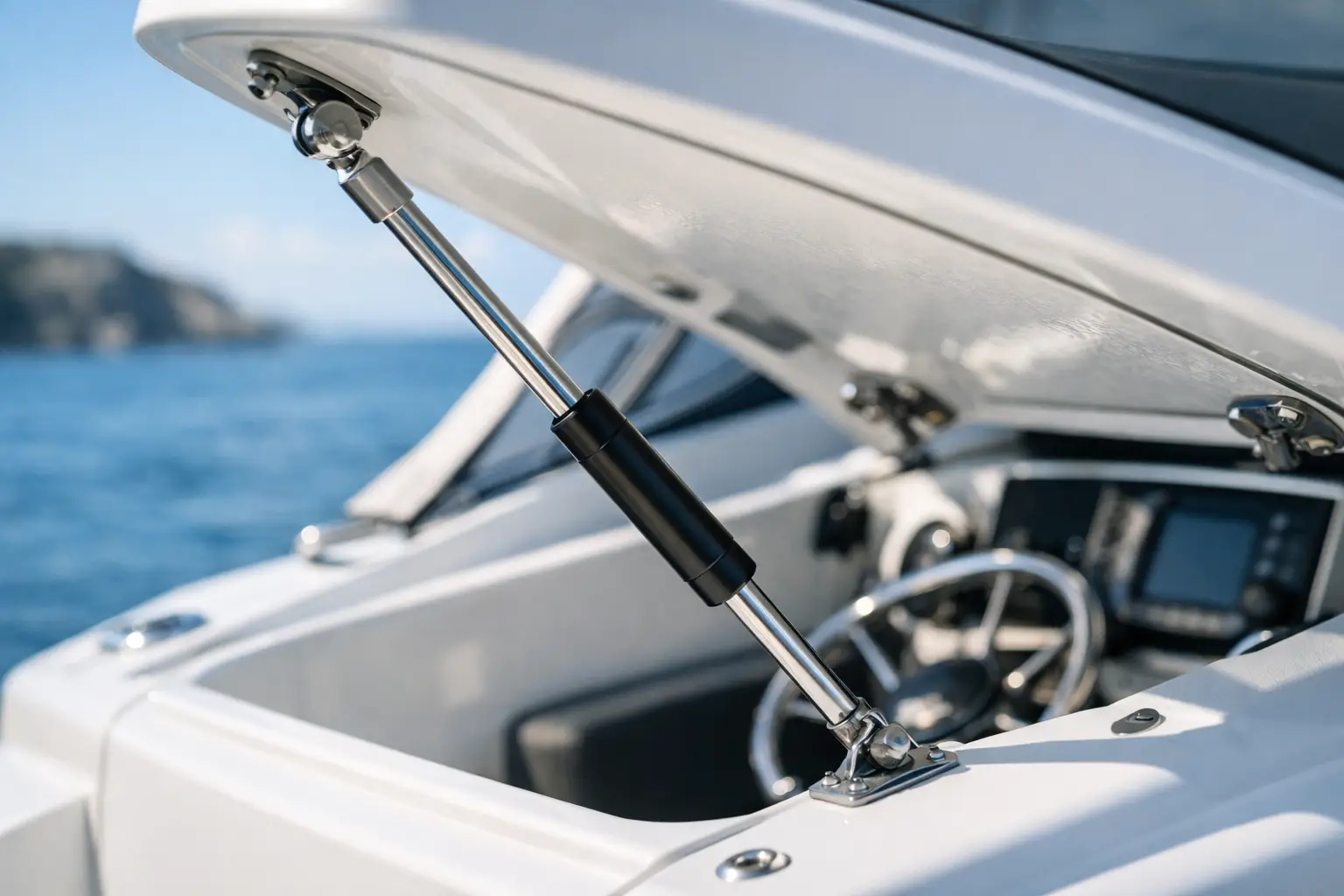
A hatch that will not stay open is more than an annoyance on a boat. It slows down access, creates a safety risk in rough conditions and usually means the strut was either underspecified, corroded or simply the wrong fit from the start. This marine petrol strut guide is written for boat owners, marine fit-out teams and maintenance professionals who need a strut that works properly in real conditions, not just on paper.
Marine applications are harder on petrol struts than many land-based jobs. Salt, spray, UV, heat and constant vibration all shorten service life. Add the weight of a wet hatch, an awkward mounting angle or a lid that opens beyond its intended range, and a standard replacement can fail quickly even if it seems close enough.
What makes a marine petrol strut different
The core job is the same as any petrol strut – controlled lifting and support. In marine use, the difference is material choice, sealing quality and how well the strut is matched to the application.
A marine strut needs to resist corrosion first and foremost. Stainless steel options are often preferred for exposed locations, especially on hatches, bait boards, engine covers and lockers that see regular wash-downs or salt exposure. In more sheltered compartments, a well-specified coated strut may be suitable, but there is always a trade-off between upfront cost and long-term durability.
The fitting hardware matters just as much as the cylinder and rod. If the ends, brackets or fasteners are not suited to the environment, corrosion often starts there. A good strut setup is a system, not just a single part.
Marine petrol strut guide to sizing correctly
Most replacement problems start with measurement errors. Close is rarely good enough. If the closed length is wrong, the hatch may not shut properly. If the extended length is wrong, the lid may not open fully or may open too far and overload hinges.
When measuring an existing strut, check the centre-to-centre length when fully closed and fully extended. Then confirm the end fitting type, such as ball joint, eyelet or fork. Also measure the cylinder diameter and rod diameter if possible, because these can help identify the original specification.
If there is no existing strut, or the current one is clearly wrong, measure the hatch and mounting geometry instead. You need the lid weight, lid dimensions, hinge position, opening angle and proposed bracket locations. The strut force depends on where the strut sits in relation to the hinge, not just the hatch weight.
This is why two hatches of similar size can need very different strut forces. A long, light lid mounted with the strut close to the hinge may need more force than a heavier lid with better leverage. Geometry changes everything.
Extended and compressed length
The extended length determines the maximum open position. The compressed length determines whether the hatch can fully close without the strut bottoming out. Both values need to suit the bracket layout.
If you are replacing a failed unit, do not assume the previous installer got it right. Boats are full of retrofits, and many struts in service were selected on guesswork. If the hatch has always been hard to close or never opened properly, use the application dimensions rather than copying the old part.
Force rating
Force is usually stated in Newtons. Too little force and the hatch drops or will not hold open reliably. Too much force and the lid becomes hard to close, places excess load on hinges and brackets, and can twist a fibreglass panel over time.
For marine applications, there is another factor – variable load. A hatch may weigh more when wet, when fitted with extra lining, or when accessories have been added after the original struts were installed. An engine box can also behave differently depending on how weight is distributed inside the panel.
Choosing materials for salt and weather exposure
Not every boat needs the same corrosion resistance. A cabin locker on an inland vessel is a different job from an exposed deck hatch on a trailer boat used in saltwater every week.
For exposed marine environments, stainless steel petrol struts and stainless hardware are usually the safer choice. They cost more, but replacement intervals are often longer and failure risk is lower. For semi-protected locations, coated struts may still be suitable if the unit is well shielded and maintained, though they are generally less forgiving when maintenance slips.
Rod finish is especially important. Once the rod surface is pitted or damaged, seals wear quickly and petrol loss follows. If a rod shows rust spots, scoring or oil residue, replacement is normally the right call.
Where marine struts commonly fail
Most failures are not dramatic. The hatch starts drifting down, needs a push to stay up or becomes jerky through the stroke. By that stage, the strut has usually already lost pressure or suffered seal wear.
Corrosion is one cause, but poor mounting is another. If the strut is side-loaded because the brackets are misaligned, internal wear increases. If the stroke is used as a stop rather than having proper mechanical limits, the strut takes impact loads it was never meant to handle.
Temperature also plays a part. Petrol struts naturally produce less force in lower temperatures and more in higher temperatures. On boats, that can show up as a hatch that behaves acceptably in summer but struggles in winter mornings. It does not always mean the strut is faulty. Sometimes the original force was simply marginal.
Installation details that affect performance
Correct orientation helps service life. In many applications, the strut should be mounted rod-down when closed so the internal seal stays lubricated. There are exceptions depending on layout, but it is a useful starting point when planning bracket positions.
Bracket strength matters. A properly rated strut can still fail in service if the mounting point tears out of thin alloy, fibreglass or timber backing. The loads on opening and closing are concentrated at the brackets, especially near full extension. If the substrate is questionable, reinforce it before fitting the new struts.
Paired struts need careful setup. If one bracket is even slightly out of position, one strut can take more load than the other. That shortens life and can rack the hatch during movement. On wider lids, accurate bracket spacing is not optional.
Single strut or pair?
It depends on hatch width, weight distribution and structural design. A single strut can work well on narrow lids or side-hinged compartments where the load path is straightforward. A pair is usually better for wider hatches, heavier lids and applications where balanced support reduces panel twist.
Using two struts does not automatically mean half the force per side in every practical sense. Geometry, asymmetrical loads and mounting locations still need to be checked.
What to have ready when ordering
If you want the right replacement without back-and-forth delays, gather the basic specifications first. The most useful details are extended length, compressed length, end fitting type, rod and tube diameters, force in Newtons if marked, and clear photos of the strut and bracket arrangement.
If there is no label left on the old unit, include hatch dimensions, estimated hatch weight, opening angle and whether the application is exposed to salt spray or mostly protected. That information makes it much easier for a strut specialist to recommend a standard replacement or advise on a custom option.
For trade and maintenance teams, standardising this information across the fleet saves time. It also reduces the common problem of ordering on visual match alone, which is one of the fastest ways to end up with a strut that almost fits.
When a custom marine strut makes sense
Off-the-shelf parts cover a lot of marine jobs, but not all of them. Custom struts are often the better option when the original setup has recurring failures, the hatch has been modified, or there is limited mounting space.
Customisation may involve force adjustment, alternate end fittings, material upgrades or revised lengths to suit a better bracket position. In practical terms, that can mean smoother operation, less strain on hinges and a longer service interval. For commercial marine use, that usually outweighs the small extra effort upfront.
A supplier such as Petrol Struts can usually work from measurements, photos and application details to narrow down the right specification quickly, which is often far more reliable than trial-and-error ordering.
Maintenance that actually helps
Marine petrol struts are low maintenance, not no maintenance. Rinse salt deposits where practical, keep the rod clean and inspect brackets for movement or corrosion. Do not grease the rod heavily – that can attract grit and damage the seal. A clean wipe-down is generally more useful than adding lubricant.
Also check for changes in hatch behaviour. If the lid starts dropping faster, needs help near the top of travel or shows uneven movement between paired struts, deal with it early. Waiting until total failure usually means more wear on hinges, latches and surrounding hardware.
A good marine strut setup should make the hatch feel controlled, predictable and safe every time it opens. If it does not, the answer is rarely guesswork. It is usually better measurement, the right material and a strut matched to the real load.