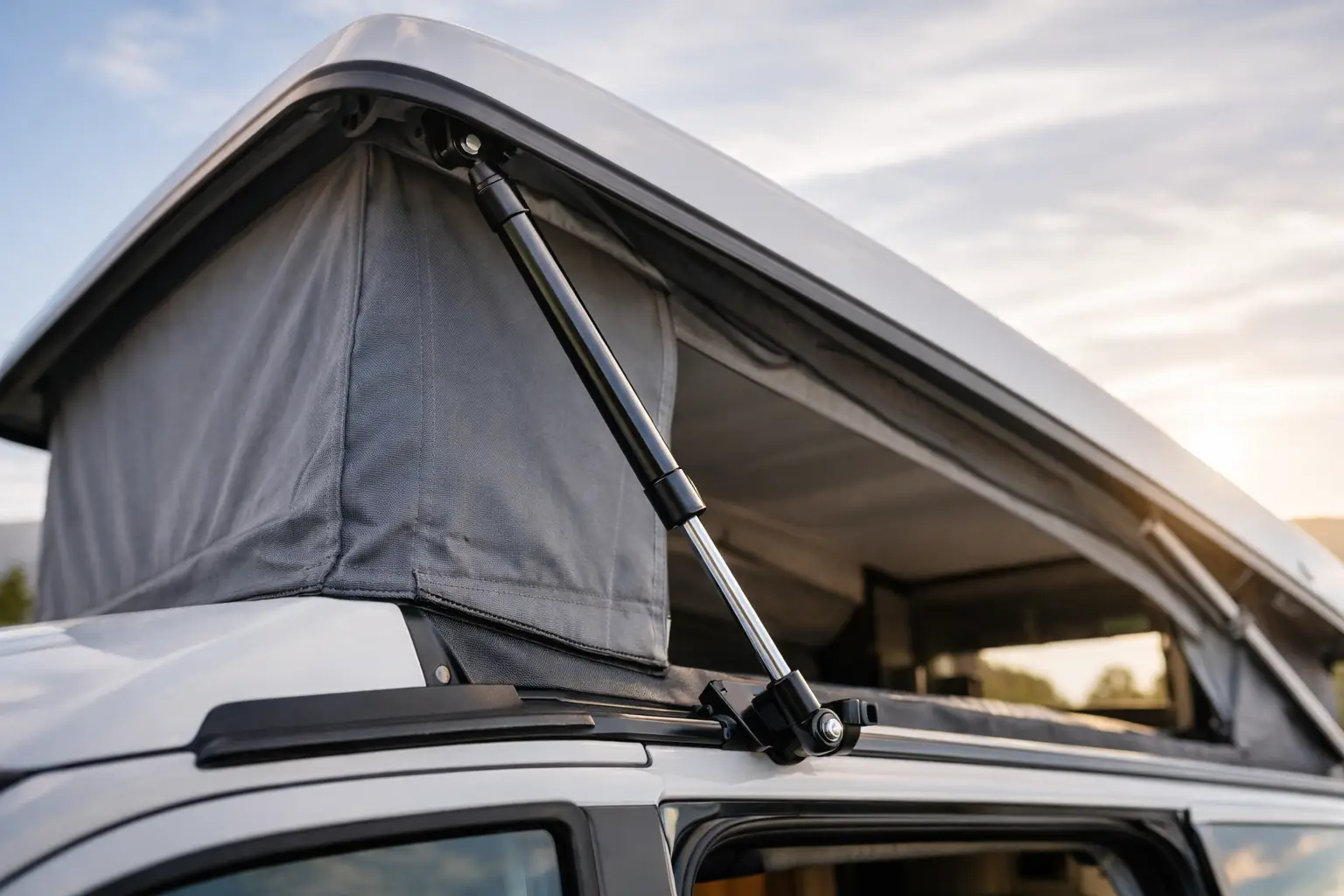
A camper roof that will not stay up is more than an annoyance. It slows setup, puts extra strain on hinges and lift points, and can become a safety issue fast. When camper roof petrol struts start losing force, leaking oil or no longer matching the roof weight, the fix is not just buying a pair that looks similar. The right strut needs to match the roof geometry, mounting positions and lifting load, or the roof will still be hard to raise, unstable, or over-assisted.
Why camper roof petrol struts fail
Most failed struts are not mystery faults. They usually come down to seal wear, gas pressure loss, corrosion, rod damage or a strut that was never correctly specified for the job. In camper applications, all of those problems are made worse by vibration, road dust, water exposure and long periods parked up between trips.
Heat also plays a part. Petrol struts naturally feel firmer in hot weather and softer in cold weather, so a marginal setup can seem acceptable in summer and underpowered in winter. If the roof has had accessories added over time, such as solar panels, racks, awnings or storage, the original struts may simply no longer have enough force to handle the extra weight.
There is also the opposite problem. Struts that are too strong can put unnecessary load into hinges, fibreglass sections and mounting brackets. They can make the roof difficult to pull down and may cause uneven lifting if the installation geometry is not right. More force is not always better.
What matters when replacing camper roof petrol struts
The starting point is always the existing strut and the roof setup itself. If the current struts worked properly when new, their specifications are usually the best guide. That means checking the extended length, compressed length, end fitting type and Newton rating marked on the body.
If the markings are worn off or the struts were wrong from the start, measurements become critical. Extended length is measured centre-to-centre from one mounting point to the other when the strut is fully open. Compressed length is measured the same way when closed. Both matter because a strut that is too long may stop the roof closing properly, while one that is too short may reduce opening height or change the lift angle.
Force rating is where many buyers come unstuck. The required Newton force depends on roof weight, the number of struts used, where they mount, and how far they sit from the hinge line. A heavier roof does not automatically mean a huge jump in force, because mounting geometry changes the effective leverage. Two roofs with similar weights can need very different struts.
End fittings also need to match. Ball sockets, eyelets, forks and brackets are not interchangeable unless the rest of the hardware suits them. Even a small mismatch can create binding, side load or accelerated wear.
When standard struts are enough and when they are not
For many camper trailers and pop-top setups, a direct replacement is straightforward if the original strut size and force are known. In that case, the main priority is getting the same dimensions, the same end fittings and a quality replacement built for repeated outdoor use.
Custom applications are different. If the roof has been modified, the original hardware is missing, or the lifting action has never been right, a standard shelf item may only solve part of the problem. A custom-specified strut can account for roof weight changes, bracket repositioning and the actual opening arc of the lid or roof section.
That is especially relevant on older campers where repairs have been made over time. New hinges, altered brackets or replaced roof panels can shift the load path enough to make the old specification unreliable. In those cases, measuring the application properly saves time and avoids buying twice.
The signs you need more than a like-for-like replacement
If the roof drops suddenly near the top of travel, if one side lifts faster than the other, or if the roof requires excessive effort to close, the issue may not be only strut wear. Bent brackets, worn pivots, hinge resistance and body distortion can all affect strut performance.
A strut that repeatedly fails early can point to side loading or poor alignment. Petrol struts are designed to work in line with their intended movement. If they are forced to twist or carry lateral load, seals and rods wear faster. That is common in camper setups where brackets have shifted slightly or aftermarket parts have changed the mounting angle.
It is also worth checking whether both struts are failing together. If one has clearly weakened before the other, the stronger unit may be carrying uneven load. Replacing struts as a matched pair is generally the safer option on camper roofs.
How to measure a camper roof strut properly
Good measurements make ordering easier and reduce the risk of getting the wrong part. The most useful details are the full extended length, full compressed length, end fitting type, rod diameter, tube diameter, and any part number still visible on the old strut.
Photos help too, especially if they show the strut fitted in both open and closed positions. On camper roof jobs, bracket orientation matters. A strut may physically fit the mounts but still foul on surrounding hardware if the fitting angle is wrong.
If no markings are visible, do not guess the force from size alone. Similar-looking struts can have very different Newton ratings. A specialist supplier can usually narrow it down faster if you provide measurements, photos, details of the camper model, and whether any accessories have been added to the roof.
Material quality matters in outdoor use
Camper roof hardware lives a harder life than many indoor or automotive applications. Dust, washdowns, salt air near the coast and long storage periods all work against seal life and surface finish. That is why build quality matters more than it might on a lightly used cabinet or internal hatch.
A decent strut should deliver consistent force, corrosion resistance and long-term sealing under repeated cycling. Lower-grade units often lose pressure early or develop rough rod movement that damages seals. That usually shows up first as inconsistent lift assist, then as visible oiling or complete failure.
For trade users, repairers and owners who want fewer callbacks or repeat replacements, certified quality and proven manufacturing standards are not just sales language. They are part of reducing downtime and avoiding avoidable rework.
Installation points that affect performance
Even the correct strut can underperform if installed badly. Mounting points need to be secure, aligned and strong enough to handle the load through the full opening and closing movement. Loose brackets and cracked mount areas are common on older campers and should be repaired before new struts go on.
Orientation also matters. In many applications, fitting the strut with the rod facing down when closed helps lubrication at the main seal and can improve service life. That depends on the specific installation, so the actual movement path should always be checked.
After fitting, test the roof slowly through the full range. Look for binding, twisting, bracket flex and uneven lift. If the roof flies up too aggressively or needs excessive force to latch down, the specification may need adjustment.
Getting the right result the first time
For a simple replacement, the fastest path is to supply the existing part number and measurements. For anything less clear, the best approach is to treat it as a specification job rather than a generic spare part order. That means giving the supplier enough information to assess size, force and fitment properly.
A specialist in petrol struts can usually help with both standard replacements and custom setups, which is useful when the camper is older, modified or missing original documentation. In Australia, where campers see everything from coastal corrosion to inland dust and rough corrugated roads, getting the strut right is not just about convenience. It is about safe operation and hardware that lasts.
If your camper roof has become harder to lift, will not stay open, or no longer closes cleanly, take the time to check the struts before the problem spreads to hinges and mounts. A correct set of camper roof petrol struts makes setup easier, protects the structure and saves a lot of frustration on the next trip.