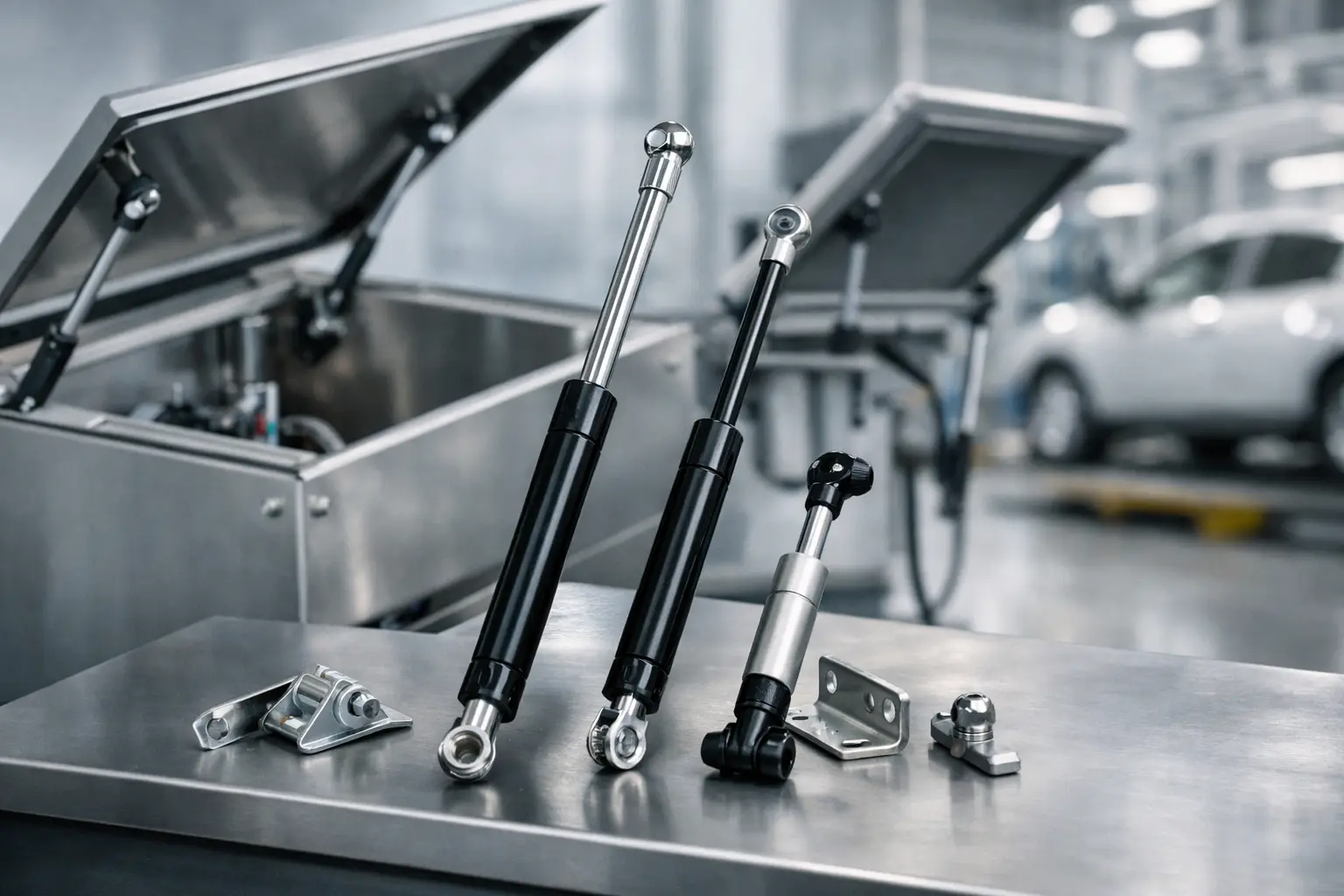
When a lid drops too fast, a panel will not stay open, or a machine guard starts loading hinges harder than it should, the problem is rarely just a worn strut. More often, the original setup was marginal, the replacement was guessed, or the application changed over time. This industrial petrol strut guide is built for buyers and fitters who need the right part, not a close-enough part.
Industrial petrol struts do a simple job, but getting them right depends on a few details that directly affect safety, service life and day-to-day usability. In workshops, plant rooms, service bodies, cabinets, enclosures and machinery, the difference between a strut that works properly and one that causes trouble usually comes down to force, length, mounting geometry and environmental conditions.
What an industrial petrol strut actually needs to do
A petrol strut is not there just to lift weight. It controls movement across the opening arc, supports the load in a predictable way, and reduces stress on hinges, frames and mounting points. In industrial use, that matters because the load is often heavy, offset, or opened repeatedly through the day.
The right strut should open smoothly, hold reliably and close without excessive effort. If it is too weak, the load can fall or feel unstable. If it is too strong, users fight the closing action, brackets flex, and lids or doors can twist. Neither outcome is acceptable on working equipment.
That is why strut selection should start with the application rather than the old part number alone. A matching number helps, but only if the original design was correct and the hardware has not been modified.
Industrial petrol strut guide: the four details that matter most
Most fitting problems come back to four measurements or specifications. If these are correct, sourcing becomes straightforward. If one is wrong, even a quality strut can perform badly.
1. Extended length
This is the eye-to-eye or centre-to-centre length when the strut is fully open. It determines the maximum opened position and whether the strut can physically fit the application without overextending brackets or hinges.
Measure the existing strut fully extended if possible. If the old unit has failed and will not extend properly, measure between mounted centres with the lid or panel in the intended open position. A few millimetres can matter, especially on compact industrial cabinets or guards with limited mounting space.
2. Compressed length and stroke
Compressed length tells you whether the strut can close fully without bottoming out. Stroke is the difference between extended and compressed length. If stroke is too short, you lose opening travel. If compressed length is too long, the panel may not shut properly or mounting points may be forced out of alignment.
On toolboxes, access hatches and machinery covers, this is a common issue after a replacement sourced by visual match rather than actual dimensions.
3. Force rating
Force is normally specified in Newtons. This is where people most often guess, and where most trouble starts. The strut force must suit the panel weight, its centre of gravity, the number of struts used, and the mounting position.
A 400N strut mounted close to the hinge behaves very differently from a 400N strut mounted further out. The geometry changes the leverage. That is why panel weight on its own is not enough to calculate the correct force.
If the load includes added lining, equipment, insulation or tools mounted to the lid, include that too. In industrial settings, these modifications are common and they change the balance point significantly.
4. End fittings and brackets
Ball joints, forks, eyes and angle brackets all affect fitment. Even with the right force and length, the wrong end fitting can create binding, side loading or poor articulation through the opening cycle.
Check thread size, fitting type and bracket orientation. Also check whether the original brackets are worn or distorted. Replacing only the strut while leaving damaged hardware in place can shorten service life straight away.
Why mounting geometry changes everything
Two struts with identical length and force can behave completely differently depending on where they are mounted. This is the part many buyers underestimate.
A strut mounted further from the hinge generally provides more lifting assistance earlier in the opening cycle. Move the lower bracket a small distance and the opening effort, hold-open angle and closing resistance all change. That can be useful when fine-tuning an application, but it also means a like-for-like replacement is not always right if the current movement is poor.
On heavy lids or upright access doors, proper geometry also prevents shock loading at full extension and reduces stress on welds, hinges and mounting faces. If a setup feels abrupt, overpowered or unstable near the top of travel, the issue may be bracket position rather than strut quality.
When standard replacement works – and when it does not
If the original strut performed well, the application has not changed, and the old unit can still be read or measured accurately, a direct replacement is often the quickest path. This is common on service bodies, canopies, cabinets, marine hatches and standard enclosure designs.
But there are plenty of cases where a standard replacement is not enough. Modified machinery covers, aftermarket toolbox lids, caravan fit-outs, plant access panels and fabricated enclosures often need a different force or custom dimensions. The old strut may have been fitted as a compromise. It may also have weakened over time, masking the fact that it was too strong when new.
In those situations, it makes more sense to work from measurements, load details and mounting points than from the label alone.
Conditions that shorten strut life in industrial use
Industrial petrol struts work hard, and their operating environment matters. Heat, dust, vibration, washdown exposure and side loading all reduce service life. So does leaving a poorly balanced lid to rely on the strut as the main structural support.
Temperature is a big one. Petrol pressure changes with temperature, so a strut may feel weaker on a cold morning and firmer in high ambient heat. In enclosed plant areas, engine bays or equipment exposed to direct sun, that variation can be noticeable. It does not always mean the strut is faulty, but it does need to be allowed for during selection.
Corrosion is another factor, especially around coastal sites, marine applications and washdown areas. If the rod, tube or fittings are not suited to the environment, deterioration starts early. For dusty or dirty settings, correct mounting orientation and good sealing quality matter because contamination can damage the seal and shaft surface over time.
How to measure for a reliable replacement
A practical industrial petrol strut guide should make one point clear: better information gives you a better result. If you need to identify or replace a strut, gather the basics before ordering or requesting a quote.
Record the extended length, compressed length, stroke if known, force in Newtons, end fitting type and thread size. Note where it is used and whether there are one or two struts on the application. Take note of the lid or door weight, approximate dimensions, and whether anything has been added since the original setup.
Photos help, especially when bracket positions are hard to describe. A side-on photo with the lid closed and another with it open can save time and avoid the usual back-and-forth. For custom applications, centre-to-centre bracket measurements and hinge-to-bracket distances are often the details that make correct force calculation possible.
Signs the current setup is wrong, not just worn out
If a lid twists during opening, the struts are mismatched or one side is carrying more load than the other. If the panel springs open aggressively, the force is likely too high or the mounting geometry is poor. If it drops through part of the travel and then catches, the force curve and bracket position may not suit the centre of gravity.
You should also be cautious if brackets are bending, mounting screws are loosening repeatedly, or users need to slam the panel shut. Those are not minor annoyances. They are signs the application is loading components incorrectly.
Replacing failed struts without fixing those underlying issues usually leads to another failure.
Choosing support that matches the job
For trade and industrial buyers, supply matters almost as much as specification. Fast turnaround is important when a vehicle, machine or enclosure is out of service, but speed should not come at the cost of fit. A supplier that can handle both stocked replacements and custom petrol struts is usually the better option because not every application falls neatly into a standard range.
It also helps to deal with people who understand the difference between automotive-style replacement and true application-based selection. On industrial work, the detail is where reliability comes from. That is why many buyers prefer direct technical support rather than sorting through generic hardware options on their own.
If you are unsure, treat the strut as part of a system rather than a standalone item. The lid weight, hinge line, bracket position, opening angle, environment and frequency of use all belong in the same conversation. Get those right and the strut will do its job properly, with less wear on everything around it.
A good fit should feel uneventful – steady lift, controlled close, no fighting it, no guessing, and no second replacement a few months later.