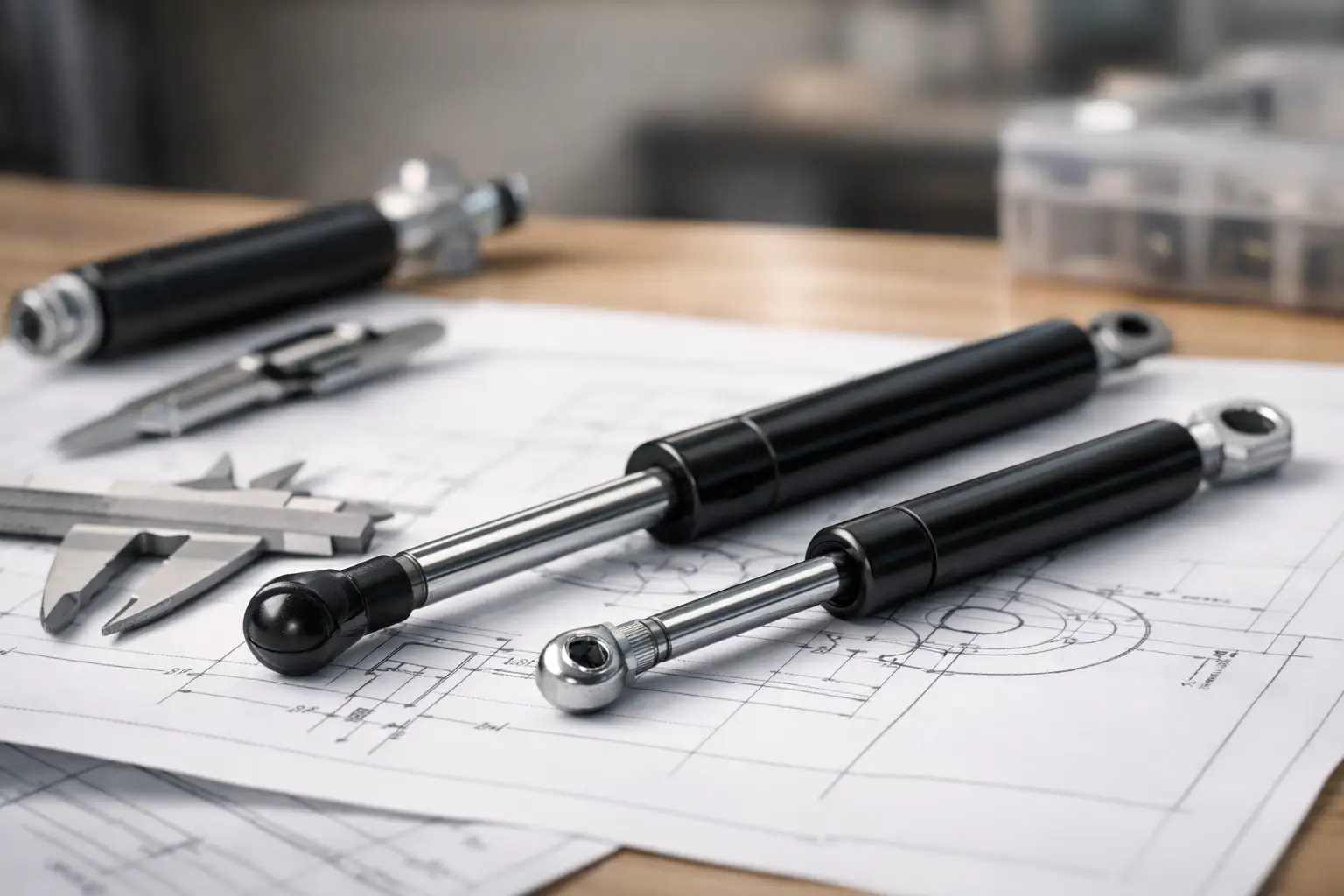
A petrol strut that is 10 mm too long or 100 N too strong can turn a simple lid into a daily nuisance. It might refuse to close, overextend a hinge, or lift too fast for safe use. If you need to choose petrol strut size for a canopy window, toolbox lid, hatch, cabinet or machinery cover, the job is not just about matching length. You also need the right force, mounting points and travel so the strut works properly under load.
What matters when you choose petrol strut size
The correct strut size comes from four things working together: extended length, compressed length, stroke, and force rating. If one of those is wrong, fitment suffers even if the ends screw on.
Extended length is the eye-to-eye or centre-to-centre measurement when the strut is fully open. Compressed length is the same measurement with the strut closed. Stroke is the difference between those two figures, which tells you how far the rod travels. Force is the push strength of the strut, measured in Newtons.
A lot of replacement jobs go wrong because people only measure the old strut while it is still fitted. That gives part of the picture, but not enough to order with confidence. If the old strut has sagged, bent, lost pressure or been replaced with the wrong part before, copying it can repeat the same problem.
Start with the application, not the part number
Before taking measurements, look at what the strut is actually doing. A rear canopy glass, boat hatch and heavy steel toolbox lid can all use struts of similar length, but they will not need the same force or mounting geometry.
Think about the lid or panel weight, where the hinges sit, how far the panel opens, and whether one or two struts are used. A long light hatch may need less force than a short heavy lid. A panel mounted high above shoulder height may also need more controlled opening than one used near waist height.
If the application is on a work vehicle, trailer, plant cover or marine hatch, also consider vibration, weather exposure and repeated use. In harder service, a strut that is technically close may still wear out early or perform poorly.
Measure the current strut properly
If you are replacing an existing unit, remove one strut if it is safe to do so and measure it off the equipment. Measure from the centre of one mounting point to the centre of the other.
Extended length
Open the strut fully and measure centre-to-centre. This is your extended length. On many applications, this determines whether the lid reaches the right open position without forcing the hinge or bracket.
Compressed length
Close the strut fully and measure centre-to-centre again. This compressed figure matters because the strut must fit inside the available space when the lid is shut. If it is too long when closed, the panel may not latch.
Stroke
Subtract the compressed length from the extended length. That gives you the stroke. If the stroke is too short, the lid may not open far enough. Too long, and the strut can bottom out or push the assembly past its intended range.
End fittings
Check whether the strut uses ball sockets, eyelets, forks or a custom end. Even if the body size and force are right, the wrong end fitting can stop the strut from mounting correctly or sitting on the right angle.
Force is where sizing often goes wrong
Length tells you if the strut will fit. Force tells you if it will work.
Petrol strut force is rated in Newtons, usually marked on the body. If the old label is still readable, that is a useful starting point. But again, do not assume it is correct just because it was fitted before.
The force required depends on more than lid weight. The distance from the hinge to the strut mounting point has a major effect. A strut mounted close to the hinge needs more force than one mounted further out. Mounting angle matters too. A poor angle can waste lifting force and make the panel feel heavier than it should.
For example, a pair of 250 N struts may suit a lightweight aluminium toolbox lid, while a canopy side window might need a much lower rating. A machinery guard with thick steel construction could require substantially more. There is no reliable one-size rule across different applications.
If the strut is too weak, the lid drops, struggles to stay open or needs manual support. If it is too strong, the lid can spring up hard, twist the mounting brackets or become difficult to close. On lighter frames such as caravan doors or cabinet lids, over-forcing can cause long-term damage.
Mounting position changes the result
This is the part many buyers overlook. Two struts with the same length and force can behave very differently depending on where they are mounted.
The open and closed angles of the lid, the bracket spacing and the strut position relative to the hinge all affect leverage. A small bracket change can improve opening motion or reduce the force needed.
That is why custom applications should be sized from the panel and geometry, not just from a guess. If you are fitting struts to something new, such as a custom canopy, storage box, access door or fabricated enclosure, you need more than a catalogue measurement. You need to know the panel dimensions, approximate weight, hinge location, desired opening angle and available mounting space.
When replacing a failed strut with no markings
If the old unit has no readable label, start with the physical measurements and application details. Record the extended length, compressed length, stroke, end fittings, rod diameter, tube diameter and where the brackets are mounted.
Then note how the existing setup behaves. Does the lid stay open at all? Does it drop halfway? Does it need excessive force to shut? Those symptoms help identify whether the previous strut was underpowered, overpowered or simply worn out.
Photos of the fitted strut in both open and closed positions are also useful, especially on non-standard jobs. For trade and industrial buyers, this can save a lot of back-and-forth when the application is unusual or the equipment has been modified over time.
New installations need a different approach
If there is no existing strut to copy, the sizing process is more technical. You need to work from the lid dimensions, weight, hinge orientation and intended opening angle.
As a rule, the heavier the panel and the closer the mounting point is to the hinge, the more force is required. But practical operation matters as much as raw lifting power. A strut should support the lid through its travel, open in a controlled way and close without excessive effort.
This is especially relevant on ute canopies, marine hatches, plant covers, service bodies and agricultural equipment where access and safety matter. In these cases, getting specialist advice is usually faster than trial-and-error ordering.
Common sizing mistakes to avoid
One of the most common mistakes is matching only the length and ignoring force. Another is measuring the strut body instead of centre-to-centre mounting points. Buyers also sometimes replace a pair with a different force on each side, which creates uneven loading and premature wear.
It is also easy to overlook end fittings, bracket condition and orientation. Most petrol struts are designed to be fitted rod-down in the closed position where possible, as this helps lubrication and service life. If a strut is installed the wrong way around due to a bracket issue, performance can suffer.
On older equipment, check the brackets and ball studs as well. If they are worn, bent or loose, even a correctly sized new strut may not sit or operate as it should.
Getting the right result faster
If you know the application is standard and the old part details are clear, replacement is usually straightforward. If the setup is custom, heavily used or safety-critical, accuracy matters more than speed.
For that reason, many buyers send through measurements, photos and application details before ordering. At Petrol Struts, that usually means a quicker path to the correct part rather than trying two or three options and hoping one works. That is particularly useful for trade fleets, workshop fit-outs, machinery covers and one-off fabrication jobs.
When you choose petrol strut size properly, the result is simple: the lid opens to the right height, stays there reliably and closes without a fight. If you are not fully confident on the numbers, get the measurements together first and have the application checked before you buy.