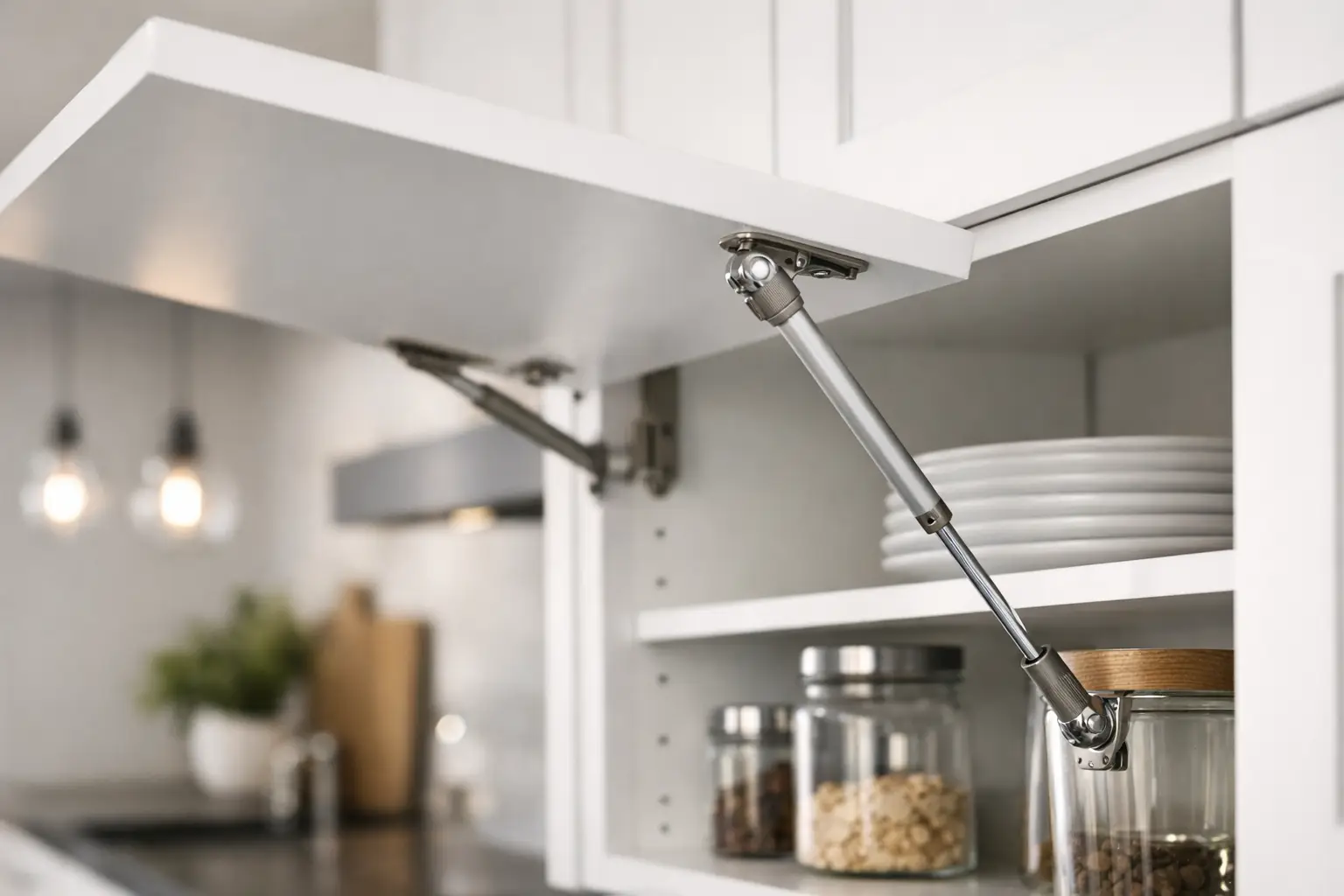
A cabinet door that drops, twists or refuses to stay open is more than an annoyance. In workshops, service vehicles, caravans, boats and industrial fit-outs, cabinet door petrol struts are there to control movement safely and make access easier in tight spaces. Get the strut wrong and you end up with a door that is hard to lift, over-stressed hinges, or a setup that wears out faster than it should.
That is why cabinet struts need to be matched to the actual job, not guessed by eye. Door size matters, but so do door weight, hinge position, mounting geometry, opening angle and where the cabinet is being used. A lightweight overhead locker in a caravan has different demands from a heavy service body hatch on a work ute or a marine compartment exposed to vibration and moisture.
Why cabinet door petrol struts need proper sizing
A petrol strut does two jobs at once. It helps lift the door and it slows the movement so the door opens and closes in a controlled way. If the force is too low, the door can feel heavy and may not stay open. If the force is too high, the door can spring upward too aggressively or fight you on the way down.
This is where many fitment problems start. People often replace a failed strut with something that looks similar, but length alone does not tell you enough. Two struts can have the same extended length and still behave very differently because the force rating, end fittings and compressed length are not the same.
In cabinet applications, small changes in bracket location can also have a big effect. Move the mounting point a short distance and the leverage changes. That can turn a smooth, balanced door into one that binds, slams or sits under constant stress.
What to measure before ordering cabinet door petrol struts
If the existing strut is still fitted, start there. Check the extended length from centre to centre of the mounting points, the compressed length if available, the end fitting type, and any part number or force marking printed on the tube. Force is usually shown in Newtons, often as N.
If the old strut is missing, damaged or was never correct, measure the application instead. You will need the door height and width, the door weight, the hinge position, the opening direction, and the desired open angle. It also helps to note whether one strut or two are being used and whether there are frame restrictions that limit mounting positions.
Door weight is the point many people skip, and it matters. Material choice changes everything. An aluminium-framed door with a light infill panel is very different from a solid timber or steel door of the same size. Add latches, seals, glazing or internal racks and the operating load increases again.
The key specifications that affect fitment
Extended length determines how far the strut reaches when open. Compressed length matters because the strut must close without bottoming out. Force rating controls lifting assistance. End fittings and bracket style decide whether the strut will actually connect securely to the cabinet and door.
Orientation can matter as well. In many applications, fitting the strut with the rod pointing downward in the closed position helps lubrication and service life. That is not always possible in every cabinet layout, but it is worth checking during design or replacement.
Common problems with cabinet petrol strut setups
One of the most common issues is a door that will not stay open even though the strut is new. That can mean the force is too low, but it can also point to poor bracket placement or worn hinges. If the geometry is wrong, the strut may not generate enough effective lift through the opening arc.
Another common problem is a door that opens too hard. This usually happens when the strut force is excessive for the door weight and mounting position. It can feel minor at first, but over time it can load up hinges, brackets and fasteners. On lighter cabinet structures, that can lead to distortion or cracking around the mounting points.
Uneven movement is another sign something is off. If a wide door uses two struts and one has weakened, the door may twist during operation. The same thing can happen if the pair are not matched in force or if one bracket has shifted. On larger cabinet doors, matched pairs are generally the safer option for balanced lifting.
Choosing between standard and custom cabinet door petrol struts
For many cabinet applications, a stocked strut size will do the job if the dimensions and force line up correctly. This is often the case for common toolbox lids, overhead cabinet doors and standard service body compartments.
Custom struts become more relevant when the door is unusually heavy, the available mounting space is tight, the opening angle is specific, or the application runs in harsh conditions. Marine, agricultural, mining and mobile service environments can be hard on fittings, seals and brackets. In those cases, getting the strut matched to the real working conditions usually saves time and repeat failures.
Customisation is also useful when an existing cabinet design has known issues. If the current setup is awkward to close, over-lifts, or does not hold reliably under load, changing the strut specification can improve operation without redesigning the whole cabinet.
When one strut is enough and when two make sense
A smaller, lighter cabinet door may only need one strut. That keeps cost down and simplifies installation. But once the door gets wider, heavier or more exposed to vibration, two struts often give better control and reduce twisting loads on the hinges.
It depends on the door construction and how the load is distributed. A narrow but dense door can still need more assistance than a larger lightweight panel. This is why dimensions alone should never be the only basis for selection.
Installation details that make a difference
Even the right strut can perform poorly if it is installed with the wrong brackets or at the wrong angle. Bracket location affects leverage through the full swing of the door, so copying a rough position is not always good enough. Measure carefully and check clearances in both the open and closed positions.
Fastener strength matters too. Cabinet substrates vary from thin sheet metal and aluminium to timber composite and reinforced polymer panels. The mounting method needs to suit the material. A strut places repeated load into the fixing points, not just static load, so weak screws in soft material can loosen over time.
If you are replacing only one strut from a pair, think twice. In most cabinet door applications, replacing both at the same time is the safer move. A fresh strut paired with a tired one usually gives inconsistent lifting and can shorten the life of the new part.
Cabinet door petrol struts in mobile and heavy-use environments
Cabinet hardware in a shed or office has an easier life than hardware in a caravan, marine compartment, mine vehicle or trade service body. Vibration, dust, washdown, salt exposure and repeated daily cycles all affect service life. That is why application context should be part of the buying decision.
For hard-use environments, durability is not a marketing extra. It affects uptime and safety. A strut that loses force early or corrodes around fittings can turn a simple access panel into a maintenance issue. For fleet operators and workshop managers, that means more time off the road and more avoidable replacements.
This is also where specialist advice helps. A supplier focused on struts can usually identify whether the issue is force, geometry, fitting style or environmental suitability from a few measurements and photos. That is often faster than trial-and-error ordering.
How to get the right strut without guesswork
The fastest way to source the right cabinet strut is to provide clear technical details upfront. A part number is useful if you have it, but it is not essential. Good photos of the existing strut and brackets, key measurements, door weight and a note about the application will usually narrow it down quickly.
If the cabinet is custom-built or the old strut was never correct, mention that as well. It changes the approach from direct replacement to proper specification. At that point, opening angle, bracket position and operating environment become even more important.
For customers who need dependable cabinet door petrol struts across workshop, vehicle, marine or industrial use, dealing with a specialist supplier such as Petrol Struts can remove a lot of uncertainty. The right advice at the start is usually cheaper than replacing the wrong part twice.
A cabinet door should open cleanly, stay where it is meant to stay, and close without a fight. If it is not doing that, the answer is usually in the measurements, not in guessing a strut that looks close enough.