
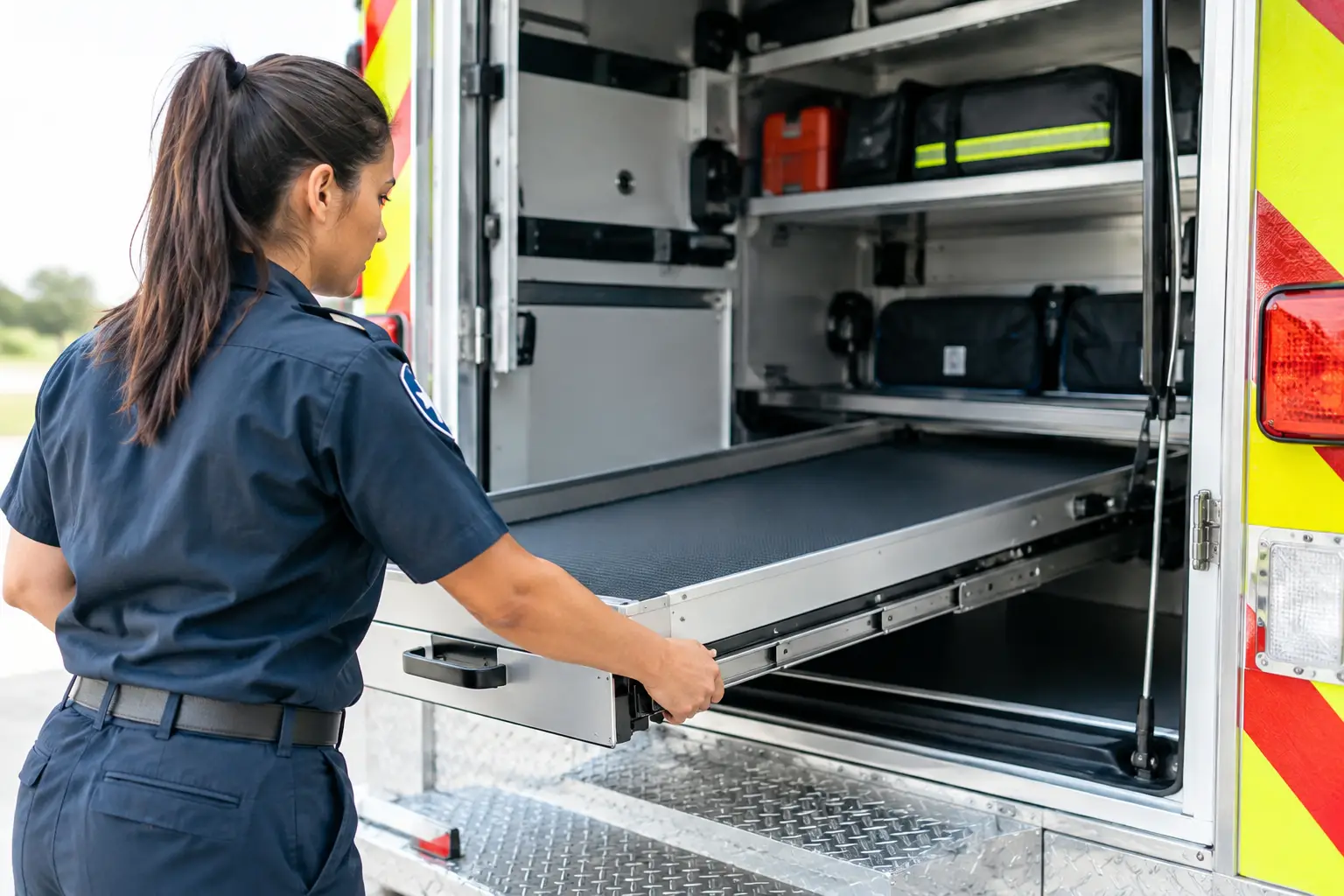
An ambulance compartment door that will not stay open is more than an inconvenience. It can obstruct access to critical equipment, create a strike hazard for crew members and slow a task where seconds matter. This ambulance compartment strut case study examines a common service-body problem: rear and side equipment doors fitted with gas struts that had lost holding force before the vehicle’s planned maintenance interval.
The solution was not simply to fit the strongest replacement available. The correct outcome depended on door weight, hinge geometry, mounting position, operating angle and the weight of accessories attached to the door. Getting those details right produced controlled opening, secure hold-open performance and closing effort that remained practical for day-to-day use.
The operating problem
The ambulance body in this example used multiple outward-opening aluminium compartment doors for trauma kits, oxygen equipment, medical consumables and electrical systems. These doors were opened repeatedly across long shifts, often while the vehicle was parked on uneven ground or exposed to heat, rain and dust.
Several doors showed familiar gas strut failure symptoms. They lifted slowly, required manual support near the top of travel and could drop unexpectedly if the vehicle was not level. One door had been fitted with a higher-force replacement in an earlier repair. It stayed open, but required excessive effort to close and placed visible stress on the mounting brackets.
This is a frequent issue with emergency-service, fleet and work vehicles. A gas strut is a motion-control component, not just a prop. Selecting one by extended length alone can leave a door under-supported, over-forced or unable to achieve full opening clearance.
Ambulance compartment strut case study: assessing the door
The first step was to assess each compartment door individually. Although several doors appeared similar, the equipment fitted inside them changed their effective weight and centre of gravity. A door carrying a mounted pouch, documentation holder or external warning light can need a different strut force from an otherwise identical panel.
Measurements were taken with the existing struts removed and the door safely supported. The key dimensions were the extended length from centre to centre of the end fittings, compressed length, stroke, and the position of both mounting points relative to the hinge. The required open angle was also recorded.
Door weight mattered, but it was not treated as a stand-alone figure. A 12 kg door, for example, will behave very differently depending on whether its centre of gravity sits close to the hinge or well out from it. The further the load is from the pivot, the greater the opening moment the strut must counteract.
The team also checked whether the brackets were square, secure and free from cracking. Gas struts transfer force into the mounting hardware at every opening and closing cycle. A fatigued bracket can make a correctly specified strut look like the problem.
Why the previous replacements failed
The original struts had gradually lost gas pressure through normal service life. High compartment temperatures and frequent cycling accelerated the decline. The higher-force replacement fitted to one door solved only the hold-open complaint.
Because it was selected without checking the closed and open geometry, the strut reached its working position with too much force acting against the door. This increased closing effort and loaded the ball studs and brackets unnecessarily. It also made the door feel abrupt near the start of opening.
In a vehicle used by different crew members across shifts, that sort of inconsistency is not ideal. The door should open positively, settle into its designed position and remain there without users needing to judge whether it is safe to work beneath.
Specifying the correct gas strut
The replacement specification retained the correct extended and compressed dimensions so the strut would not bottom out before the door closed or restrict the designed opening angle. Force was then selected to support the door through the most demanding part of its travel, rather than only at full extension.
The selected struts used suitable end fittings for the existing mounting points and were installed rod-down where practical. Rod-down mounting helps keep the internal seal lubricated during normal operation, which can support longer service life. This is not always possible on every door design, but it should be considered during assessment.
For ambulance compartments, material and seal quality are as important as force rating. The strut may be exposed to wash-down water, road grime, salt air in coastal areas and substantial heat inside a parked vehicle. Quality gas struts with reliable sealing and corrosion-resistant finishes are a better fit for this duty than light-use hardware intended for occasional domestic access.
A small force margin was included, but not an excessive one. This allowed for minor variations in temperature and door load while keeping manual closing force reasonable. Gas pressure changes with temperature, so a door that feels acceptable in a cool workshop may behave differently during a hot Australian summer shift.
Installation and verification
Before fitting, the door was supported independently. Gas struts are under pressure and should never be removed while expected to hold a compartment door in place. The ball studs, clips and brackets were inspected and replaced where wear or corrosion could compromise retention.
After installation, each door was cycled repeatedly from fully closed to fully open. Testing included level ground and a moderate vehicle angle to reflect real use. The doors needed to clear adjacent fittings, hold at the required access angle and close without slamming or excessive force.
The results were straightforward. The doors opened with a controlled lift, stayed reliably in position and no longer needed crew members to support them while retrieving equipment. Closing force was manageable, and the corrected geometry reduced stress on the mounts.
The practical gain was not dramatic-looking hardware. It was predictable access to equipment when the vehicle was in service. That is the standard a compartment strut should meet.
What maintenance teams should check before ordering
When replacing an ambulance compartment gas strut, the old part number can be useful but should not be the only reference. Vehicles are often repaired, refitted or modified during their working life. Mounting points, doors and carried equipment may no longer match the original build.
Provide the existing strut’s extended length, compressed length and Newton force rating if visible. Clear photos of the end fittings and mounting brackets are also valuable. For a custom or uncertain application, include the door weight, door dimensions, hinge position, mounting-point measurements and the required open angle.
It also helps to describe the actual fault. A strut that is weak in all positions is different from a door that only drops near full opening. The first may point to pressure loss, while the second can indicate poor geometry, a changed door load or bracket movement.
Maintenance intervals should reflect vehicle use rather than waiting for total failure. A compartment door that begins to drift downward, needs a push to reach full opening or shows oil around the rod is giving an early warning. Replacing struts before they fail completely reduces the chance of an injury, damaged door or interrupted callout.
The trade-off between standard and custom struts
A stocked replacement gas strut is often the quickest option where length, force and fittings match the application. This is suitable for many standard ambulance body doors and can return a vehicle to service promptly.
Custom specification is worth considering when the compartment has been modified, a door carries additional equipment, brackets have been repositioned or the available replacement does not provide controlled operation. A custom solution may take more assessment upfront, but it can prevent repeated replacements and bracket repairs later.
For fleet operators, standardising correctly specified struts across matching vehicles can also simplify maintenance stores. The condition is that the vehicles genuinely share the same door design and load. Assuming every compartment door needs the same force is a common and costly shortcut.
Gas Struts can assist with measurement review, force selection and custom gas strut requirements where the original specification is unavailable or no longer suits the application. Accurate information at the start makes the replacement process faster and safer.
A compartment door should support the people relying on it, not become another issue to manage during a shift. If its opening action is uncertain, measure the application properly before ordering the next strut.