A tailgate that drops without warning is more than an inconvenience. On a ute canopy, wagon, trailer box or service body, it becomes a safety issue fast. A proper tailgate petrol strut replacement fixes the immediate problem, but only if the new strut matches the original load, length and fitting style.
Too many replacements are ordered off a rough guess – close enough on length, similar end fittings, maybe a higher force for good measure. That is where fitment problems start. The tailgate may not open fully, may be hard to close, or may twist because one strut is doing more work than the other. Getting it right means looking at the application, not just the old part.
When a tailgate petrol strut replacement is needed
Most failed struts are easy to spot. The tailgate will not stay open, lifts unevenly, drops in cold weather, or needs a shove to get moving. Sometimes the strut body is oily, which usually means the internal seal has failed and the petrol charge is no longer holding as it should.
There are also less obvious signs. If the tailgate opens but feels jerky, if one side sits higher than the other, or if the brackets are starting to flex, the struts may be the wrong force or have worn out gradually. In workshop and trade vehicles, that slow decline often gets ignored until someone takes the load on their shoulder.
Age, heat, dust, vibration and repeated cycling all shorten service life. On vehicles and equipment used every day, especially in commercial conditions, struts are consumable parts. Replacing them before complete failure often prevents bracket damage and avoids unnecessary strain on hinges and mounting points.
The measurements that matter
For a successful tailgate petrol strut replacement, three details matter most – extended length, force rating and end fittings. If one of those is wrong, the strut may install but still perform poorly.
Extended length
Measure the strut from centre of fitting to centre of fitting when fully extended. Do not measure the body alone. Even a small difference can change opening height and leverage, especially on shorter tailgates or compact canopies.
Force rating
Force is usually marked in Newtons, often shown as N on the tube. This is not a detail to estimate casually. A higher rating does not automatically mean a better result. Too much force can make the tailgate difficult to shut, overload the brackets, or cause the panel to spring open aggressively. Too little force and the tailgate will sag or refuse to stay up.
End fittings
Ball sockets, eyelets, forks and angled ends are all common, and thread size matters as well. Two struts with the same length and force can still be incompatible if the end fittings do not match the original mounting points.
If the printed rating is worn off or the strut has no visible markings, the next best approach is to measure accurately and provide the application details. Tailgate size, panel weight, mounting geometry and whether one or two struts are fitted all affect the correct selection.
Why matching the original strut is not always enough
In many cases, the best replacement is a direct equivalent. But not always. If the original struts failed early, if the tailgate has been modified, or if added accessories have changed the load, the original specification may no longer be ideal.
This comes up regularly with canopies fitted with internal shelving, rear ladders, spare wheel mounts or heavier glass. It also applies to custom toolboxes, service bodies and trailer compartments. The strut has to suit the real working load, not just the base model it started with.
That is where specialist advice matters. A supplier focused on petrol struts can work from dimensions, mounting positions and application details to confirm whether a standard replacement is right or whether a revised force or custom build is the better option.
How to remove old tailgate struts safely
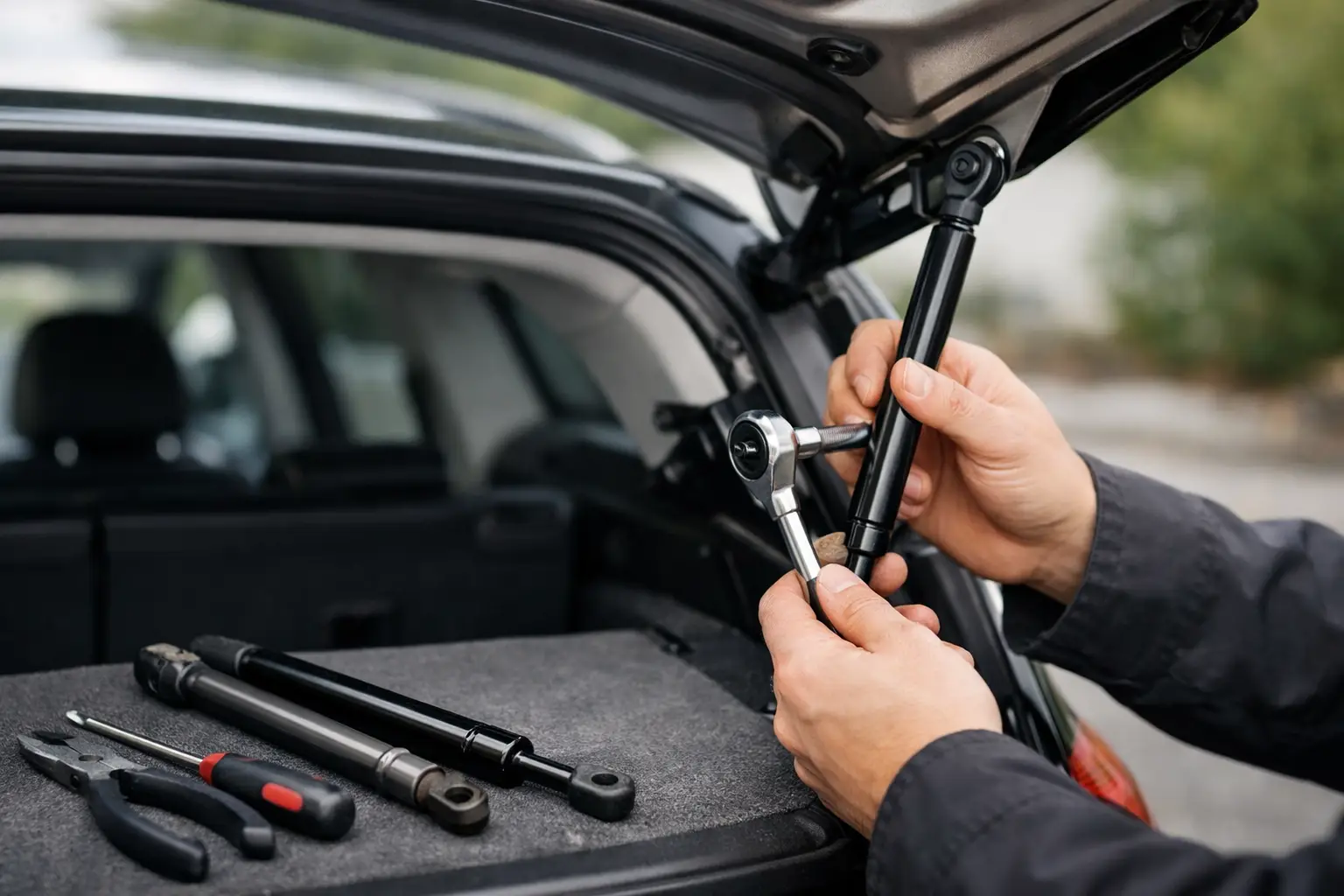
Before removing anything, support the tailgate properly. Do not rely on one remaining strut to hold the load. Use a prop, get a second person to hold it, or secure it in place. This is especially important on large canopies, heavy rear doors and steel lids.
Most automotive-style petrol struts use retaining clips on the socket ends. These usually do not need to be removed completely. A small flat screwdriver can be used to lift the clip slightly so the socket releases from the ball stud. If the strut uses bolted eyelets or fork ends, remove the fastener while the panel is supported.
Replace struts in pairs where possible. If one has failed, the other is usually not far behind. A new strut on one side and a tired strut on the other often leads to uneven lifting and premature wear.
Installing the replacement correctly
A new strut should match the original orientation unless advised otherwise. In many applications, the rod end is installed facing downward when the panel is closed. That helps keep the internal seal lubricated and can extend service life.
Fit one end first, then align the second end without forcing the strut sideways. If the strut appears too short or too long at this stage, stop and check the dimensions. Forcing the panel to make it fit can damage the mounts or preload the hinges.
Once installed, cycle the tailgate a few times carefully. It should open smoothly, hold reliably and close without excessive effort. Minor stiffness in a brand-new strut is normal, but binding, twisting or over-centre movement is not.
Common mistakes that cause fitment problems
The most common error is ordering by appearance alone. A strut can look right in a photo and still be wrong by enough to affect operation. The second is assuming force should be increased to compensate for wear. If the original setup worked when new, a correct replacement usually restores proper function without upsizing.
Another issue is ignoring the brackets. Worn ball studs, bent mounts and elongated holes can make a correct strut seem faulty. If the fittings are loose or misaligned, replace or repair them at the same time.
It is also worth checking whether both struts are sharing the load equally. On a twisted tailgate frame or a canopy door that has settled over time, one side can carry more than intended. In that case, replacing struts alone may not fully solve the problem.
Choosing a supplier for tailgate petrol strut replacement
For standard passenger vehicles, common replacements are often straightforward. For work utes, trailers, canopies, custom bodies and industrial applications, accuracy matters more. You need the right force, the right hardware and a supplier who understands how the mounting geometry affects performance.
That is why many buyers prefer to work with a specialist rather than treating petrol struts as a generic hardware item. Good support saves time. It also reduces the chance of repeat orders, bracket damage and unsafe operation.
At Petrol Struts, customers can supply measurements, photos and application details to help identify a suitable replacement or custom solution. That is particularly useful where the original part number is missing, the setup is modified, or the tailgate is part of a non-standard build.
What to have ready before you order
The quickest way to source the right strut is to gather the practical details first. Measure the extended length centre-to-centre, note any part numbers still visible, identify the end fittings, and confirm the force rating if it is marked. A clear photo of the strut installed and another of the mounting points can help as well.
If the old strut is missing or completely unreadable, provide the tailgate dimensions, approximate panel weight, and whether one or two struts are used. Mention any modifications such as racks, glass changes, storage fit-outs or reinforced doors. Those details make a real difference.
A tailgate should open cleanly, stay put and close without a fight. If it does not, the fix is usually simple – but only when the replacement is specified properly from the start. A few careful measurements now are cheaper than ordering twice, and a lot safer than trusting a worn strut for one more week.